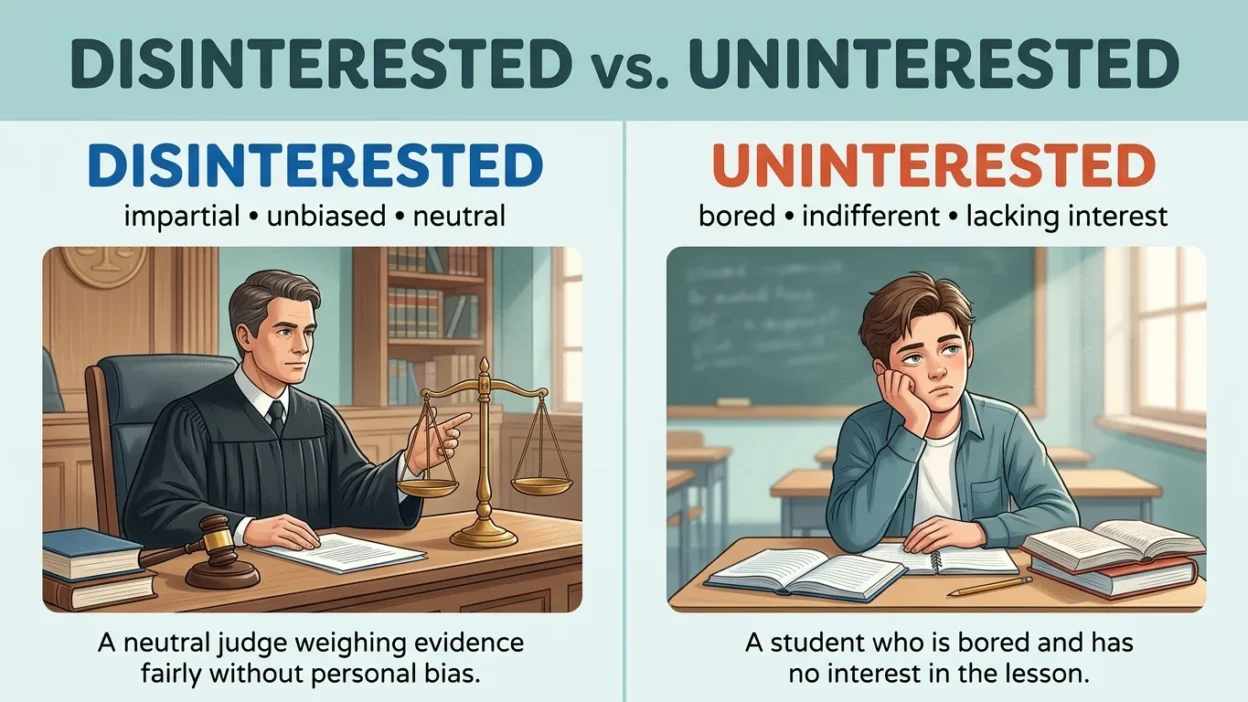
The words disinterested and uninterested look similar, but they have different meanings. Disinterested traditionally means impartial or unbiased, while uninterested means not interested in something or not wanting to pay attention to it. Although the words are sometimes confused in everyday English, knowing the difference helps you choose the right word for the situation.
For example, a disinterested judge considers both sides of a case fairly, without favoring either party. An uninterested student, on the other hand, may feel bored by a lesson and pay little attention. The distinction matters in professional writing, academic work, legal discussions, and everyday conversations.
This guide explains how to use disinterested and uninterested correctly, with simple definitions, comparison tables, practical examples, common mistakes, and memory tips to help you remember which word fits your meaning.
Quick Answer: What Is the Difference Between Disinterested and Uninterested?
Disinterested traditionally means impartial, neutral, or free from personal bias. Uninterested means lacking interest, curiosity, or enthusiasm. A disinterested observer can judge a situation fairly, while an uninterested observer may not care enough to pay attention. In modern usage, disinterested can also mean not interested, but uninterested is clearer when you mean a lack of interest.
Why Do People Confuse Disinterested and Uninterested?
People confuse these words because both contain the word interested and begin with a negative prefix. However, their traditional meanings are different.
- Disinterested: Not influenced by personal feelings or benefits; impartial.
- Uninterested: Not curious, enthusiastic, or concerned about something.
The difference is especially important when fairness matters. For example, a disinterested referee should treat both teams fairly. An uninterested referee would be someone who lacks enthusiasm or attention, which is not a desirable quality in that role.
1. What Does Disinterested Mean?
Disinterested is an adjective that traditionally describes someone who is impartial, unbiased, or free from personal interest in the outcome of a situation.
A disinterested person does not allow personal gain, favoritism, or emotional attachment to influence their judgment.
Examples of disinterested in a sentence
- We asked a disinterested expert to review the report.
- A disinterested judge must consider the evidence fairly.
- The committee needs a disinterested person to settle the disagreement.
- She offered a disinterested assessment of both proposals.
- The mediator remained disinterested throughout the negotiation.
- They appointed a disinterested observer to monitor the election.
- The investigation requires a disinterested review of the facts.
- A disinterested adviser can help you compare your options objectively.
Common expressions with disinterested
Disinterested observer: Someone who watches or evaluates a situation without taking sides.
Example: A disinterested observer might notice details that the two arguing parties overlook.
Disinterested judgment: A decision made without personal bias or favoritism.
Example: The panel promised a disinterested judgment based on the available evidence.
Disinterested party: A person who has no personal stake in the outcome.
Example: They asked a disinterested party to help resolve the dispute.
2. What Does Uninterested Mean?
Uninterested means not interested in something. An uninterested person may feel bored, indifferent, or unwilling to pay attention to a subject or activity.
The word describes a lack of curiosity, enthusiasm, or concern rather than impartiality.
Examples of uninterested in a sentence
- The students seemed uninterested in the long lecture.
- He was uninterested in discussing sports.
- She looked uninterested during the presentation.
- My brother is uninterested in watching reality television.
- The audience became uninterested when the speaker repeated the same points.
- They were uninterested in buying the old house.
- The child appeared uninterested in the new toy.
- I am uninterested in gossip about other people.
Common expressions with uninterested
Uninterested audience: An audience that does not show much curiosity or enthusiasm.
Example: The speaker struggled to engage an uninterested audience.
Uninterested in something: Not wanting to learn about, participate in, or pay attention to something.
Example: She is uninterested in joining the club.
Seem uninterested: Appear bored or disengaged.
Example: He seemed uninterested in the conversation.
Disinterested vs. Uninterested: Comparison Table
| Feature | Disinterested | Uninterested |
|---|---|---|
| Traditional meaning | Impartial or unbiased | Not interested |
| Main idea | Fairness and neutrality | Lack of curiosity or enthusiasm |
| Common context | Judging, mediation, reviewing, decision-making | Hobbies, conversations, lessons, activities |
| Example | We need a disinterested judge. | The student is uninterested in history. |
| Related concept | Objectivity | Indifference or boredom |
| Best substitute | Impartial, unbiased, neutral | Unengaged, indifferent, not interested |
When Should You Use Disinterested or Uninterested?
Use disinterested when you want to emphasize impartiality or freedom from personal bias.
Examples:
- A disinterested judge
- A disinterested mediator
- A disinterested expert opinion
- A disinterested assessment
- A disinterested observer
Use uninterested when you want to say that someone does not care about, enjoy, or want to engage with something.
Examples:
- An uninterested student
- An uninterested listener
- Uninterested in politics
- Uninterested in the offer
- An uninterested audience
What if you mean both?
A person can be both disinterested and uninterested, but the words describe different things.
For example, an independent reviewer may have no personal stake in a project and therefore be disinterested. That same reviewer might also be uninterested in the topic because it does not appeal to them. However, the second meaning is less common in contexts where impartiality is the main concern.
12 Examples of Disinterested vs. Uninterested in Sentences
- Disinterested: The company hired a disinterested consultant to examine its financial practices.
- Uninterested: The employees seemed uninterested in attending another meeting.
- Disinterested: A disinterested mediator helped the neighbors resolve their disagreement.
- Uninterested: My friend is uninterested in learning to play the guitar.
- Disinterested: The panel sought a disinterested evaluation of the evidence.
- Uninterested: The children became uninterested in the documentary.
- Disinterested: A disinterested observer could assess the debate without taking sides.
- Uninterested: He was uninterested in the details of the proposed project.
- Disinterested: The organization appointed a disinterested reviewer to investigate the complaint.
- Uninterested: She appeared uninterested in the job offer.
- Disinterested: The arbitrator remained disinterested while listening to both parties.
- Uninterested: The audience grew uninterested when the presentation became repetitive.
Common Mistakes With Disinterested and Uninterested
Mistake 1: Using disinterested when you mean bored
Incorrect: The students were disinterested in the lecture because it was too long.
Clearer: The students were uninterested in the lecture because it was too long.
Why? The sentence describes a lack of interest rather than impartiality.
Mistake 2: Using uninterested when you mean impartial
Less precise: We need an uninterested person to judge the dispute.
Better: We need a disinterested person to judge the dispute.
Why? The intended meaning is that the person should be unbiased and should not favor either side.
Mistake 3: Assuming disinterested can never mean not interested
In traditional usage, disinterested means impartial. However, major modern dictionaries also recognize a sense meaning not interested. Because this meaning can create ambiguity, uninterested is usually the clearer choice when you mean a lack of interest.
Mistake 4: Assuming uninterested always means completely indifferent
Someone who is uninterested may simply lack curiosity about one particular subject. It does not necessarily mean that the person is uncaring in every area of life.
An Easy Memory Trick
Remember these two associations:
Disinterested = detached from personal bias.
Think of a judge or mediator who does not take sides.
Uninterested = not interested.
Think of someone who is bored by a lecture or has no desire to join an activity.
A simple way to remember the difference is to ask yourself: Am I describing someone’s fairness, or their lack of curiosity?
If the answer is fairness, disinterested is usually the best choice. If the answer is lack of interest, choose uninterested.
American vs. British English
American and British English generally recognize the traditional distinction between disinterested and uninterested. In both varieties, disinterested commonly means impartial, while uninterested means lacking interest.
However, the meaning of disinterested as “not interested” is also recognized in modern usage and dictionaries. This means that context matters in both varieties of English.
For clear formal writing, particularly in legal, academic, or professional contexts, use disinterested for impartiality and uninterested for a lack of interest.
Similar Words to Know
| Word | Meaning | Example |
|---|---|---|
| Impartial | Fair and not favoring either side | The referee remained impartial. |
| Unbiased | Not influenced by personal prejudice | We need an unbiased opinion. |
| Neutral | Not supporting either side | The mediator stayed neutral. |
| Indifferent | Showing little concern or preference | He seemed indifferent to the result. |
| Apathetic | Showing little interest or enthusiasm | The voters appeared apathetic. |
| Unengaged | Not actively involved or attentive | The audience looked unengaged. |
These words have related meanings, but they are not always interchangeable. Impartial and unbiased are close alternatives to the traditional meaning of disinterested. Indifferent, apathetic, and unengaged may describe different degrees or types of low interest.
Frequently Asked Questions
Is disinterested the opposite of interested?
Traditionally, disinterested means impartial rather than simply the opposite of interested. However, modern English also uses it to mean not interested. If you want to avoid confusion, use uninterested when describing a lack of interest.
Does uninterested mean impartial?
No. Uninterested means lacking interest or enthusiasm. It does not necessarily mean that someone is fair or unbiased.
Can disinterested mean not interested?
Yes. Modern dictionaries recognize this meaning, although the traditional sense is impartial or unbiased. In formal writing, it is often better to use uninterested when you mean a lack of curiosity.
Which word should I use for a judge?
Use disinterested when you mean that a judge should be impartial and free from personal bias. For example: “The case requires a disinterested judge.”
Which word should I use for a bored student?
Use uninterested. For example: “The student was uninterested in the lesson.”
Are disinterested and uninterested interchangeable?
Not in every context. Although disinterested can mean not interested in modern usage, disinterested traditionally emphasizes impartiality, while uninterested clearly expresses a lack of interest.
What is another word for disinterested?
Depending on the context, you can use impartial, unbiased, neutral, or objective.
What is another word for uninterested?
Depending on the context, alternatives include indifferent, unenthusiastic, unengaged, or not interested. These words have slightly different shades of meaning.
Remember This
Disinterested traditionally means impartial, unbiased, or free from personal interest in an outcome.
Uninterested means lacking interest, curiosity, or enthusiasm.
A disinterested judge is fair. An uninterested student is not interested in the lesson. Although modern usage sometimes allows disinterested to mean not interested, using uninterested for that meaning is usually clearer.
Conclusion
Disinterested and uninterested are similar looking words with different traditional meanings. Disinterested describes impartiality and freedom from personal bias, while uninterested describes a lack of curiosity or enthusiasm. Understanding this distinction helps you communicate more precisely, especially in situations involving fairness, judgment, or personal preferences.
The easiest rule is to connect disinterested with impartiality and uninterested with a lack of interest. Although the meanings of disinterested have broadened in modern English, choosing the more specific word will help your readers understand exactly what you mean.

Lucas Luke is a passionate language writer and content creator at SimileHive, specializing in similes, idioms, metaphors, and figurative language. He enjoys making complex English expressions simple, engaging, and easy to understand for students, writers, and language enthusiasts through well-researched, practical content.