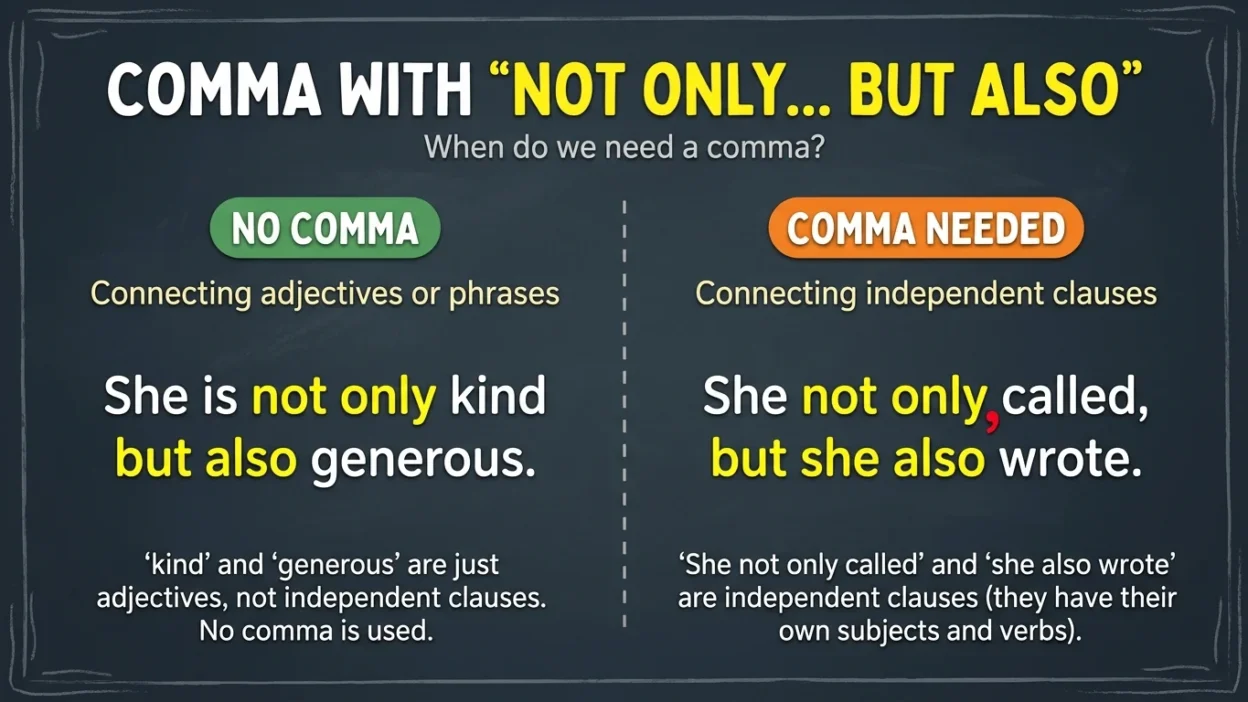
Should you use a comma with “not only … but also”? The answer depends on the sentence structure. In most cases, you do not need a comma between “not only” and “but also” when the phrase connects words, phrases, or closely related ideas. However, a comma may be necessary when “not only” introduces an independent clause and “but” connects it to another independent clause.
For example, you would normally write, “She is not only intelligent but also hardworking.” No comma is needed because the expression connects two adjectives. However, in “He not only completed the project, but he also presented the results,” a comma separates two independent clauses. Understanding this distinction helps you punctuate sentences correctly in essays, emails, articles, and everyday writing. This guide explains the comma rules for “not only … but also” with simple examples, a comparison table, and practical tips.
Quick Answer: Do You Need a Comma With Not Only But Also?
You usually do not need a comma with “not only … but also” when it connects words or phrases, as in “She is not only kind but also generous.” Use a comma when the construction connects two independent clauses, as in “She not only finished the report, but she also submitted it early.” The sentence structure determines the punctuation.
Why Do People Confuse Commas With Not Only But Also?
The expression “not only … but also” is a correlative conjunction. It connects two grammatically related elements and emphasizes that both are true.
People often add a comma because they assume “but also” always requires one. However, the word “but” does not automatically require a comma. The correct punctuation depends on what the conjunction connects.
Compare these sentences:
- She is not only talented but also hardworking.
- She not only sang beautifully, but she also played the piano.
The first sentence connects two adjectives, so no comma is needed. The second connects two independent clauses, so a comma is appropriate.
1. When Should You Use No Comma With Not Only But Also?
Do not normally use a comma when “not only … but also” connects words, phrases, or other sentence elements that belong to the same grammatical structure.
When connecting adjectives
Examples:
- She is not only intelligent but also creative.
- The movie was not only entertaining but also educational.
- He is not only polite but also respectful.
- The room was not only spacious but also comfortable.
No comma is needed because the expression connects adjectives describing the same subject.
When connecting nouns
Examples:
- She invited not only her friends but also her relatives.
- The course covers not only grammar but also vocabulary.
- We visited not only Lahore but also Islamabad.
- The company sells not only books but also magazines.
The expression connects nouns or noun phrases, so a comma is generally unnecessary.
When connecting verbs or verb phrases
Examples:
- He not only reads books but also writes stories.
- She not only teaches English but also develops learning materials.
- They not only cleaned the house but also prepared dinner.
- The team not only designed the website but also tested it.
These sentences use a parallel structure. Each pair of actions is connected without a comma.
2. When Should You Use a Comma With Not Only But Also?
A comma is generally used when “not only … but also” connects two independent clauses, particularly when the second clause begins with “but he,” “but she,” “but they,” or another subject and verb.
An independent clause can stand alone as a complete sentence.
Examples:
- She not only finished the assignment, but she also helped her classmates.
- He not only missed the meeting, but he also forgot to send an apology.
- They not only renovated the kitchen, but they also redesigned the living room.
- The company not only increased its profits, but it also expanded into new markets.
- We not only enjoyed the concert, but we also met the performers afterward.
In each example, the second part contains its own subject and verb. The comma before “but” separates the two independent clauses.
However, some of these sentences can be written without repeating the subject, in which case a comma is usually unnecessary.
For example:
With a comma: She not only finished the assignment, but she also helped her classmates.
Without a comma: She not only finished the assignment but also helped her classmates.
Both versions are grammatically acceptable. The second is more concise.
3. Comma Before But Also: Is It Necessary?
A comma before “but also” is not automatically required.
Consider these examples:
No comma:
He is not only hardworking but also reliable.
Comma:
He not only works hard, but he also helps others.
In the first example, “but also” connects two adjectives. In the second, “but” connects two independent clauses.
A useful rule is to check whether the words after “but” contain a new subject and verb that form a complete clause. If they do, a comma is often appropriate. If “but also” simply introduces another word or phrase, a comma is generally unnecessary.
4. Comma After Not Only: Should You Use One?
You normally do not put a comma immediately after “not only.”
Incorrect: She is not only, intelligent but also creative.
Correct: She is not only intelligent but also creative.
The expression works as a pair. The first part introduces the initial element, and the second part adds another related element.
However, if a separate introductory phrase or parenthetical expression appears in the sentence, its own punctuation rules may require a comma.
Not Only But Also Comma Rules: Comparison Table
| Sentence structure | Example | Comma needed? |
|---|---|---|
| Connecting adjectives | She is not only kind but also generous. | No |
| Connecting nouns | He bought not only tea but also coffee. | No |
| Connecting verbs | She not only sings but also dances. | No |
| Connecting phrases | The trip was not only exciting but also affordable. | No |
| Connecting independent clauses | She not only called, but she also sent an email. | Usually yes |
| Beginning a sentence with not only | Not only did he apologize, but he also offered to help. | Yes, between the clauses |
| Emphasizing a balanced construction | Not only was the room clean, but it was also comfortable. | Yes, between the clauses |
5. How to Use Not Only But Also at the Beginning of a Sentence
You can begin a sentence with “not only” to create emphasis. When “not only” comes at the beginning, it often causes subject and auxiliary verb inversion.
For example:
Not only did she finish the project, but she also presented it to the team.
Not only was the meal delicious, but it was also inexpensive.
Not only can he speak French, but he can also speak Spanish.
In these examples, a comma separates the two independent clauses. Notice that the first clause uses inversion, such as “did she finish” instead of “she did finish.”
6. The Importance of Parallel Structure
When using “not only … but also,” keep the two connected elements grammatically parallel. This means connecting the same kinds of words or structures whenever possible.
Correct: She is not only intelligent but also hardworking.
Incorrect: She is not only intelligent but also works hard.
Better: She is not only intelligent but also diligent.
The original incorrect example connects an adjective with a verb phrase. Although readers can understand it, matching the grammatical structures makes the sentence smoother and more balanced.
More examples:
- Correct: He not only enjoys reading but also likes writing.
- Correct: The job requires not only patience but also determination.
- Correct: The program is not only affordable but also easy to use.
Parallel structure helps make the relationship between the two elements clear.
7. Common Mistakes With Not Only But Also
Mistake 1: Adding a comma between connected adjectives
Incorrect: She is not only friendly, but also helpful.
Preferred: She is not only friendly but also helpful.
Why? The expression connects two adjectives, not two independent clauses.
Mistake 2: Forgetting a comma between independent clauses
Example: He not only finished the work but he also submitted it.
A clearer version is: He not only finished the work, but he also submitted it.
The comma helps separate the two independent clauses. Alternatively, simplify the sentence to avoid repeating the subject: “He not only finished the work but also submitted it.”
Mistake 3: Placing a comma after not only
Incorrect: They not only, saved money but also reduced waste.
Correct: They not only saved money but also reduced waste.
Mistake 4: Using an unbalanced sentence structure
Incorrect: She not only enjoys painting but also to write stories.
Correct: She not only enjoys painting but also enjoys writing stories.
The two parts should follow a parallel grammatical structure.
8. American vs. British English
American and British English follow broadly similar punctuation rules for “not only … but also.” In both varieties, a comma is generally unnecessary when the expression connects words or phrases, while a comma is commonly used when it connects independent clauses.
Examples:
American English: She is not only talented but also dedicated.
British English: She is not only talented but also dedicated.
There is no major regional difference in this comma rule. Follow the style guide used by your school, workplace, or publication if it has specific punctuation preferences.
9. Similar Correlative Conjunctions and Their Comma Rules
Other paired expressions follow similar principles.
| Expression | Example | Typical comma use |
|---|---|---|
| Either … or | You can either call me or send an email. | No comma |
| Neither … nor | He likes neither tea nor coffee. | No comma |
| Both … and | She is both smart and creative. | No comma |
| Whether … or | Whether we stay or leave depends on the weather. | Depends on sentence structure |
| Not only … but also | She is not only kind but also generous. | No comma |
These expressions usually do not need commas when connecting words or phrases. Punctuation may change when they appear in more complex sentence structures.
Frequently Asked Questions
Do you put a comma before but also?
Usually not when “but also” connects words or phrases, as in “She is kind but also honest.” A comma is generally used when “but” connects two independent clauses.
Is there a comma after not only?
No comma is normally needed immediately after “not only.” For example, write “He is not only intelligent but also creative.”
Should I write “not only, but also” with a comma?
Usually, no. When connecting adjectives, nouns, verbs, or phrases, write “not only … but also” without a comma. Use a comma when the structure connects independent clauses.
Is a comma required before but?
Not always. A comma is commonly used before “but” when it joins two independent clauses. If “but” connects words or phrases within the same clause, a comma is generally unnecessary.
Can a sentence begin with not only?
Yes. For example: “Not only did she win the competition, but she also broke the record.” This construction uses subject and auxiliary verb inversion in the first clause.
Can I use not only without but also?
Yes, especially when the sentence continues with a structure that clearly communicates the intended meaning. However, using “not only … but also” as a pair often creates a more balanced and emphatic sentence.
Is “not only but also” a conjunction?
It is commonly described as a correlative conjunction because its two parts work together to connect related grammatical elements.
Remember This
The key rule is simple: do not add a comma just because you see “but also.”
Use no comma when the expression connects words or phrases:
“She is not only kind but also generous.”
Use a comma when “but” connects two independent clauses:
“She not only helped us, but she also stayed until the work was finished.”
Keep the connected parts parallel, and your sentences will be clearer and more natural.
Conclusion
The correct comma placement with “not only … but also” depends on sentence structure. When the expression connects adjectives, nouns, verbs, or phrases, a comma is usually unnecessary. When “but” joins two independent clauses, a comma is generally appropriate.
To choose the right punctuation, identify the two elements being connected and check whether each part forms a complete sentence. This simple method will help you avoid common mistakes and use “not only … but also” confidently in academic, professional, and everyday writing.

Adam Aaron is a language enthusiast and content writer at SimileHive, creating clear, engaging guides on similes, idioms, metaphors, and figurative language to help readers improve English confidently every day.