Understanding the difference between a direct descendant and an indirect descendant can help you discuss family relationships, genealogy, ancestry, and family history more accurately. Although both expressions describe a connection between people who belong to the same family line, they do not describe the same type of relationship.
A direct descendant is someone who comes directly from another person through a line of parent and child relationships. An indirect descendant, on the other hand, is a less precise expression that people may use when referring to a more distant family connection or a relationship that does not follow a direct line of descent.
For example, your daughter, grandson, and great granddaughter are your direct descendants. Your niece, nephew, cousin, or sibling may be related to you, but they are not your descendants because they do not come from you through a parent and child line. Knowing this distinction can prevent confusion when researching family trees, explaining ancestry, or describing historical relationships.
Quick Answer
A direct descendant is a person who comes from another person through a continuous line of parent and child relationships, such as a child, grandchild, or great grandchild. Indirect descendant is less commonly used and can be ambiguous. For relatives connected through siblings, cousins, or other branches, terms such as collateral relative or distant relative may be more accurate.
What Is a Direct Descendant?
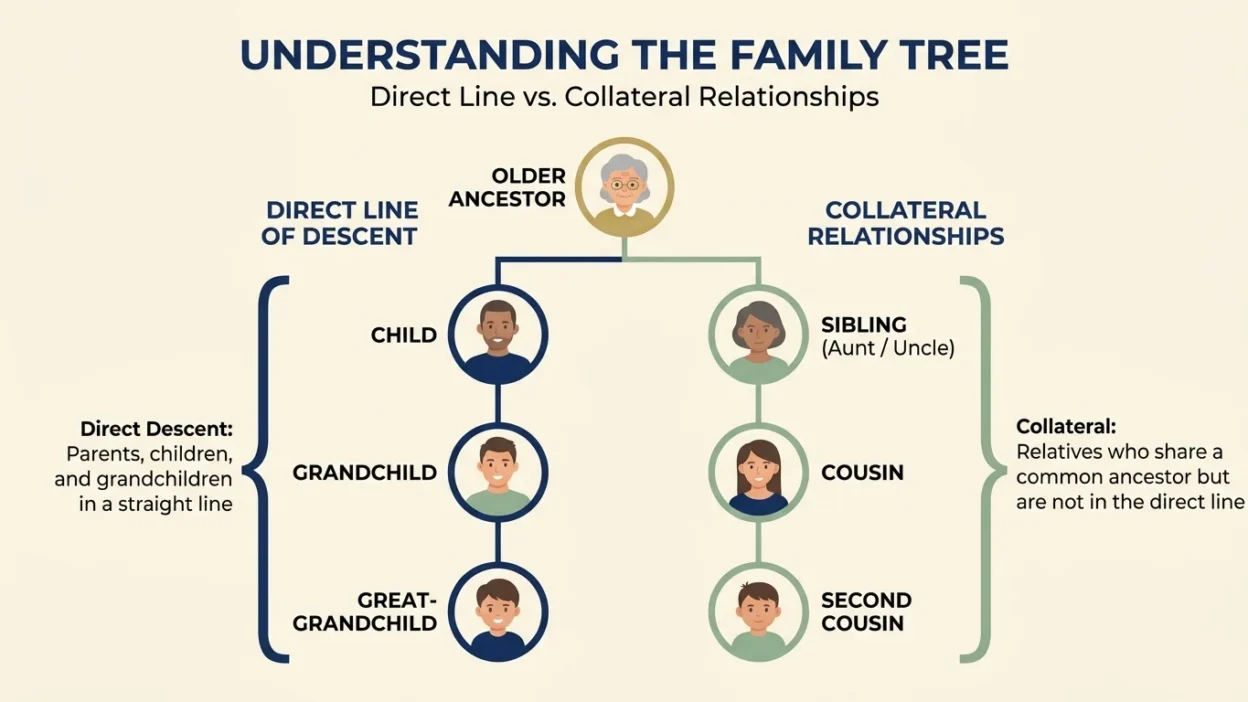
A direct descendant is a person who comes from a particular ancestor through an unbroken chain of parent and child relationships. Each generation connects directly to the next through parenthood.
For example, if you have a child, that child is your direct descendant. Your child’s child is your grandchild and is also your direct descendant. The same rule applies to great grandchildren and later generations.
Direct descendants can include:
- Children
- Grandchildren
- Great grandchildren
- Great great grandchildren
- Further generations of children and their descendants
Examples of Direct Descendants
- Maria is the daughter of James. Maria is James’s direct descendant.
- Daniel is the grandson of Helen. Daniel is Helen’s direct descendant.
- Olivia is the great granddaughter of Robert. Olivia is Robert’s direct descendant.
- A king’s son, grandson, or great grandson can be a direct descendant of that king.
- A person researching their family tree may discover that they are a direct descendant of a historical figure.
The key point is that a direct descendant belongs to a continuous line of parent and child relationships extending from the ancestor to the descendant.
What Is an Indirect Descendant?
The expression indirect descendant is sometimes used informally to describe someone who is connected to an ancestor through a less direct family relationship. However, it is not a consistently defined genealogical term.
In genealogy, the distinction is usually between lineal relatives and collateral relatives. Lineal relatives include ancestors and direct descendants. Collateral relatives share a common ancestor but are not in a direct parent and child line with one another.
For example, your cousin may share your grandparents as ancestors, but your cousin is not your descendant. Your cousin belongs to a related branch of the family tree.
Examples of Indirect Family Connections
- Your cousin is related to you through a shared family ancestor, but is not your descendant.
- Your niece is connected to your family through your sibling, but she is not your descendant.
- Your nephew belongs to a related branch of your family tree.
- Your aunt and uncle are related to you through earlier generations, but they are not your descendants.
- A distant cousin may share an ancestor with you several generations ago without being your direct descendant.
These examples describe indirect family connections, not necessarily people who should technically be called indirect descendants. For accuracy, use the specific relationship term whenever possible.
Direct Descendant vs Indirect Descendant: Key Differences
| Feature | Direct descendant | Indirect descendant |
|---|---|---|
| Meaning | A person descended from an ancestor through a parent and child line | An ambiguous expression for a less direct family connection |
| Relationship | Direct line of descent | Often intended to describe a related branch |
| Examples | Child, grandchild, great grandchild | Sometimes used informally for cousins or relatives in other branches |
| Genealogical precision | Established and precise term | Not a consistently defined technical term |
| Best usage | Family trees, ancestry, genealogy, inheritance discussions | Use a more specific term when possible |
When Should You Use Each Expression?
Use Direct Descendant for a Clear Line of Descent
Use direct descendant when one person comes from another through successive generations of parent and child relationships.
Examples:
- She is a direct descendant of a famous explorer.
- The family records show that he is a direct descendant of the original settlers.
- Their children and grandchildren are direct descendants of the founder.
- The historian traced her ancestry to a direct descendant of the royal family.
This expression is especially useful in genealogy, historical research, and discussions about family lineage.
Be Careful When Using Indirect Descendant
Use indirect descendant cautiously because readers may not know exactly what relationship you mean. If you are referring to a relative who shares a common ancestor but does not descend from you, a more precise expression is preferable.
For example:
- Instead of saying, “My cousin is my indirect descendant,” say, “My cousin and I share a common ancestor.”
- Instead of saying, “She is an indirect descendant of my grandfather,” clarify whether she is your grandfather’s descendant through another child or a relative from a different branch.
- Instead of saying, “He is an indirect descendant of the family,” specify his relationship to the ancestor.
There is an important distinction here. If someone is descended from your grandfather through your grandfather’s other child, that person may still be a direct descendant of your grandfather, even though they belong to a different branch from yours.
Ten Examples to Understand the Difference
- Direct: Emma is the daughter of William, so she is his direct descendant.
- Direct: Noah is the great grandson of Arthur, making him Arthur’s direct descendant.
- Direct: The researcher proved that the author was a direct descendant of the historical leader.
- Direct: Every generation in the family tree connects through a parent and child relationship.
- Direct: His granddaughter is a direct descendant of the family patriarch.
- Indirect connection: Two cousins share grandparents but are not descendants of one another.
- Indirect connection: A niece is related through her aunt or uncle, not descended from that aunt or uncle.
- Indirect connection: Two branches of a family may share an ancestor without either branch descending from the other.
- Clarification needed: Calling someone an indirect descendant of a historical figure may require an explanation of the exact family relationship.
- Better wording: “She is related to the historical figure through a collateral branch of the family” is more precise when the person is not in the figure’s direct line of descent.
Common Mistakes to Avoid
1. Calling Every Relative a Descendant
Not every family member is your descendant. Your siblings, cousins, aunts, and uncles may be related to you, but they are not your descendants.
2. Confusing a Distant Descendant With an Indirect Descendant
A person can be a distant direct descendant. For example, a great great great grandchild is still a direct descendant, even though many generations separate that person from the ancestor.
3. Assuming Another Family Branch Means Indirect Descent
A person who descends from your grandfather through your aunt or uncle is still a direct descendant of your grandfather. The relationship is indirect only when considered in relation to you, not necessarily in relation to the shared ancestor.
4. Using Indirect Descendant in Formal Genealogy
Because the phrase does not have one universally accepted technical meaning, it may confuse readers. Prefer terms such as collateral relative, distant relative, or a specific relationship such as cousin when appropriate.
Memory Trick
Remember this simple rule:
Direct descendant means down the family tree.
Think of a family tree with the ancestor at the top. Children, grandchildren, and great grandchildren appear below that ancestor along a continuous line of parent and child relationships.
A collateral relative belongs to a different branch of the tree. Such a relative may share the same ancestor but is not necessarily a descendant of the person you are comparing them with.
American vs British English
There is no major difference between American and British English in the meaning of direct descendant. Both varieties use the term for someone who comes from an ancestor through a line of parent and child relationships.
The phrase indirect descendant is also understandable in both varieties, but it remains less precise than established genealogical terminology. In formal writing, American and British writers can both use collateral relative to describe a family member who shares an ancestor without being in the direct line of descent.
Related Terms You Should Know
- Ancestor: A person from whom someone is descended, such as a parent, grandparent, or earlier family member.
- Descendant: A person who comes from an ancestor through successive generations.
- Lineal descendant: A formal term for someone in the direct line of descent.
- Collateral relative: A relative who shares a common ancestor but is not in the direct line of descent from the person being discussed.
- Distant relative: A family member whose relationship is separated by several generations or branches.
- Genealogy: The study of family relationships, ancestry, and family history.
- Lineage: A line of descent from an ancestor.
Frequently Asked Questions
1. Is a grandchild a direct descendant?
Yes. A grandchild is a direct descendant because the relationship follows a continuous line from grandparent to parent to child.
2. Is a cousin an indirect descendant?
Not usually in precise genealogical language. A cousin is a collateral relative who shares a common ancestor with you. A cousin is not your descendant.
3. Can someone be a distant direct descendant?
Yes. A person can be separated from an ancestor by many generations and still be a direct descendant. The number of generations does not make the line of descent indirect.
4. What is the opposite of a direct descendant?
There is no single perfect opposite in every context. Collateral relative describes a relative outside the direct line of descent. The expression indirect descendant is sometimes used informally, but it is less precise.
5. Is a niece a direct descendant?
No. A niece is the daughter of your sibling. She is related to you through your family, but she does not descend from you through a parent and child line.
6. Is a great grandchild a direct descendant?
Yes. A great grandchild is a direct descendant because the relationship follows three successive parent and child connections from the great grandparent to the great grandchild.
7. Can a person be a direct descendant of a historical figure?
Yes. If a person can trace an unbroken line of parent and child relationships from a historical figure to themselves, they are a direct descendant of that figure.
8. Which term is better for formal writing?
Direct descendant is appropriate when describing a line of descent. For relatives outside that line, use a specific relationship term or collateral relative rather than relying on the ambiguous expression indirect descendant.
Remember This
A direct descendant is someone who comes from an ancestor through a continuous line of parent and child relationships. Children, grandchildren, and great grandchildren all qualify, regardless of how many generations separate them from the ancestor.
Indirect descendant is less precise and can cause confusion. If you mean a cousin, niece, nephew, or another relative from a different branch, identify that relationship clearly or use collateral relative when appropriate.
Conclusion
The main difference between a direct descendant and an indirect descendant concerns how clearly the relationship follows a line of descent. A direct descendant belongs to a continuous chain of parent and child relationships extending from an ancestor. This includes children, grandchildren, great grandchildren, and later generations.
Although people sometimes use indirect descendant to describe a more distant or less direct family connection, the expression is not a consistently defined genealogical term. When accuracy matters, describe the specific relationship or use a term such as collateral relative. Understanding these distinctions makes it easier to discuss ancestry, research family history, and explain relationships without confusing descendants with other relatives.

Lucas Luke is a passionate language writer and content creator at SimileHive, specializing in similes, idioms, metaphors, and figurative language. He enjoys making complex English expressions simple, engaging, and easy to understand for students, writers, and language enthusiasts through well-researched, practical content.