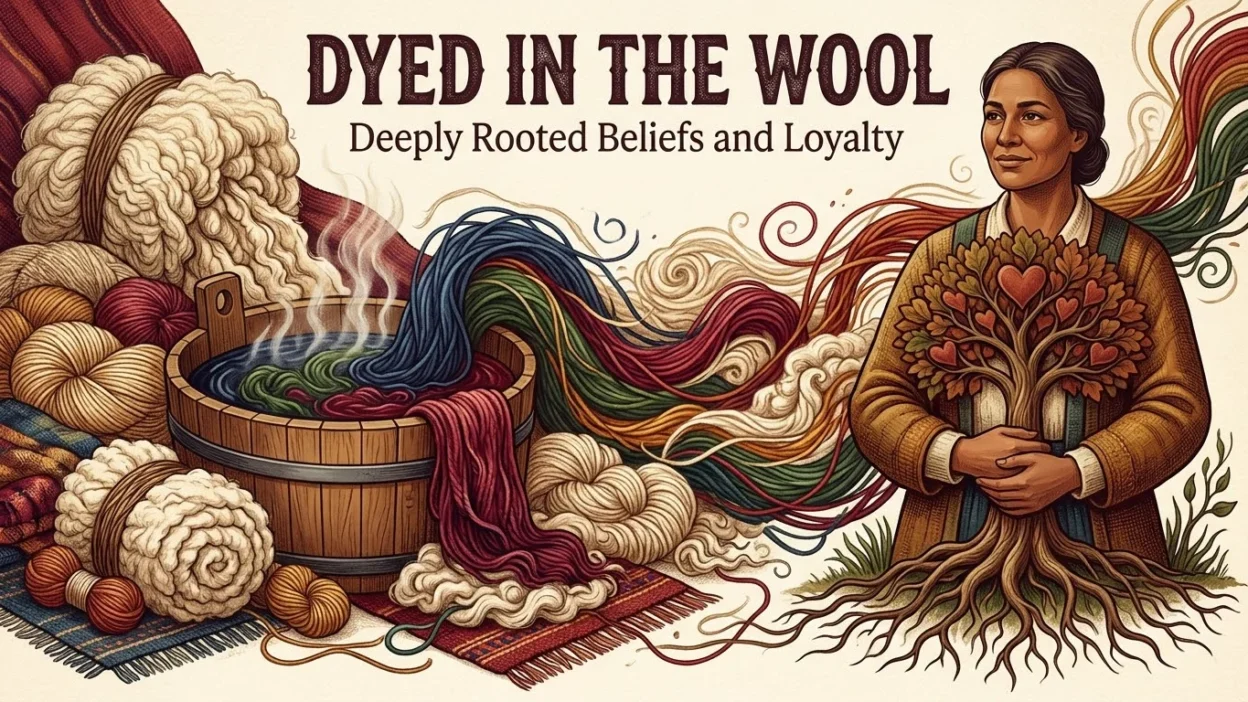
Have you ever heard someone described as a “dyed in the wool traditionalist” or a “dyed in the wool football fan”? This unusual English expression has nothing to do with coloring someone’s hair or clothing. Instead, it describes a person whose beliefs, opinions, habits, or loyalties are deeply established and unlikely to change. When someone is described as dyed in the wool, it usually means that a particular quality or belief is an essential part of who they are.
The expression is commonly used to describe strong political views, religious beliefs, personal loyalties, and long standing habits. For example, a dyed in the wool supporter of a sports team remains loyal to that team even when it performs poorly. Understanding this idiom will help you recognize it in books, newspapers, conversations, and everyday English. It will also help you use it naturally when describing someone with deeply rooted beliefs or commitments.
Quick Answer
Dyed in the wool is an idiom that describes someone whose beliefs, opinions, habits, or loyalties are deeply established and unlikely to change. For example, a dyed in the wool conservative is someone with firmly held conservative political beliefs. The expression emphasizes strong and lasting commitment.
What Does Dyed in the Wool Mean?
The phrase dyed in the wool means deeply committed to a particular belief, attitude, habit, or way of thinking. It describes something that has become such a strong part of a person’s identity that changing it is unlikely.
People commonly use this expression to describe someone who is:
- Firmly committed to a political belief.
- Deeply loyal to a sports team.
- Strongly attached to a tradition.
- Unwilling to change a long held opinion.
- Completely devoted to a particular lifestyle or cause.
For example:
“She is a dyed in the wool environmentalist.”
This means she strongly believes in protecting the environment and is deeply committed to environmental causes.
The expression is generally used to emphasize how firmly someone holds a particular belief or identity.
What Does Dyed in the Wool Mean in Everyday English?
In everyday English, dyed in the wool describes a person who is strongly committed to something and unlikely to change their position.
For example:
“My grandfather is a dyed in the wool cricket fan.”
This means his love for cricket is deeply rooted. He has supported the sport for a long time and is unlikely to lose interest.
Here are more examples:
- He is a dyed in the wool Democrat.
- She is a dyed in the wool traditionalist.
- My father is a dyed in the wool supporter of his local football club.
- They are dyed in the wool believers in education.
In each sentence, the expression highlights a strong and lasting commitment.
What Is the Origin of Dyed in the Wool?
The expression comes from the traditional process of dyeing wool.
In older textile production, wool could be dyed before it was made into yarn or fabric. This process allowed the color to become deeply established in the fibers. The color was therefore less likely to fade or wash out than a surface treatment.
The expression developed a figurative meaning. Just as dye could become deeply fixed in wool, a person’s beliefs or characteristics could become deeply fixed in their personality.
Over time, dyed in the wool became an idiom for someone whose convictions, loyalties, or habits are firmly established.
The expression is now used figuratively rather than as a description of textile production.
How to Use Dyed in the Wool in a Sentence
The phrase is generally used before a noun to describe someone who is deeply committed to a particular identity, belief, or activity.
1. Political Beliefs
The expression is frequently used to describe people with strong political views.
Examples:
- He is a dyed in the wool conservative.
- My uncle is a dyed in the wool socialist.
- She has always been a dyed in the wool supporter of the party.
- They are dyed in the wool advocates of political reform.
2. Sports Loyalty
It can describe people who remain loyal to a particular sports team.
Examples:
- My brother is a dyed in the wool Manchester United fan.
- She is a dyed in the wool cricket supporter.
- He has been a dyed in the wool football fan since childhood.
- They are dyed in the wool supporters of their hometown team.
3. Personal Beliefs and Traditions
The expression can also describe people who strongly value certain traditions or principles.
Examples:
- My grandmother is a dyed in the wool traditionalist.
- He is a dyed in the wool believer in hard work.
- She remains a dyed in the wool supporter of family traditions.
- They are dyed in the wool advocates of simple living.
4. Professional and Personal Identity
It can describe someone who is deeply committed to a profession, interest, or way of life.
Examples:
- He is a dyed in the wool journalist.
- She is a dyed in the wool book lover.
- My father is a dyed in the wool businessman.
- They are dyed in the wool supporters of independent publishing.
Dyed in the Wool: Meaning and Examples in Different Contexts
| Context | Meaning | Example |
|---|---|---|
| Politics | Strong political commitment | He is a dyed in the wool conservative. |
| Sports | Deep loyalty to a team | She is a dyed in the wool cricket fan. |
| Religion | Firm religious commitment | He is a dyed in the wool believer. |
| Traditions | Strong attachment to customs | My grandmother is a dyed in the wool traditionalist. |
| Lifestyle | Deep commitment to a way of living | They are dyed in the wool minimalists. |
| Professional identity | Strong attachment to a profession | She is a dyed in the wool journalist. |
Is Dyed in the Wool Positive or Negative?
The expression is generally neutral, but its meaning depends on the context and the speaker’s attitude.
Positive Meaning
It can suggest loyalty, dedication, consistency, and strong personal convictions.
Example:
“She is a dyed in the wool supporter of public education.”
This presents her commitment as a positive quality.
Negative Meaning
It can also suggest stubbornness, inflexibility, or unwillingness to consider different opinions.
Example:
“He is a dyed in the wool traditionalist who refuses to consider new ideas.”
Here, the expression highlights his resistance to change.
Neutral Meaning
Sometimes, it simply describes a person’s deeply established identity without praising or criticizing it.
Example:
“My father is a dyed in the wool cricket fan.”
This sentence merely describes his strong interest in cricket.
Dyed in the Wool vs Set in Your Ways
These expressions are related, but they have different meanings.
| Expression | Meaning | Example |
|---|---|---|
| Dyed in the wool | Deeply committed to a belief, identity, or loyalty | He is a dyed in the wool football fan. |
| Set in your ways | Unwilling or reluctant to change your habits or routines | My grandfather is set in his ways. |
Dyed in the wool emphasizes deep commitment or identity. Set in your ways focuses more on established habits and resistance to change.
Common Mistakes to Avoid
1. Taking the Expression Literally
The phrase usually does not refer to wool that has been colored. In everyday language, it is an idiom describing deeply established beliefs or characteristics.
2. Using It Only for Political Beliefs
Although the expression is common in political discussions, it can also describe sports loyalty, traditions, personal interests, and other strong commitments.
3. Assuming It Is Always Positive
The phrase can express admiration or criticism. Context determines whether the person’s strong commitment is being praised or questioned.
4. Confusing It With Set in Your Ways
Both expressions can suggest resistance to change, but they are not identical. Dyed in the wool emphasizes deeply rooted beliefs or loyalties, while set in your ways emphasizes habits and routines.
5. Forgetting the Correct Expression
The established idiom is dyed in the wool. Expressions such as died in the wool are incorrect when you intend to describe someone’s deeply rooted beliefs or identity.
Memory Trick
Think about the traditional process of dyeing wool.
When wool is dyed deeply, its color becomes firmly established in the fibers. It is not easily removed.
In the same way, a person who is dyed in the wool has beliefs, loyalties, or habits that are firmly established.
Remember:
Dyed in the wool = Deeply rooted and unlikely to change.
For example, a dyed in the wool football fan remains loyal to their team through both victories and defeats.
American vs British English
The expression dyed in the wool is used in both American and British English. Its meaning remains the same in both varieties.
American examples:
- He is a dyed in the wool Republican.
- She is a dyed in the wool baseball fan.
British examples:
- He is a dyed in the wool traditionalist.
- She is a dyed in the wool supporter of her football club.
The phrase is understood in both varieties, although the particular beliefs, interests, or groups described may differ depending on the context.
Similar Words and Expressions
Here are some expressions that have meanings related to dyed in the wool.
- Deep rooted: Firmly established and difficult to change.
- Firmly committed: Strongly dedicated to a belief, cause, or activity.
- Devoted: Very loyal or dedicated to someone or something.
- Die hard: Unwilling to give up a belief, habit, or loyalty.
- Set in your ways: Unwilling to change established habits or routines.
- Hard core: Extremely committed to a particular activity, belief, or group.
- Unwavering: Remaining firm and steady despite difficulties or opposition.
- Steadfast: Loyal, dependable, and firmly committed.
These expressions are related, but they are not interchangeable in every sentence.
Frequently Asked Questions
1. What does dyed in the wool mean?
Dyed in the wool means deeply committed to a particular belief, opinion, habit, or identity. It describes someone whose convictions or loyalties are firmly established and unlikely to change.
2. Is dyed in the wool a compliment?
It can be a compliment, a criticism, or a neutral description. It may praise someone’s loyalty and dedication, but it can also suggest stubbornness or an unwillingness to consider other views.
3. What is an example of dyed in the wool?
“My grandfather is a dyed in the wool cricket fan.” This means he is deeply devoted to cricket and has a strong, lasting interest in the sport.
4. Where did the expression dyed in the wool come from?
The expression comes from the traditional process of dyeing wool. When wool was dyed before being made into yarn or fabric, the color became deeply established in its fibers. This inspired the figurative meaning of firmly established beliefs or characteristics.
5. Is dyed in the wool an idiom?
Yes. It is an idiom because its figurative meaning is different from the literal meaning of dyeing wool. It describes a person’s deeply rooted beliefs, loyalties, or characteristics.
6. What is another word for dyed in the wool?
Depending on the context, alternatives include deep rooted, devoted, steadfast, die hard, and firmly committed. The best alternative depends on what kind of commitment you want to describe.
7. What does dyed in the wool conservative mean?
A dyed in the wool conservative is someone who strongly supports conservative political beliefs and is unlikely to change those views.
8. Is it died in the wool or dyed in the wool?
The correct expression is dyed in the wool. The word dyed refers to coloring wool and is used figuratively to describe deeply established beliefs or loyalties. Died in the wool is a common spelling mistake.
Remember This
Dyed in the wool describes someone whose beliefs, opinions, habits, or loyalties are deeply established.
It can express strong dedication, lasting loyalty, or resistance to change. The expression comes from the traditional process of dyeing wool, in which color became deeply fixed in the fibers.
For example, a dyed in the wool sports fan remains loyal to a team regardless of its performance. The phrase can be positive, negative, or neutral depending on the context.
Conclusion
The idiom dyed in the wool describes someone who is deeply committed to a particular belief, identity, habit, or loyalty. It is commonly used in discussions about politics, sports, traditions, and personal values. When you describe someone as a dyed in the wool supporter, you mean that their loyalty is strong and unlikely to change.
The expression originated from the traditional process of dyeing wool, where color became deeply established in the fibers. Today, it is used figuratively to describe deeply rooted characteristics and convictions. Remember that it can express admiration for someone’s dedication or criticism of their unwillingness to change. Its exact meaning depends on the surrounding context.

Charles Kevin is a passionate language writer and researcher at SimileHive, creating clear, engaging content about similes, idioms, metaphors, and figurative language to help readers improve English communication confidently every day.