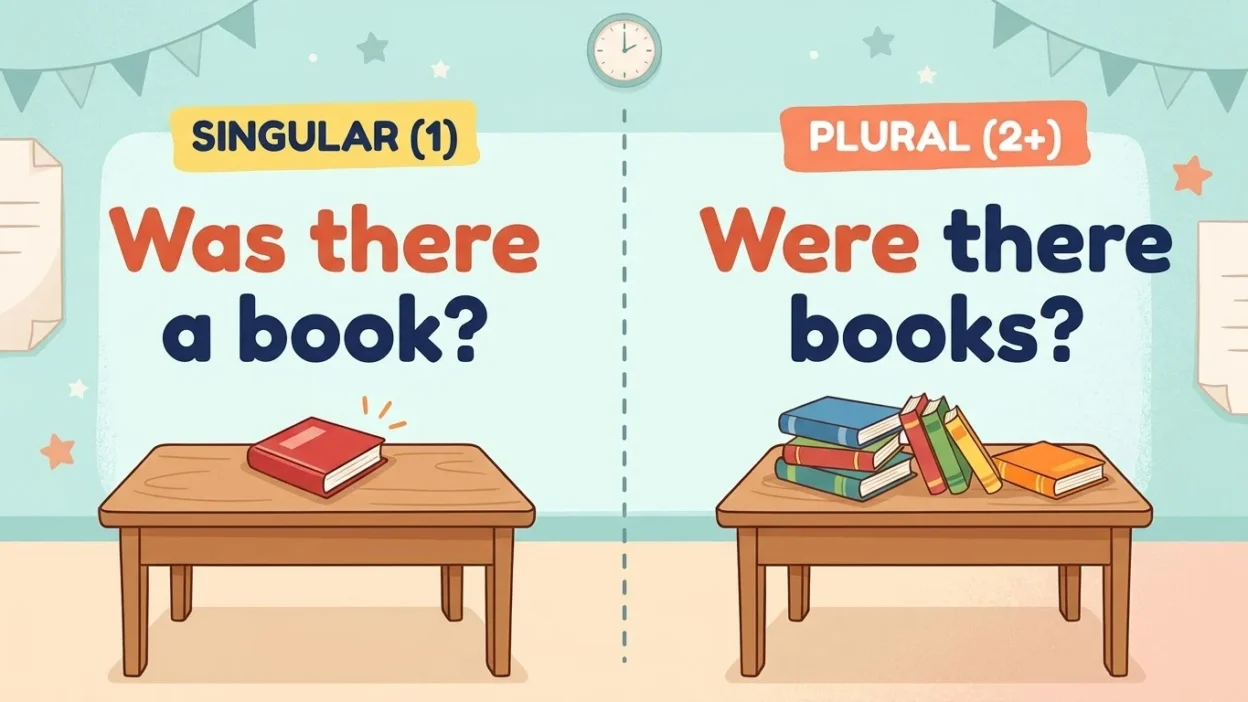
Choosing between was there and were there can be confusing because both expressions refer to the past. The difference becomes easier to understand when you know if you are talking about one person or thing or more than one. Both phrases are past tense forms of the verb be, and both can be used to ask questions, make statements, and describe whether someone or something existed or was present in a particular place.
In general, use was there with singular subjects and were there with plural subjects. For example, “Was there a problem?” is correct because a problem is singular. However, “Were there any problems?” is correct because problems is plural. Understanding this basic rule will help you choose the correct expression in everyday conversations, formal writing, and English grammar exercises.
Quick Answer
Use was there when referring to one person, thing, or singular subject in the past. Use were there when referring to two or more people or things. For example, “Was there a student in the room?” is correct, while “Were there students in the room?” is correct.
Why Do People Confuse Was There and Were There?
People often confuse these expressions because both are used to talk about past situations. They also appear in similar sentence structures, especially when asking whether someone or something was present.
The main difference is subject agreement.
- Was is the past tense form of be used with singular subjects such as he, she, it, and singular nouns.
- Were is used with plural subjects such as they and plural nouns.
For example:
- Was there a book on the table?
- Were there books on the table?
Both sentences are grammatically correct. The choice depends on whether the noun is singular or plural.
What Does Was There Mean?
Was there is used to ask or state whether one person, thing, or singular subject existed or was present in a particular place or situation in the past.
It combines the past tense verb was with there.
When to Use Was There
Use was there with singular nouns and uncountable nouns.
Examples:
- Was there a problem with the computer?
- Was there a student in the classroom?
- Was there a reason for his decision?
- Was there any milk in the refrigerator?
- Was there a meeting yesterday?
- Was there enough time to finish the work?
- Was there a message for me?
- Was there an accident on the highway?
- Was there any water in the bottle?
- Was there a mistake in the report?
Was There in Statements
You can also use was there in statements to describe something that existed or was present in the past.
Examples:
- There was a beautiful garden behind the house.
- There was a problem with the internet.
- There was a lot of traffic this morning.
- There was someone waiting outside.
- There was an interesting article in the newspaper.
Notice that statements usually place there before was, as in “There was a problem.” Questions reverse the order to “Was there a problem?”
What Does Were There Mean?
Were there is used to ask or state whether two or more people or things existed or were present in a particular place or situation in the past.
It combines the past tense verb were with there.
When to Use Were There
Use were there with plural nouns and plural subjects.
Examples:
- Were there any students in the classroom?
- Were there many people at the party?
- Were there any problems with the project?
- Were there enough chairs for everyone?
- Were there two meetings yesterday?
- Were there any messages for me?
- Were there several mistakes in the document?
- Were there children playing outside?
- Were there any opportunities available?
- Were there many shops in that area?
Were There in Statements
Use were there in statements when referring to multiple people or things in the past.
Examples:
- There were many guests at the wedding.
- There were three books on the desk.
- There were several reasons for his decision.
- There were no students in the classroom.
- There were many opportunities in the city.
As with was there, statements usually use the order “There were,” while questions use “Were there?”
Was There vs Were There: Key Differences
| Feature | Was there | Were there |
|---|---|---|
| Verb | Was | Were |
| Subject | Singular | Plural |
| Main use | One person or thing | Two or more people or things |
| Example | Was there a problem? | Were there any problems? |
| Statement form | There was a problem. | There were problems. |
| Common nouns | A book, a student, a reason | Books, students, reasons |
When Should You Use Was There or Were There?
Use Was There With Singular Nouns
Choose was there when the noun refers to one person or thing.
Examples:
- Was there a doctor at the hospital?
- Was there a car outside your house?
- Was there a reason to leave early?
- Was there a phone call for me?
- Was there a delay in the schedule?
Use Was There With Uncountable Nouns
Uncountable nouns generally take singular verb forms.
Examples:
- Was there any information about the event?
- Was there enough food for everyone?
- Was there much noise outside?
- Was there any progress on the project?
- Was there enough money to pay the bill?
Use Were There With Plural Nouns
Choose were there when referring to more than one person or thing.
Examples:
- Were there any visitors yesterday?
- Were there enough tickets for everyone?
- Were there many questions after the lecture?
- Were there several options to choose from?
- Were there any restaurants nearby?
What About There Was and There Were?
The same subject agreement rule applies to statements.
There was is used with singular and uncountable nouns.
Examples:
- There was a cat in the garden.
- There was a serious problem.
- There was some water on the floor.
There were is used with plural nouns.
Examples:
- There were two cats in the garden.
- There were several serious problems.
- There were some books on the floor.
Remember that was there and were there are commonly used in questions, while there was and there were are the usual forms in statements.
Ten Common Sentence Pairs
These examples show how changing a singular noun to a plural noun changes the verb.
| Singular | Plural |
|---|---|
| Was there a student? | Were there students? |
| Was there a book? | Were there books? |
| Was there a problem? | Were there problems? |
| Was there a visitor? | Were there visitors? |
| Was there a question? | Were there questions? |
| Was there a mistake? | Were there mistakes? |
| Was there a chair? | Were there chairs? |
| Was there a meeting? | Were there meetings? |
| Was there a reason? | Were there reasons? |
| Was there a message? | Were there messages? |
Common Mistakes to Avoid
1. Using Was There With Plural Nouns
Incorrect: Was there many people at the event?
Correct: Were there many people at the event?
Use were there because people is plural.
2. Using Were There With Singular Nouns
Incorrect: Were there a problem with your computer?
Correct: Was there a problem with your computer?
Use was there because a problem is singular.
3. Forgetting That Uncountable Nouns Are Usually Singular
Incorrect: Were there any information about the course?
Correct: Was there any information about the course?
The noun information is uncountable, so it takes was in this construction.
4. Confusing Questions With Statements
Incorrect: Was there a meeting yesterday? There were a meeting yesterday.
Correct: Was there a meeting yesterday? There was a meeting yesterday.
The first sentence is a question, and the second is a statement. Both use was because a meeting is singular.
5. Ignoring the Main Noun
Incorrect: Was there several reasons for the decision?
Correct: Were there several reasons for the decision?
The noun reasons is plural, so use were there.
Memory Trick
Use this simple rule to remember the difference:
Was there = One
Were there = More than one
Think of these examples:
- Was there a book? One book.
- Were there books? More than one book.
- Was there a student? One student.
- Were there students? More than one student.
Also remember that uncountable nouns such as water, information, money, and food generally take was in this structure.
American vs British English
There is no meaningful difference between American and British English when choosing was there or were there. Both varieties follow the same standard subject agreement rules.
American and British speakers use:
- Was there a problem?
- Were there any problems?
- Was there enough food?
- Were there many people?
The correct choice depends on whether the subject is singular, uncountable, or plural, not on the variety of English being used.
Related Grammar Topics
Understanding these related expressions can help you use was there and were there more confidently.
- There is vs There are: Use there is with singular and uncountable nouns and there are with plural nouns in the present tense.
- Was vs Were: Both are past tense forms of be, but they are used with different subjects.
- There was vs There were: These are statement forms used to describe what existed or was present in the past.
- Is there vs Are there: These expressions ask whether something exists or is present now.
- Was it vs Were they: These forms also follow subject agreement rules, but use pronouns instead of the introductory word there.
Frequently Asked Questions
1. Is it was there or were there?
Both are correct. Use was there with singular and uncountable nouns, and were there with plural nouns. For example, “Was there a problem?” and “Were there any problems?”
2. Should I say was there any or were there any?
Both can be correct, depending on the noun that follows. Say “Was there any water?” because water is uncountable. Say “Were there any students?” because students is plural.
3. Is “Were there any problems?” grammatically correct?
Yes. It is grammatically correct because problems is a plural noun, so it requires were.
4. Is “Was there people” correct?
No. In standard English, say “Were there people?” because people is plural. However, “Was there a person?” is correct because a person is singular.
5. Can I use was there with uncountable nouns?
Yes. Uncountable nouns generally take singular verbs. For example, “Was there enough food?” and “Was there any information?”
6. What is the difference between there was and there were?
There was is used with singular and uncountable nouns, while there were is used with plural nouns. For example, “There was a car outside” and “There were two cars outside.”
7. Is “Were there a lot of people?” correct?
Yes. The expression a lot of can be followed by a plural noun. Since people is plural, the correct question is “Were there a lot of people?”
8. Which is correct: “Was there any questions?” or “Were there any questions?”
“Were there any questions?” is correct because questions is plural. Use was there with a singular noun, as in “Was there any question about the instructions?”
Remember This
The difference between was there and were there is based on the noun that follows.
Use was there with one person or thing and with uncountable nouns. Use were there with two or more people or things.
For example, say “Was there a reason?” but “Were there several reasons?” Once you identify whether the noun is singular, plural, or uncountable, choosing the correct expression becomes much easier.
Conclusion
Both was there and were there are correct English expressions used to ask questions or describe the existence or presence of people and things in the past. The important difference is subject agreement. Use was there with singular nouns and uncountable nouns, and use were there with plural nouns.
If you remember the simple rule that was there refers to one and were there refers to more than one, you can avoid most common mistakes. Pay attention to the noun in your sentence, and you will be able to use both expressions naturally in everyday conversations and formal writing.

Lucas Luke is a passionate language writer and content creator at SimileHive, specializing in similes, idioms, metaphors, and figurative language. He enjoys making complex English expressions simple, engaging, and easy to understand for students, writers, and language enthusiasts through well-researched, practical content.