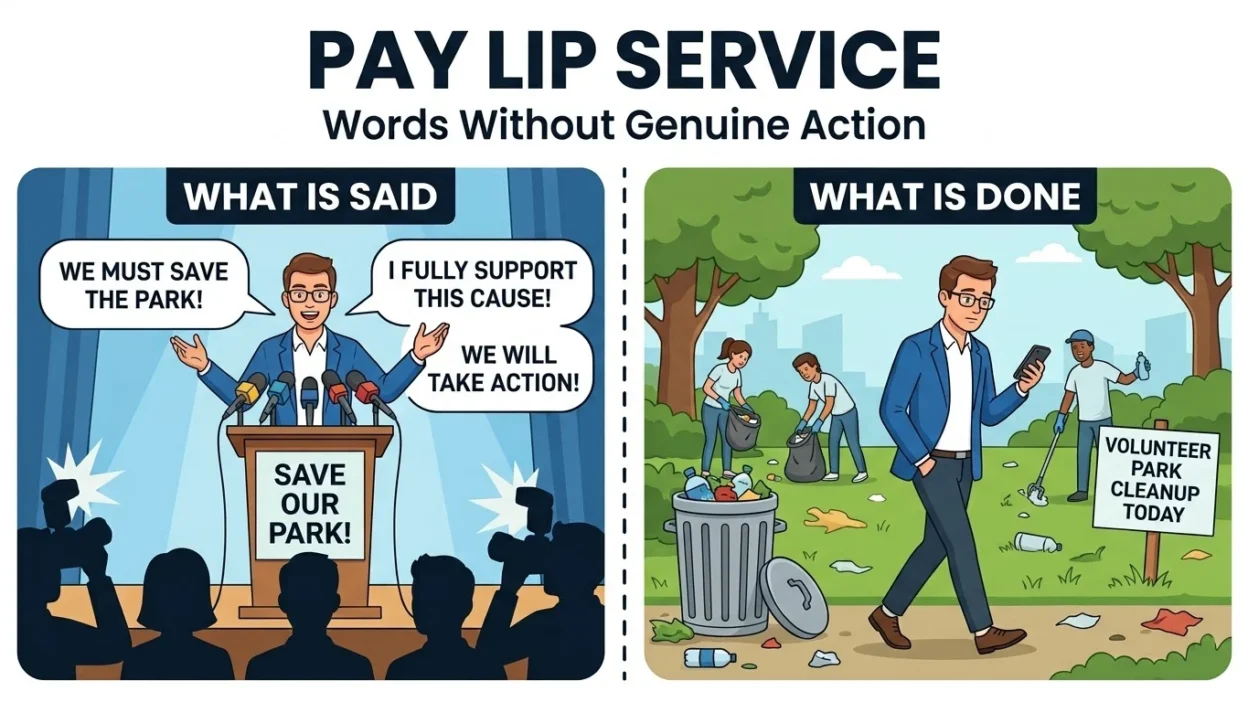
Have you ever heard someone say they support an important cause but never take any action to help it? In English, there is a useful expression for this kind of behavior: pay lip service. This idiom describes expressing support, approval, or agreement through words without showing genuine commitment through actions. It is often used when someone’s statements sound positive, but their behavior does not match what they claim to believe.
For example, a company may publicly promise to protect the environment but continue using harmful practices. In this situation, people might say the company is paying lip service to environmental protection. The expression is commonly used in conversations about politics, workplaces, social issues, relationships, and public promises. Understanding its meaning will help you recognize situations in which words and actions do not agree and use the phrase naturally in everyday English.
Quick Answer
Pay lip service means to express support, agreement, or approval for something without genuinely believing in it or taking meaningful action to support it. For example, if a manager says employee well being is important but does nothing to improve working conditions, the manager is paying lip service to employee well being.
What Does Pay Lip Service Mean?
The expression pay lip service means saying that you support or believe in something without showing genuine commitment through your actions.
In simple words, it means supporting something with words but not with actions.
People use this idiom when someone makes statements that sound sincere but does not follow them with meaningful behavior.
For example:
“The government pays lip service to education but does not provide enough funding to improve schools.”
This means the government claims to support education, but its actions do not demonstrate the same level of commitment.
The phrase often suggests insincerity, hypocrisy, or a lack of genuine interest.
What Does It Mean When Someone Pays Lip Service to Something?
When someone pays lip service to something, they publicly express support or approval without making a real effort to act according to their statements.
It can happen in several situations.
1. Expressing Support Without Taking Action
Someone may claim to support a cause but refuse to contribute to it.
Example:
“He pays lip service to animal welfare but has never supported any animal protection efforts.”
This suggests that his words do not match his actions.
2. Making Empty Promises
A person or organization may repeatedly make promises without fulfilling them.
Example:
“The company pays lip service to workplace safety but ignores employees’ concerns.”
The company talks about safety without making meaningful improvements.
3. Pretending to Agree
Someone may express agreement simply to avoid disagreement or criticism.
Example:
“She paid lip service to the proposal during the meeting, although she had no intention of supporting it.”
This means she appeared to agree but was not genuinely committed.
4. Supporting a Cause for Public Approval
A public figure may express support for an issue mainly to create a positive impression.
Example:
“Critics accused the politician of paying lip service to poverty reduction.”
This suggests that the politician’s statements were not supported by meaningful efforts.
What Is the Origin of Pay Lip Service?
The expression comes from the idea of using only the lips to express something.
A person can speak words of praise, agreement, or support without genuinely feeling what those words communicate. In other words, the person uses their lips to express approval, but their heart or actions may not reflect that approval.
The word lip refers to the physical lips used for speaking, while service suggests an act of respect, devotion, or acknowledgment.
The expression developed the figurative meaning of offering verbal support without sincere commitment.
Today, pay lip service is commonly used to criticize empty promises, insincere statements, and support that exists only in words.
How to Use Pay Lip Service in a Sentence
The expression is commonly used with the preposition to. You can use it when someone expresses support for a cause, idea, principle, or person without genuinely supporting it.
1. In Politics
Politicians and political organizations may use supportive language without taking meaningful action.
Examples:
- The politician pays lip service to education reform but has introduced no meaningful changes.
- Many voters believe the government is paying lip service to economic equality.
- The minister paid lip service to healthcare improvements during the campaign.
- Critics accused the party of paying lip service to environmental protection.
2. In the Workplace
The phrase can describe managers or companies that make promises without following through.
Examples:
- The company pays lip service to employee satisfaction but ignores staff complaints.
- Our manager pays lip service to teamwork but encourages competition among employees.
- The organization paid lip service to workplace diversity without changing its hiring practices.
- The employer claims to value work life balance but only pays lip service to it.
3. In Relationships
It can describe someone who says caring or supportive things without showing those feelings through behavior.
Examples:
- He pays lip service to our friendship but rarely makes an effort to stay in touch.
- She paid lip service to my concerns but never listened to what I was saying.
- They keep paying lip service to family values without spending time with their relatives.
- He says he supports me, but sometimes I feel he is only paying lip service.
4. In Social Issues
The idiom is useful when discussing public support for social causes.
Examples:
- The organization pays lip service to gender equality but does not promote equal opportunities.
- Many businesses pay lip service to environmental protection.
- The community leader paid lip service to affordable housing.
- Some institutions pay lip service to mental health awareness without providing adequate support.
Pay Lip Service vs Give Lip Service
Both expressions are used, but pay lip service to is the established and more widely recognized form of the idiom.
| Expression | Meaning | Example |
|---|---|---|
| Pay lip service to | Express support without genuine commitment | They pay lip service to equality. |
| Give lip service to | A less common variation with a similar intended meaning | He gives lip service to the proposal. |
For standard writing, especially formal or professional writing, pay lip service to is the safer choice.
Pay Lip Service vs Practice What You Preach
These expressions have contrasting meanings.
| Expression | Meaning | Example |
|---|---|---|
| Pay lip service | Express support without meaningful action | He pays lip service to honesty but often lies. |
| Practice what you preach | Act according to the beliefs or principles you promote | She practices what she preaches by treating everyone fairly. |
Someone who pays lip service to a principle does not consistently follow it. Someone who practices what they preach demonstrates their beliefs through their behavior.
Is Pay Lip Service Positive or Negative?
The expression usually has a negative meaning because it suggests that someone’s words are insincere or unsupported by actions.
For example:
“The company pays lip service to customer satisfaction.”
This suggests that the company talks about caring for customers but does not make a genuine effort to improve their experience.
The phrase can also be used in a neutral explanation of someone’s behavior, but it generally carries criticism.
Common Mistakes to Avoid
1. Thinking It Means Genuine Support
Paying lip service does not mean sincerely supporting something. It means expressing support without genuine commitment.
2. Forgetting the Preposition To
The standard expression is pay lip service to something.
Correct: “They pay lip service to environmental protection.”
Incorrect: “They pay lip service for environmental protection.”
3. Using It for Every Verbal Expression of Support
Not every statement of support is lip service. The expression suggests a difference between what someone says and what they genuinely believe or do.
4. Confusing It With Paying a Compliment
Paying lip service is not the same as paying someone a compliment. A compliment is an expression of praise, while paying lip service means offering verbal support without genuine commitment.
5. Assuming It Always Involves Deliberate Deception
Someone may pay lip service because they want to avoid criticism, maintain a good public image, or simply avoid making an effort. The phrase does not always prove that the person is deliberately lying.
Memory Trick
Think of the expression literally:
Lip service = Service provided only through the lips.
When someone pays lip service, they use words to express support, but they do not necessarily support the idea through their actions.
Remember this simple formula:
Pay lip service = Say you support something without genuinely acting on it.
For example, a manager who talks about employee welfare but ignores workplace problems is paying lip service to employee welfare.
American vs British English
The expression pay lip service is commonly understood and used in both American and British English.
The meaning and grammatical structure remain the same in both varieties.
American English:
- The company pays lip service to diversity.
- Politicians often pay lip service to education reform.
British English:
- The government pays lip service to environmental protection.
- The organization paid lip service to workers’ rights.
There is no significant difference in meaning, spelling, or usage between the two varieties.
Similar Words and Expressions
Here are some expressions that have meanings related to pay lip service.
- Empty promises: Promises that are not fulfilled.
- Insincere support: Support that is not genuine.
- Token support: Limited or symbolic support that does not create meaningful change.
- Hypocrisy: Claiming to have certain beliefs or principles while behaving differently.
- Go through the motions: Perform an action without genuine interest or commitment.
- Talk the talk: Say the right things, sometimes without demonstrating them through actions.
- Empty words: Statements that lack sincerity or meaningful commitment.
- Practice what you preach: Behave according to the principles you encourage others to follow. This is a contrasting expression rather than a synonym.
Frequently Asked Questions
1. What does pay lip service mean in simple words?
It means saying that you support or agree with something without genuinely believing in it or taking meaningful action. In simple terms, it means offering support through words rather than actions.
2. Is paying lip service a negative thing?
Usually, yes. The phrase suggests insincerity, hypocrisy, or a lack of genuine commitment. It is often used to criticize people or organizations whose actions do not match their statements.
3. How do you use pay lip service in a sentence?
You can use it as pay lip service to something. For example, “The company pays lip service to employee well being but does not improve working conditions.”
4. What is another word for pay lip service?
Depending on the context, alternatives include offer insincere support, make empty promises, express false approval, or give token support. These expressions have related meanings but are not interchangeable in every situation.
5. What is the difference between lip service and genuine support?
Lip service involves expressing support without meaningful commitment. Genuine support involves sincerely believing in something and demonstrating that commitment through actions.
6. Can you pay lip service to a person?
Yes. You can pay lip service to someone’s concerns, needs, or achievements. For example, “The manager paid lip service to the employees’ concerns but made no effort to address them.”
7. Is it pay lip service or give lip service?
Pay lip service to is the established and more common expression. Give lip service to is also encountered, but it is less common. For standard English writing, use pay lip service to.
8. What is the opposite of paying lip service?
A useful opposite is practice what you preach. It means acting according to the beliefs and principles you express. Other alternatives include show genuine support and follow through on your promises.
Remember This
Pay lip service means expressing support, approval, or agreement without genuine commitment or meaningful action.
The expression is commonly used when someone’s words do not match their behavior. It often carries a negative meaning because it suggests empty promises or insincere support.
For example, a company that talks about employee welfare but ignores workers’ problems is paying lip service to employee welfare.
Conclusion
The idiom pay lip service describes a situation in which someone expresses support for an idea, cause, or principle without genuinely committing to it. It is often used in politics, workplaces, relationships, and discussions about social issues. The expression highlights the difference between what people say and what they actually do.
Remember that paying lip service is generally associated with insincerity or a lack of meaningful action. If someone claims to support equality, honesty, or environmental protection but does nothing to demonstrate that support, they may be paying lip service to those principles. Understanding this idiom will help you recognize empty promises and describe the difference between verbal support and genuine commitment.

Lucas Luke is a passionate language writer and content creator at SimileHive, specializing in similes, idioms, metaphors, and figurative language. He enjoys making complex English expressions simple, engaging, and easy to understand for students, writers, and language enthusiasts through well-researched, practical content.