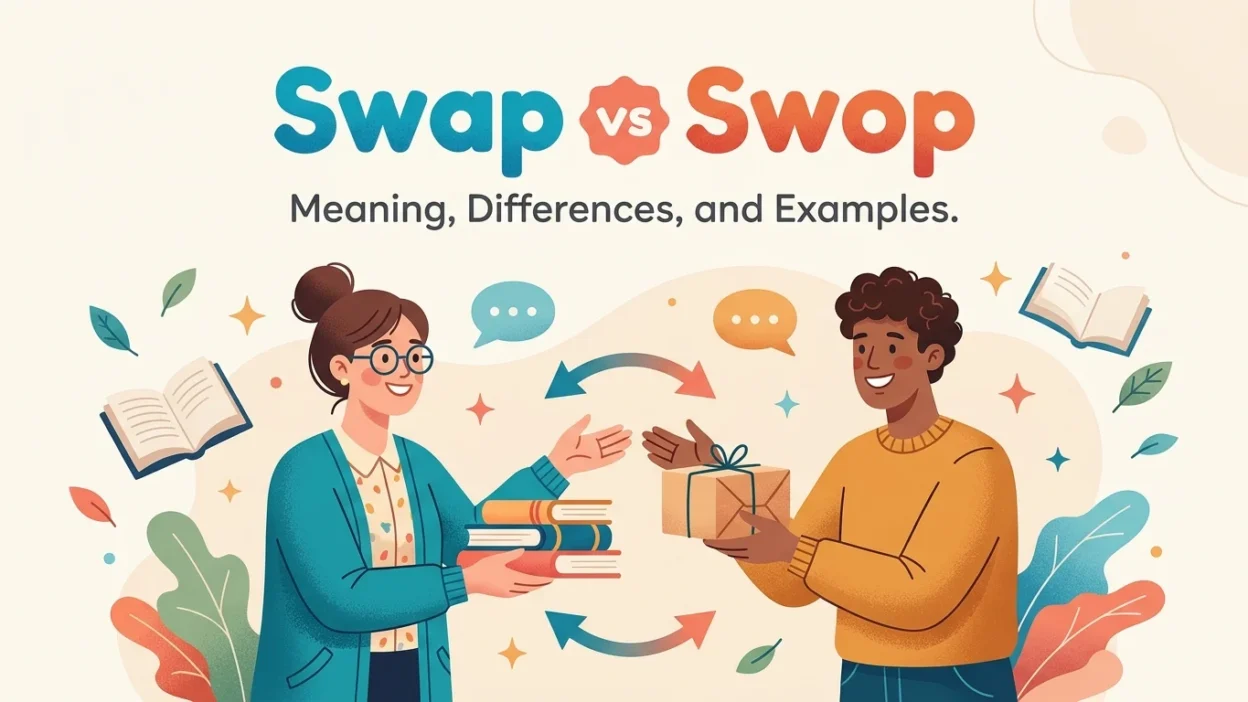
Is it swap or swop? Both spellings are correct, and both can refer to exchanging one thing for another. However, they are not equally common in modern English. Swap is the standard and widely preferred spelling in American English and British English, while swop is a less common alternative, particularly associated with British English.
Although the two words have the same basic meaning, knowing which spelling to use can help you write more naturally and avoid confusion. If you are exchanging clothes with a friend, trading items, switching responsibilities, or replacing one thing with another, choosing the appropriate spelling matters. This guide explains the difference between swap and swop, provides practical examples, and answers common questions about their usage.
Quick Answer
Swap and swop are alternative spellings of the same word. Both mean to exchange one thing for another. However, swap is much more common and is the preferred spelling in modern English, including American and British English. Swop is an accepted but less frequently used variant, particularly in British English.
What Does Swap Mean?
Swap is a verb and a noun that means to exchange one thing for another.
As a verb, it describes the action of exchanging items, positions, responsibilities, or ideas.
As a noun, it refers to an exchange or the arrangement through which two things are exchanged.
Examples:
- Can we swap seats?
- They decided to swap their old phones.
- I would like to swap this shirt for a larger size.
- We made a quick swap before the meeting.
- The children swapped their lunch boxes.
Swap is the spelling you will encounter most often in books, newspapers, websites, and everyday communication.
What Does Swop Mean?
Swop has the same basic meaning as swap. It is an alternative spelling of the word and can also function as both a verb and a noun.
Although swop is recognized in English dictionaries, it is considerably less common than swap.
Examples:
- They agreed to swop their books.
- Would you like to swop places?
- She decided to swop her blue dress for a red one.
- The children wanted to swop their toys.
These sentences have the same meanings if you replace swop with swap.
What Is the Difference Between Swap and Swop?
The main difference is spelling preference and frequency, not meaning.
| Feature | Swap | Swop |
|---|---|---|
| Meaning | To exchange | To exchange |
| Word type | Verb and noun | Verb and noun |
| American English | Standard and common | Rare |
| British English | Standard and common | Less common |
| Modern usage | Widely preferred | Less frequently used |
| Recommended spelling | Yes | Usually not preferred |
In most situations, swap is the better choice because it is familiar to a much wider range of English speakers.
Swap vs Swop: Which Spelling Should You Use?
You should generally use swap in both American and British English.
Although swop is an accepted spelling, it is uncommon in contemporary writing. Readers are more familiar with swap, so choosing it makes your writing clearer and more consistent.
Consider these examples:
- Preferred: We decided to swap our seats.
- Less common: We decided to swop our seats.
Both sentences are correct, but the first is more widely used.
If you are writing an article, academic assignment, business email, or professional document, swap is the safer choice.
Swap vs Swop Examples in Sentences
Here are examples showing how both spellings work in different contexts.
- Can you swap your shift with mine?
- The two friends decided to swap their bicycles.
- I want to swap this jacket for another size.
- They made a quick swap during the game.
- We often swap books after finishing them.
- The students agreed to swap their assignments for review.
- Would you like to swop your seat with mine?
- The children decided to swop their toys.
- She asked whether she could swop her tickets.
- They planned to swop their responsibilities for a week.
- The company introduced a system that allows customers to swap products.
- We arranged a book swap at school.
Notice that swap and swop can replace each other in these examples without changing the basic meaning.
Common Expressions With Swap
Swap appears in many common English expressions. These expressions are much more familiar than their versions using swop.
Swap Places
To exchange positions with someone.
Example: The two players decided to swap places.
Swap Seats
To exchange seats with another person.
Example: Could we swap seats so I can sit near the window?
Swap Ideas
To share thoughts or opinions.
Example: The team members met to swap ideas.
Swap Stories
To share personal experiences or stories.
Example: We spent the evening swapping stories about our childhood.
Swap Something for Something
To exchange one item for another.
Example: I swapped my old phone for a newer model.
Is Swap a Verb or a Noun?
Swap can be used as both a verb and a noun.
As a verb:
- I will swap my jacket with yours.
- They swapped houses for the summer.
- We need to swap the damaged item.
As a noun:
- The children made a swap.
- It was a fair swap.
- The book swap attracted many students.
Swop can also be used in both ways, although its use is much less common.
Common Mistakes When Using Swap and Swop
1. Thinking They Have Different Meanings
Swap and swop have the same basic meaning. The difference is mainly their spelling and frequency of use.
2. Assuming Swop Is Incorrect
Swop is an accepted alternative spelling. It is simply much less common than swap.
3. Using Swop in Formal Writing Without a Reason
Although swop is not inherently incorrect, swap is generally the more suitable choice for professional and academic writing.
4. Confusing Swap With Replace
Swap usually involves exchanging one thing for another. Replace means putting something new or different in place of something else.
For example:
- I swapped my old phone for a new one.
- I replaced my broken phone.
The first sentence emphasizes an exchange, while the second emphasizes substitution.
Memory Trick
Remember this simple rule:
Swap is the standard spelling. Swop is an alternative spelling.
If you are unsure which one to use, choose swap. It is widely accepted and understood in both American and British English.
American vs. British English
Unlike some spelling differences between American and British English, swap and swop do not represent a major regional distinction.
Swap is the normal and widely preferred spelling in both varieties.
Swop is recognized as a variant, especially in British English, but it is much less common. Therefore, you do not need to change swap to swop when writing for a British audience.
Related Words and Expressions
Here are some words related to swap and swop:
- Exchange: To give something and receive something else in return.
- Trade: To exchange goods, services, or items.
- Switch: To change from one thing to another.
- Replace: To put something else in the place of an existing item.
- Barter: To exchange goods or services without using money.
- Substitute: To use one thing instead of another.
- Interchange: To exchange positions or functions.
These words are related, but they are not always interchangeable. Their precise meanings depend on the context.
Frequently Asked Questions
1. Is swap or swop correct?
Both are correct spellings. However, swap is much more common and is the preferred spelling in modern English.
2. Is swop a real word?
Yes. Swop is an accepted alternative spelling of swap. It means to exchange one thing for another.
3. Is swap American or British English?
Swap is used in both American and British English. It is the standard spelling in both varieties.
4. Is swop British English?
Swop is particularly associated with British English as an alternative spelling, but it is much less common than swap.
5. Do swap and swop mean the same thing?
Yes. Both words mean to exchange something with someone or exchange one thing for another.
6. Which spelling should I use in formal writing?
Use swap. It is the more common and widely accepted spelling in modern English.
7. What is the past tense of swap?
The past tense of swap is swapped. Its present participle is swapping.
Examples:
- We swapped our books yesterday.
- They are swapping their seats.
The less common spelling swop also forms its past tense as swopped and its present participle as swopping.
Remember This
- Swap and swop are both accepted spellings.
- Both have the same basic meaning: to exchange.
- Swap is much more common in modern English.
- Swop is a less frequently used alternative.
- Swap is preferred in American and British English.
- Use swap in formal, academic, and professional writing.
Conclusion
Swap and swop are two spellings of the same word, and neither has a different basic meaning from the other. Both can function as nouns and verbs and describe the act of exchanging things, positions, or responsibilities. The main distinction is how frequently they are used.
For everyday communication and formal writing, swap is the best choice. It is the standard spelling in both American and British English, while swop remains an accepted but uncommon alternative. When in doubt, remember to choose swap.

Lucas Luke is a passionate language writer and content creator at SimileHive, specializing in similes, idioms, metaphors, and figurative language. He enjoys making complex English expressions simple, engaging, and easy to understand for students, writers, and language enthusiasts through well-researched, practical content.