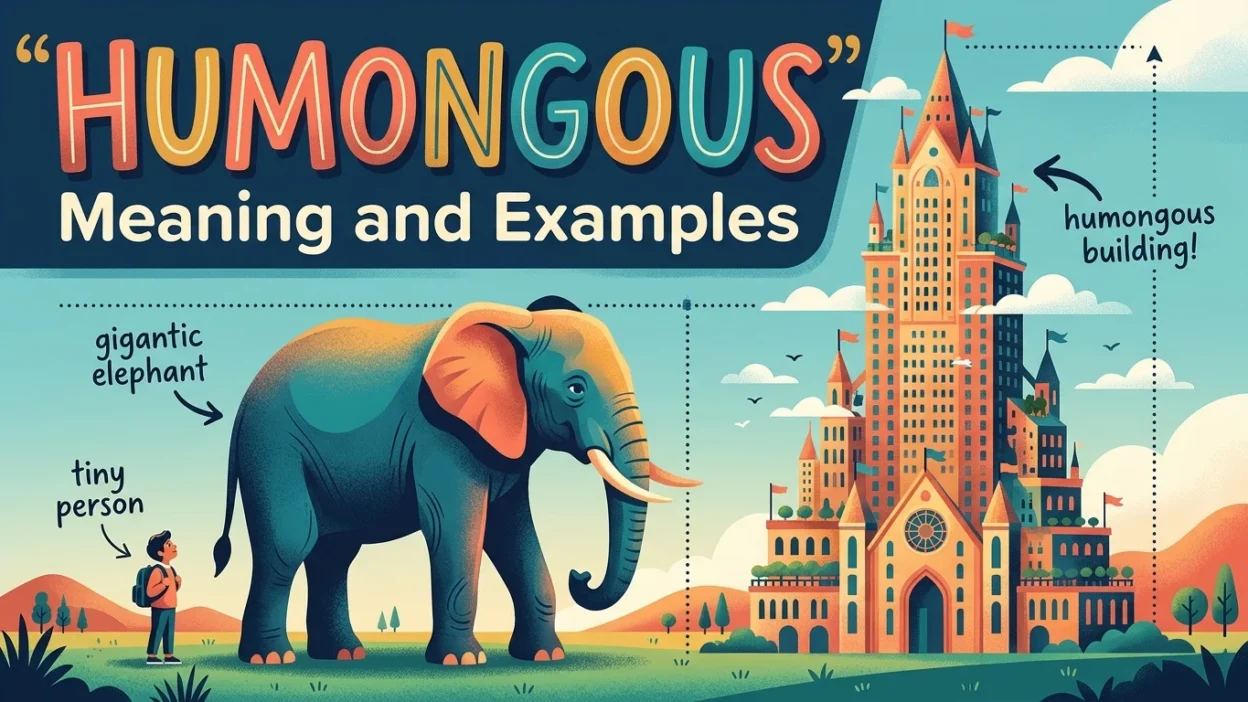
Have you ever seen something so big that the ordinary words large or huge do not seem strong enough to describe it? The English word humongous is often used in such situations. It describes something extremely large in size, amount, or degree. If you are talking about a giant building, an enormous meal, a massive collection, or a very serious problem, this expressive word can make your description more vivid.
Humongous is especially common in informal conversations, although it also appears in stories, advertisements, reviews, and other types of writing. It has a lively, exaggerated tone that makes it useful when you want to emphasize just how big something is. In this guide, you will learn what humongous means, how to pronounce and use it, how it differs from similar words, and how to include it naturally in everyday English.
Quick Answer
Humongous means extremely large, enormous, or gigantic. It is an informal adjective used to emphasize the size, amount, or scale of something. For example, a humongous building is an extremely large building. The word is often used in everyday conversation to make descriptions more expressive.
What Does Humongous Mean?
Humongous is an adjective that means extremely big or enormous.
It is generally used to describe something that is much larger than usual or expected. The word can refer to physical objects, places, quantities, and even abstract things such as problems or expenses.
Examples:
- They built a humongous shopping mall.
- We ordered a humongous pizza for dinner.
- The company made a humongous profit last year.
- He has a humongous collection of books.
- That was a humongous mistake.
In each example, humongous emphasizes an unusually large size, amount, or degree.
How Do You Pronounce Humongous?
The word humongous is pronounced:
hyoo MONG gus
Its phonetic transcription is /hjuːˈmʌŋɡəs/.
The stress falls on the second syllable, MONG.
Breaking the word into syllables can make it easier to pronounce:
- Hu
- Mon
- Gous
Practice saying the word slowly before using it in a sentence.
Is Humongous a Formal or Informal Word?
Humongous is generally considered informal. It is especially common in conversations, casual writing, entertainment, and advertising.
For example:
Informal: We saw a humongous whale during our trip.
More formal: We saw an enormous whale during our trip.
Both sentences communicate the same basic idea, but enormous is more suitable for formal or academic writing.
How to Use Humongous in a Sentence
Humongous usually appears before a noun because it functions as an adjective.
Common combinations include:
- Humongous building
- Humongous house
- Humongous problem
- Humongous amount
- Humongous mistake
- Humongous opportunity
- Humongous meal
- Humongous collection
- Humongous crowd
- Humongous success
It can also appear after linking verbs such as is, was, and seems.
Examples:
- Their new house is humongous.
- The problem seems humongous.
- The crowd was humongous.
15 Examples of Humongous in Sentences
Here are practical examples showing how to use the word naturally.
- They live in a humongous house near the lake.
- My brother bought a humongous television for his living room.
- We ordered a humongous cake for the birthday party.
- The company faced a humongous financial challenge.
- There was a humongous crowd outside the stadium.
- She has a humongous collection of vintage photographs.
- The elephant looked humongous compared with the other animals.
- He made a humongous mistake by ignoring the instructions.
- We spent a humongous amount of money on the renovation.
- The children were excited to see the humongous dinosaur model.
- That restaurant serves humongous portions of food.
- The construction workers are building a humongous bridge.
- She received a humongous number of messages after the announcement.
- The company celebrated a humongous increase in sales.
- They discovered a humongous cave during their expedition.
Humongous vs. Huge vs. Enormous vs. Gigantic
These words all describe something very large, but they differ slightly in tone and usage.
| Word | Meaning | Typical tone |
|---|---|---|
| Humongous | Extremely large | Informal and expressive |
| Huge | Very large | Neutral and widely used |
| Enormous | Extremely large | Neutral or formal |
| Gigantic | Extremely large, like a giant | Expressive |
| Massive | Very large, heavy, or substantial | Neutral |
| Colossal | Extremely large or impressive | Dramatic or formal |
Examples:
- Humongous: They bought a humongous television.
- Huge: They bought a huge television.
- Enormous: They bought an enormous television.
- Gigantic: They bought a gigantic television.
All four sentences describe a very large television, but humongous and gigantic sound more expressive.
Is Humongous a Positive or Negative Word?
Humongous is generally neutral. Its emotional meaning depends on what it describes and the context in which it appears.
Positive Meaning
It can emphasize something impressive, exciting, or desirable.
Examples:
- The company achieved a humongous success.
- They have a humongous garden with beautiful flowers.
- Winning the competition was a humongous achievement.
Negative Meaning
It can also emphasize something undesirable, difficult, or excessive.
Examples:
- We have a humongous problem to solve.
- The project requires a humongous amount of money.
- He made a humongous mistake.
Therefore, humongous does not automatically express praise or criticism. It simply emphasizes size, amount, or degree.
What Is the Plural of Humongous?
Humongous is an adjective, so it does not have a plural form.
It remains the same whether the noun it describes is singular or plural.
Examples:
- A humongous building
- Two humongous buildings
- A humongous problem
- Several humongous problems
The noun changes according to number, but the adjective stays the same.
Common Mistakes When Using Humongous
1. Using It in Very Formal Writing
Humongous is informal and expressive. In academic papers, technical reports, or highly formal documents, enormous or substantial may be more appropriate.
2. Assuming It Only Describes Physical Size
Humongous can describe abstract things such as mistakes, problems, opportunities, expenses, and achievements.
3. Confusing It With Humble
Humongous means extremely large, while humble means modest or not overly proud. These words have very different meanings.
4. Changing Its Form Incorrectly
Humongous does not need an additional plural ending when describing plural nouns.
Correct: They bought two humongous houses.
Incorrect: They bought two humongouses.
5. Using It When a Precise Measurement Is Needed
Humongous is subjective and informal. If exact size or quantity matters, use a measurement or a more precise description.
Memory Trick
Remember this simple connection:
Humongous = Huge + Enormous.
Think of humongous as an expressive way to say something is extremely big.
For example, if someone shows you an unusually large building, you can say, “That building is humongous!”
American vs. British English
Humongous is understood and used in both American and British English.
There is no significant difference in its spelling or meaning between the two varieties. However, the word is particularly familiar in informal American English and is also widely recognized in British English.
In both varieties, it is generally more appropriate for casual conversations than formal academic writing.
Related Words and Expressions
Here are some useful words and expressions related to humongous:
- Enormous: Extremely large.
- Gigantic: Extremely large or giant sized.
- Massive: Very large, heavy, or substantial.
- Colossal: Extremely large or impressive.
- Immense: Very great in size or degree.
- Mammoth: Extremely large or extensive.
- Tremendous: Very great in size, amount, or degree.
- Hulking: Large, heavy, and often awkward in appearance.
- Vast: Extremely large in area, extent, or quantity.
- Monumental: Exceptionally large or important.
Frequently Asked Questions
1. What does humongous mean in simple English?
Humongous means extremely big or enormous. It is an informal word used to describe something much larger than usual.
2. Is humongous a real word?
Yes. Humongous is a recognized English adjective. It is commonly used in everyday conversations and informal writing.
3. Is humongous formal or informal?
Humongous is generally informal. Words such as enormous, immense, and substantial may be better choices in formal writing.
4. Is humongous stronger than huge?
Humongous often sounds more exaggerated and expressive than huge. However, both words describe something very large, and their relative strength depends on context.
5. What is another word for humongous?
Some common alternatives are enormous, gigantic, massive, immense, colossal, and mammoth.
6. Can humongous describe a person?
Yes. It can describe a person’s physical size, although the word may sound exaggerated or insensitive depending on the context. Consider the situation and use respectful language.
7. What is the opposite of humongous?
Common opposites include tiny, miniature, little, small, and minuscule.
8. Is humongous used in British English?
Yes. Humongous is understood and used in British English, although it is generally considered informal.
Remember This
- Humongous means extremely large or enormous.
- It is an adjective.
- It is generally informal and expressive.
- It can describe physical objects and abstract things.
- It can have positive, neutral, or negative associations depending on context.
- It is used in both American and British English.
- It has no plural form.
Conclusion
Humongous is a lively and expressive English adjective that means extremely large, enormous, or gigantic. It can describe physical objects such as buildings, vehicles, and animals, as well as abstract things such as problems, expenses, mistakes, and achievements. Its informal tone makes it especially useful in everyday conversations and casual writing.
When you want to emphasize that something is unusually big or significant, humongous can be an effective word. However, remember that it is less formal than enormous or immense. Choosing the right word for your audience and situation will help make your English more natural, clear, and expressive.

Charles Kevin is a passionate language writer and researcher at SimileHive, creating clear, engaging content about similes, idioms, metaphors, and figurative language to help readers improve English communication confidently every day.