Is it naught or nought? Both spellings are correct, and both are associated with the number zero or the idea of nothing. However, their usage can differ depending on the expression, context, and variety of English. These words are particularly interesting because they have similar meanings but appear in different situations.
You may encounter naught in expressions such as come to naught and nought in expressions such as all or nought. Both words can also refer to zero, although nought is especially common in British English when referring to the number. Understanding the distinction will help you choose the right word when writing or speaking. This guide explains their meanings, differences, common expressions, and practical examples.
Quick Answer
Naught and nought are alternative spellings that can both mean zero or nothing. Naught is commonly used in expressions such as come to naught, meaning to fail or produce no result. Nought is especially common in British English when referring to the number zero. In many contexts, the two words are interchangeable.
What Does Naught Mean?
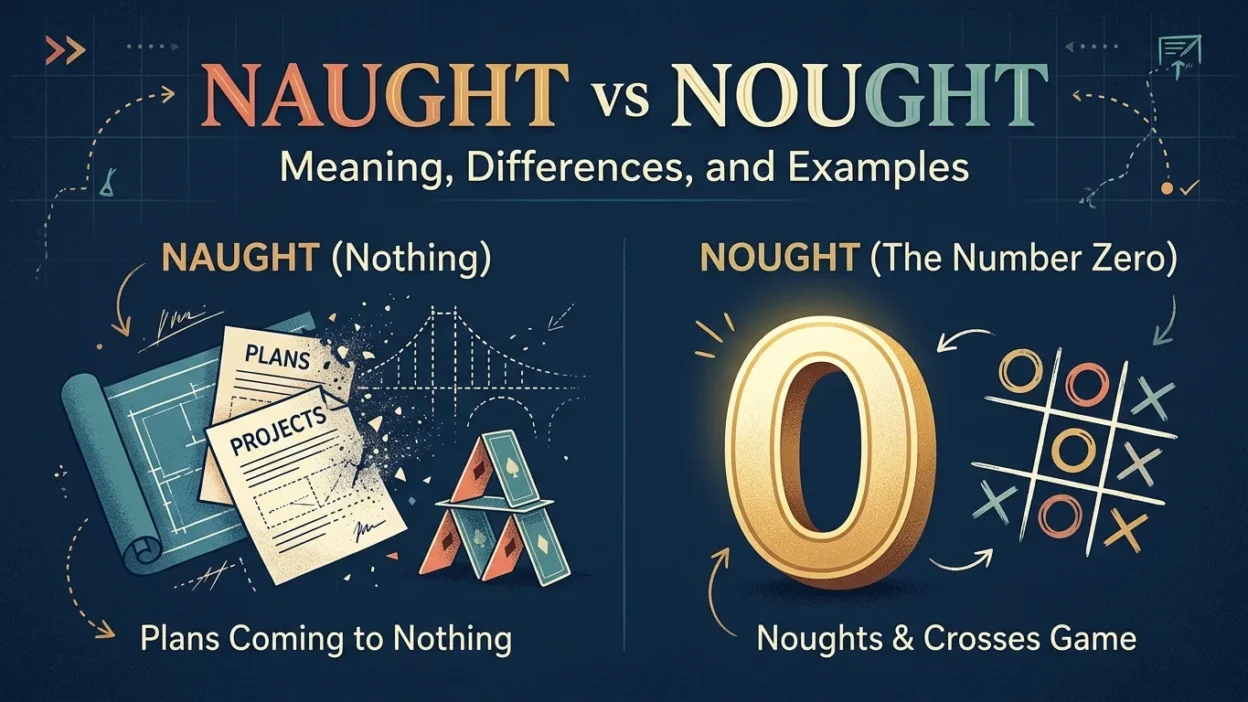
Naught is a noun that means nothing, zero, or something of no value or importance.
It is often used in formal, literary, or traditional expressions. One of its most common uses is the phrase come to naught, which means to fail, achieve nothing, or produce no useful result.
Examples:
- All their efforts came to naught.
- His plans were reduced to naught.
- The promises amounted to naught.
- She turned their criticism into naught through her achievements.
- Their hopes came to naught after the announcement.
In these examples, naught refers to nothing or a complete lack of results.
What Does Nought Mean?
Nought also means zero or nothing. It is particularly familiar in British English when referring to the number zero.
For example:
- The score was two nought.
- The temperature dropped to nought degrees.
- The result was nought.
- The account showed nought in the balance.
Nought is also used in the name of the traditional game noughts and crosses, which is known as tic tac toe in American English.
What Is the Difference Between Naught and Nought?
The main difference is their usage and regional preference. Both words can mean zero or nothing, but certain expressions favor one spelling.
| Feature | Naught | Nought |
|---|---|---|
| Basic meaning | Nothing or zero | Nothing or zero |
| Common usage | Literary and established expressions | Referring to zero, especially in British English |
| Common expression | Come to naught | Noughts and crosses |
| American English | Recognized but uncommon | Less common |
| British English | Used | Widely recognized |
| Interchangeability | Often interchangeable | Often interchangeable |
The distinction is not absolute. Both spellings are accepted, and context often determines which one sounds more natural.
Naught vs Nought: Which Spelling Should You Use?
Both spellings are correct, but the best choice depends on the context.
Use naught when writing familiar expressions such as:
- Come to naught
- Bring something to naught
- Reduce something to naught
Use nought when referring to zero in British English or using established expressions such as:
- Noughts and crosses
- Point nought
- Zero expressed as nought
For general writing, zero is often the clearest and most widely understood choice when referring to the number.
Common Expressions With Naught and Nought
Some expressions strongly favor one spelling.
1. Come to Naught
This means to fail or produce no result.
Example: All their efforts came to naught.
2. Bring Something to Naught
This means to make something unsuccessful or cause it to have no result.
Example: One careless decision brought their plans to naught.
3. Reduce Something to Naught
This means to make something worthless, ineffective, or equal to nothing.
Example: The unexpected expenses reduced their savings to naught.
4. Noughts and Crosses
This is the British name for a simple game played on a grid using circles and crosses. In American English, it is called tic tac toe.
Example: The children played noughts and crosses during the break.
5. All or Nought
This is a less common expression suggesting that something is an absolute success or complete failure. The more familiar expression is all or nothing.
Example: Their approach was all or nought.
15 Examples of Naught and Nought in Sentences
Here are practical examples showing how both words are used.
- All our efforts came to naught.
- Their ambitious plans eventually came to naught.
- The team’s hard work was not reduced to naught.
- His promises amounted to naught.
- The negotiations came to naught after several disagreements.
- She refused to let her achievements count for naught.
- The score was three nought.
- The temperature fell to nought degrees.
- The children played noughts and crosses after school.
- The account had nought remaining.
- Their hopes of winning came to naught.
- The entire project was brought to naught by poor planning.
- He started with nought and built a successful business.
- The final result was two goals to nought.
- Their careful preparations were not all for naught.
Naught vs Nought vs Zero vs Nothing
These words are related, but they are not always used in the same way.
| Word | Meaning | Example |
|---|---|---|
| Naught | Nothing or zero | Their efforts came to naught. |
| Nought | Zero or nothing | The score was one nought. |
| Zero | The number 0 | The temperature reached zero. |
| Nothing | Not anything | There is nothing in the box. |
Zero is the most widely used term in mathematics and everyday communication. Naught and nought are less common and often appear in particular expressions or regional usage.
Is Naught or Nought Used in American or British English?
Both words are recognized in American and British English, but their frequency and preferred contexts differ.
American English
American English generally favors zero when referring to the number. Naught is recognized, particularly in expressions such as come to naught, while nought is less common.
British English
British English uses nought more frequently when referring to zero. The expression noughts and crosses is also standard in British English.
Naught is also used in British English, particularly in established expressions.
Common Mistakes When Using Naught and Nought
1. Assuming One Spelling Is Incorrect
Both naught and nought are accepted English words. The difference is mainly a matter of usage and preference.
2. Confusing Them With Nothing
Naught and nought can mean nothing, but they are not suitable replacements for nothing in every sentence.
Natural: All their efforts came to naught.
Natural: There was nothing in the box.
3. Using Nought Instead of Zero in Every Situation
Although nought can mean zero, zero is generally preferred in mathematics, measurements, and everyday communication.
4. Confusing Naught With Naughty
Naught means nothing or zero, while naughty means badly behaved or mischievous.
Example:
- Their efforts came to naught.
- The naughty child refused to listen.
These words have different meanings and should not be confused.
5. Forgetting Established Expressions
Some expressions traditionally use a particular spelling. For example, come to naught and noughts and crosses are the familiar forms.
Memory Trick
Remember this simple distinction:
Naught = Come to naught.
Think of something that fails and produces nothing.
Nought = Noughts and crosses.
Think of the British name for the game also called tic tac toe.
Both words can refer to zero, but remembering these familiar expressions can help you choose the more natural spelling.
Related Words and Expressions
Here are some words and expressions related to naught and nought:
- Zero: The number 0.
- Nothing: Not anything.
- Nil: Zero, especially in sports scores.
- None: Not any or not one.
- Void: Empty or without legal or practical effect.
- Null: Having no value or effect in a particular context.
- Worthless: Having no value.
- Come to nothing: To fail or produce no result.
- In vain: Without achieving the intended result.
- All or nothing: A situation involving complete success or complete failure.
Frequently Asked Questions
1. Are naught and nought the same?
Yes. Both words can mean zero or nothing. However, they differ in common usage and regional preference. Naught often appears in expressions such as come to naught, while nought is frequently used for zero in British English.
2. Is naught or nought correct?
Both spellings are correct. Neither is inherently wrong. The appropriate choice depends on the expression and context.
3. What does come to naught mean?
Come to naught means to fail, achieve nothing, or produce no useful result.
Example: Their plans came to naught because of unexpected difficulties.
4. Is nought British or American?
Nought is particularly common in British English, especially when referring to zero. It is less common in American English, where zero is generally preferred.
5. Is naught the same as nothing?
Naught can mean nothing, but the words are not interchangeable in every context. Naught is particularly common in established expressions such as come to naught.
6. What is noughts and crosses in American English?
Noughts and crosses is called tic tac toe in American English. It is a game in which two players use circles and crosses on a three by three grid.
7. What is the difference between naught and naughty?
Naught means nothing or zero. Naughty describes someone who behaves badly or mischievously. They are different words with different meanings.
8. Should I use naught, nought, or zero?
Use zero when referring to the number 0 in ordinary communication, mathematics, and measurements. Use naught or nought when they fit an established expression or the style of your writing.
Remember This
- Naught and nought are both correct spellings.
- Both can mean zero or nothing.
- Naught commonly appears in the expression come to naught.
- Nought is particularly common in British English.
- Noughts and crosses is called tic tac toe in American English.
- Zero is generally the clearest choice in everyday and mathematical contexts.
- Neither word should be confused with naughty.
Conclusion
Naught and nought are two accepted English spellings with closely related meanings. Both can refer to zero or nothing, but their usage varies according to context. Naught is especially familiar in expressions such as come to naught, while nought is commonly associated with zero in British English and appears in the expression noughts and crosses.
The easiest way to remember the distinction is to connect each spelling with its familiar expressions. When you are simply referring to the number 0, zero is usually the safest choice. Understanding these differences will help you use both words accurately and confidently.

Lucas Luke is a passionate language writer and content creator at SimileHive, specializing in similes, idioms, metaphors, and figurative language. He enjoys making complex English expressions simple, engaging, and easy to understand for students, writers, and language enthusiasts through well-researched, practical content.