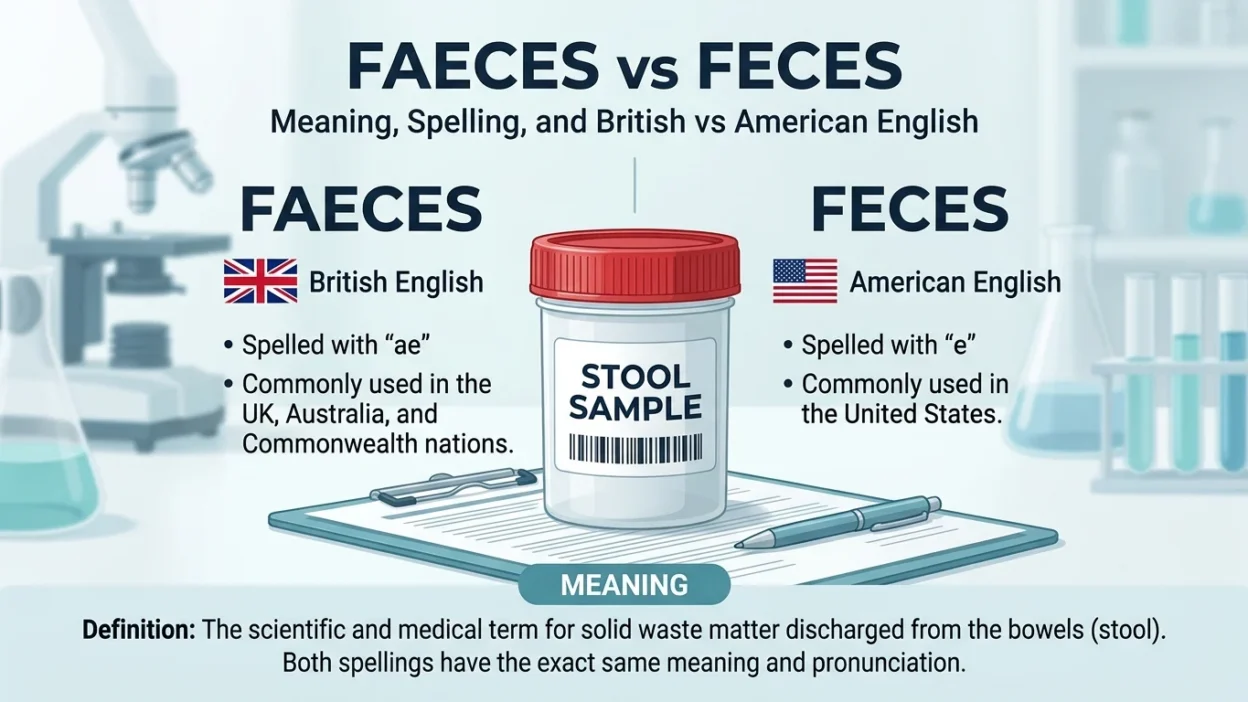
Have you ever wondered if the correct spelling is faeces or feces? Both forms are correct, and they have exactly the same meaning. The difference is mainly regional: faeces is the traditional British English spelling, while feces is the standard American English spelling. Both words refer to solid waste that passes out of the body through the anus after digestion.
You may encounter these spellings in medical reports, health articles, scientific discussions, and everyday communication. Although they refer to the same thing, choosing the appropriate spelling can make your writing more consistent with your intended variety of English. This guide explains the meanings, spelling differences, pronunciation, grammatical usage, and related terms. You will also find practical examples and answers to common questions.
Quick Answer
Faeces and feces are two accepted spellings of the same word. Faeces is preferred in British English, while feces is preferred in American English. Both refer to solid bodily waste produced by the digestive system. Neither spelling is incorrect, but you should choose one according to your audience and use it consistently.
What Does Faeces Mean?
Faeces is a noun that refers to solid waste discharged from the digestive system through the anus.
It consists of undigested food material, bacteria, water, and other waste products. The word is commonly used in medical, scientific, and health related contexts.
Examples:
- The doctor examined a sample of faeces.
- The laboratory tested the faeces for harmful bacteria.
- The presence of blood in faeces may require medical attention.
- Proper sanitation helps prevent contact with human faeces.
- The report included the results of the faeces examination.
In these examples, faeces refers to bodily waste.
What Does Feces Mean?
Feces has exactly the same meaning as faeces. It is the preferred spelling in American English.
It is commonly used in medical reports, scientific writing, health discussions, and educational materials.
Examples:
- The doctor requested a feces sample.
- The laboratory analyzed the feces.
- The presence of parasites in feces can indicate an infection.
- The study examined animal feces.
- Proper hygiene helps prevent the spread of diseases through feces.
The meaning does not change when the spelling changes.
What Is the Difference Between Faeces and Feces?
The main difference is regional spelling, not meaning.
| Feature | Faeces | Feces |
|---|---|---|
| Meaning | Solid bodily waste | Solid bodily waste |
| Preferred variety | British English | American English |
| Part of speech | Noun | Noun |
| Pronunciation | Same | Same |
| Medical usage | Common | Common |
| Correctness | Correct | Correct |
Both spellings are accepted. The choice depends on the variety of English you are using.
Faeces vs Feces: Which Spelling Should You Use?
The appropriate spelling depends on your intended audience.
Use Faeces in British English
Choose faeces when writing according to British English spelling conventions.
Examples:
- The doctor requested a faeces sample.
- The laboratory examined the faeces.
- The medical report included a faeces test.
Use Feces in American English
Choose feces when writing according to American English spelling conventions.
Examples:
- The doctor requested a feces sample.
- The laboratory examined the feces.
- The medical report included a feces test.
If you are writing for an international audience, either spelling is understandable. Consistency is more important than choosing one particular form.
Is Faeces or Feces Singular or Plural?
Faeces and feces are generally treated as uncountable nouns in modern English. They usually take a singular verb when referring to bodily waste as a substance.
Examples:
- The faeces is unusually dark.
- The feces was examined in the laboratory.
- Human faeces can contain harmful microorganisms.
However, the word can also be used in scientific contexts to refer to separate samples or deposits, depending on the sentence.
When referring to one individual portion, a stool or a faecal sample may be more natural.
Examples:
- The patient provided a stool sample.
- The laboratory received a faecal sample.
Faeces vs Feces vs Stool vs Excrement
These words have related meanings, but their usage and tone differ.
| Word | Meaning | Typical usage |
|---|---|---|
| Faeces | Solid bodily waste | British medical and scientific English |
| Feces | Solid bodily waste | American medical and scientific English |
| Stool | Waste passed from the digestive system | Medical and everyday English |
| Excrement | Waste discharged from the body | Formal or general English |
| Poop | Bodily waste | Informal English |
| Bowel movement | The act of passing stool | Medical and everyday English |
Faeces and feces are more technical terms, while stool is especially common in medical conversations. Poop is informal and is often used when speaking with children.
15 Examples of Faeces and Feces in Sentences
Here are practical examples showing how both spellings are used.
- The doctor requested a sample of faeces for testing.
- The laboratory examined the feces under a microscope.
- Human faeces can contain bacteria and parasites.
- The research team collected animal feces from the forest.
- The medical report mentioned blood in the patient’s faeces.
- Proper sanitation prevents the contamination of water with feces.
- The veterinarian examined the dog’s faeces.
- The study investigated the effects of contaminated feces on soil.
- The nurse explained how to collect a faeces sample.
- The laboratory identified harmful organisms in the feces.
- The presence of mucus in faeces can have several causes.
- The researchers analyzed elephant feces to study its diet.
- The doctor asked about changes in the patient’s faeces.
- Human feces must be handled carefully to prevent disease transmission.
- The report described the appearance and consistency of the faecal sample.
What Is a Faeces Test or Feces Test?
A faeces test, also called a feces test, involves examining a stool sample to look for signs of certain health conditions.
Depending on the type of test, a laboratory may examine the sample for:
- Blood
- Parasites
- Bacteria
- Certain viruses
- Signs of digestive problems
- Other substances that may help with diagnosis
The exact purpose depends on the test requested by a healthcare professional.
Common Mistakes When Using Faeces and Feces
1. Assuming One Spelling Is Incorrect
Both spellings are correct. Faeces is preferred in British English, while feces is preferred in American English.
2. Mixing British and American Spellings
Try to maintain consistency throughout a document.
For example, if you use British English, choose faeces rather than switching randomly between faeces and feces.
3. Confusing Faeces With Faecal
Faeces is a noun, while faecal is an adjective.
Examples:
- The laboratory examined the faeces.
- The doctor requested a faecal sample.
The American spelling of the adjective is fecal.
4. Treating Faeces as a Regular Countable Noun
Faeces is generally uncountable when referring to bodily waste as a substance. Avoid adding a plural ending to it.
5. Using Technical Language in Casual Conversations
Faeces and feces are formal or scientific terms. In informal conversations, people may prefer words such as poop or stool, depending on the situation.
Memory Trick
Remember this simple distinction:
Faeces = British English.
Feces = American English.
Think of the extra letter a in faeces as a reminder of the British spelling convention.
Both words have the same meaning, so you only need to remember which spelling suits your audience.
American vs British English
The spelling difference follows a familiar pattern in British and American English.
| British English | American English |
|---|---|
| Faeces | Feces |
| Faecal | Fecal |
| Anaemia | Anemia |
| Paediatric | Pediatric |
| Oestrogen | Estrogen |
The spelling faeces is common in British English and other varieties that follow British spelling conventions. Feces is standard in American English.
Related Words and Expressions
Here are some useful terms related to faeces and feces:
- Faecal: Relating to faeces.
- Fecal: The American spelling of faecal.
- Stool: Solid waste passed from the digestive system.
- Excrement: Waste discharged from the body.
- Poop: An informal word for faeces.
- Bowel movement: The act of passing stool.
- Defecation: The process of passing faeces.
- Digestive system: The body system responsible for processing food.
- Intestinal waste: Waste material in the intestines.
- Stool sample: A sample of faeces collected for laboratory testing.
Frequently Asked Questions
1. Is it faeces or feces?
Both spellings are correct. Faeces is the preferred British English spelling, while feces is the preferred American English spelling.
2. Do faeces and feces mean the same thing?
Yes. Both words refer to solid waste discharged from the digestive system. There is no difference in meaning.
3. Is faeces British or American?
Faeces is the traditional British English spelling. It is also used in other varieties of English that follow British spelling conventions.
4. Is feces American or British?
Feces is the standard American English spelling. It is also understood in British English.
5. Is faeces singular or plural?
Faeces is generally treated as an uncountable noun and usually takes a singular verb when referring to bodily waste as a substance.
6. What is the adjective form of faeces?
The adjective form is faecal in British English and fecal in American English.
Example: The doctor requested a faecal sample.
7. Is stool the same as faeces?
Yes, stool refers to the waste passed from the digestive system. It is especially common in medical contexts and everyday health discussions.
8. Which spelling should I use in formal writing?
Use faeces if you are following British English and feces if you are following American English. Both are appropriate in formal and scientific writing.
Remember This
- Faeces and feces have the same meaning.
- Faeces is the preferred British English spelling.
- Feces is the preferred American English spelling.
- Both refer to solid bodily waste.
- Faeces and feces are generally uncountable nouns.
- Faecal is British English, while fecal is American English.
- Stool is a common alternative, especially in medical contexts.
Conclusion
Faeces and feces are two correct spellings of the same English word. Both refer to solid waste produced by the digestive system and discharged through the anus. The only meaningful difference between them is regional spelling preference. Faeces is commonly used in British English, whereas feces is standard in American English.
When choosing between these spellings, consider your audience and the variety of English you are following. Use faeces for British English writing and feces for American English writing. Keeping your spelling consistent will make your writing clearer and more professional.

Charles Kevin is a passionate language writer and researcher at SimileHive, creating clear, engaging content about similes, idioms, metaphors, and figurative language to help readers improve English communication confidently every day.