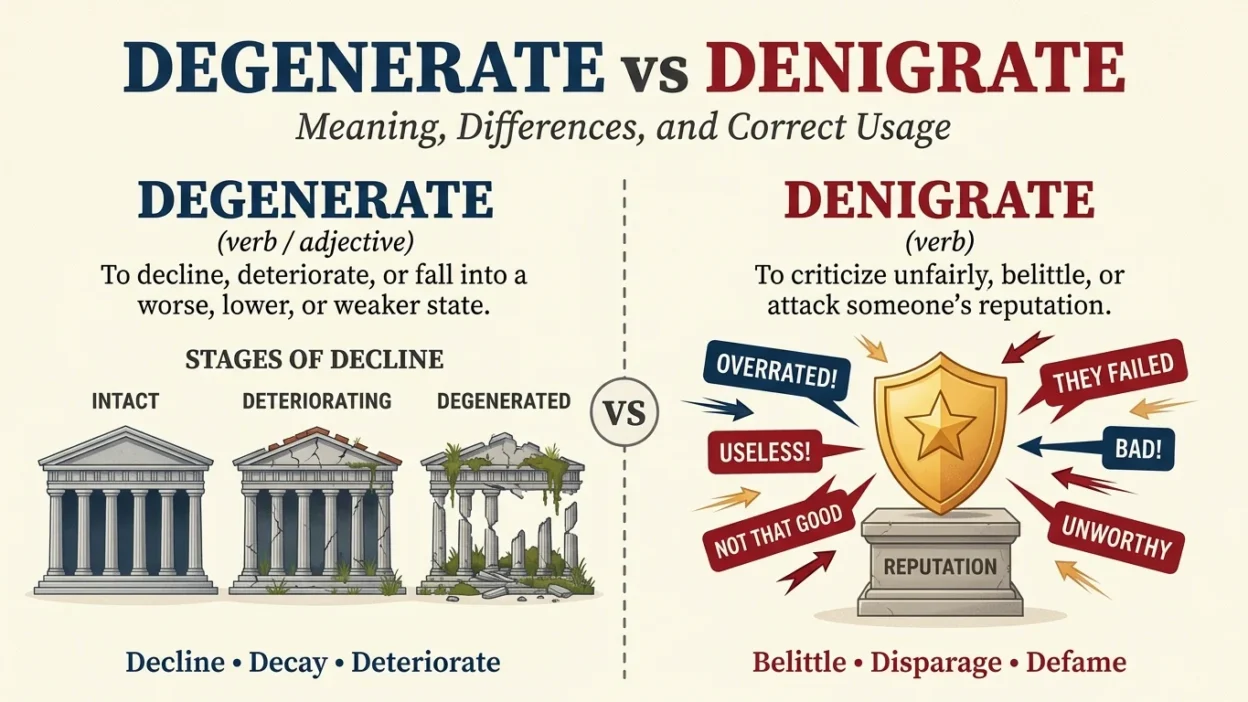
Have you ever confused degenerate with denigrate? Although these words look and sound somewhat similar, they have different meanings and uses. Degenerate can describe a decline in quality, condition, behavior, or moral standards. It can also refer to a person whose behavior is considered morally unacceptable. Denigrate, on the other hand, means to criticize, insult, or unfairly damage someone’s reputation.
Understanding the difference is important because using one word in place of the other can change the meaning of your sentence. Both words often appear in discussions about behavior, society, reputation, and personal character, but they are not interchangeable. This guide explains their definitions, grammatical forms, differences, and correct usage. You will also find examples, common mistakes, memory tips, and answers to frequently asked questions.
Quick Answer
Degenerate means to decline in quality, condition, or moral standards. It can also describe someone or something considered morally corrupt. Denigrate means to criticize, belittle, or speak negatively about someone or something. In simple terms, something can degenerate over time, while a person can denigrate another person’s reputation.
What Does Degenerate Mean?
Degenerate can function as a verb, adjective, or noun. Its meaning depends on how it is used in a sentence.
As a verb, it means to become worse in quality, condition, behavior, or character over time.
Examples:
- The discussion gradually degenerated into an argument.
- The neighborhood began to degenerate because of neglect.
- Their friendly conversation degenerated into a heated disagreement.
- The situation degenerated into complete confusion.
- Without proper care, the building may degenerate further.
As an adjective, degenerate describes something that has declined from an earlier or expected standard. It can also describe behavior considered morally corrupt.
Examples:
- The report described the degenerate condition of the building.
- The writer criticized what he considered degenerate behavior.
- The society was portrayed as morally degenerate.
As a noun, a degenerate can refer to a person considered morally corrupt or lacking acceptable standards of behavior. This use is often insulting or judgmental.
Example:
- The character was portrayed as a degenerate who exploited others.
Important: The word can have different meanings in specialized fields. In mathematics and science, degenerate can describe a special or reduced condition that does not necessarily involve moral decline.
What Does Denigrate Mean?
Denigrate is a verb that means to unfairly criticize, belittle, insult, or damage someone’s reputation.
When you denigrate someone, you speak about them in a way that makes them seem less valuable, capable, or respectable.
Examples:
- He tried to denigrate his colleague’s achievements.
- You should not denigrate people because of their backgrounds.
- The article appeared to denigrate the efforts of the entire team.
- She refused to denigrate her competitors.
- The politician was accused of trying to denigrate his opponent.
Denigrate can also be used when speaking negatively about things such as ideas, traditions, institutions, or achievements.
Examples:
- The speaker denigrated the value of traditional education.
- It is unfair to denigrate someone’s hard work without understanding it.
- The reviewer denigrated the entire project.
The central idea is that someone is being spoken about in a dismissive or damaging way.
What Is the Difference Between Degenerate and Denigrate?
The main difference is that degenerate refers to a decline or deterioration, while denigrate refers to unfair criticism or belittlement.
| Feature | Degenerate | Denigrate |
|---|---|---|
| Part of speech | Verb, adjective, noun | Verb |
| Main meaning | To decline or become worse | To criticize or belittle |
| Focus | Deterioration or decline | Negative treatment through words |
| Common context | Behavior, condition, quality, society | Reputation, achievements, people, ideas |
| Example | The discussion degenerated into an argument. | He tried to denigrate her achievements. |
| Related word | Deteriorate | Disparage |
Remember that degenerate describes a process of decline or a condition, whereas denigrate describes an act of speaking negatively about something or someone.
Degenerate vs Denigrate: Examples in Sentences
The following examples show how to use both words correctly.
Examples of Degenerate
- The peaceful gathering began to degenerate into chaos.
- The quality of the service has degenerated over the years.
- Their disagreement degenerated into a personal argument.
- The abandoned house continued to degenerate because nobody maintained it.
- The discussion degenerated when participants stopped listening to one another.
- The author described the character as morally degenerate.
- The organization began to degenerate after losing its original purpose.
- The condition of the old bridge has degenerated significantly.
- The debate degenerated into an exchange of personal insults.
- The film explores a society that appears to be morally degenerate.
Examples of Denigrate
- You should not denigrate someone else’s accomplishments.
- The manager refused to denigrate his former employees.
- The article seemed designed to denigrate the reputation of the organization.
- She felt hurt when her colleagues denigrated her work.
- The speaker was criticized for trying to denigrate another culture.
- He used the interview to denigrate his political opponent.
- It is unfair to denigrate an idea without considering its merits.
- The reviewer did not denigrate the author’s efforts.
- They accused the newspaper of trying to denigrate the public figure.
- Respectful disagreement does not require you to denigrate another person.
Can Degenerate and Denigrate Be Used Interchangeably?
No. Although both words can appear in discussions about negative behavior or criticism, their meanings are different.
Consider these examples:
Correct: The conversation degenerated into a shouting match.
This means the conversation became worse and less controlled.
Correct: He tried to denigrate his opponent during the debate.
This means he tried to make his opponent appear less respectable through negative comments.
Using denigrate in the first sentence would change its meaning. Likewise, using degenerate in the second sentence would not express the intended idea of belittling someone.
Common Mistakes When Using Degenerate and Denigrate
1. Confusing Deterioration With Criticism
Degenerate describes a decline in condition, quality, or behavior. Denigrate means to criticize or belittle.
Incorrect: The building denigrated because of poor maintenance.
Correct: The building degenerated because of poor maintenance.
2. Using Denigrate to Describe Something Becoming Worse
Denigrate is not the correct verb for describing physical or general deterioration.
Incorrect: The quality of the service denigrated over time.
Correct: The quality of the service deteriorated over time.
3. Assuming Degenerate Always Describes a Person
Degenerate can describe a process, situation, condition, or behavior. It is not limited to people.
Example: The discussion degenerated into an argument.
4. Thinking Denigrate Only Applies to People
You can denigrate a person, but you can also denigrate an idea, achievement, institution, or tradition.
Example: The critic denigrated the value of the research.
5. Confusing the Words Because They Look Similar
Their similar appearance does not mean they have similar definitions. Remember the difference in meaning before choosing one.
Memory Trick: How to Remember the Difference
Use this simple memory trick:
Degenerate = Deteriorate.
Both words can describe something becoming worse.
Denigrate = Disparage.
Both words involve speaking negatively about someone or something.
For example:
- A conversation can degenerate into an argument.
- A person can denigrate another person’s achievements.
Remembering these two associations will help you choose the correct word.
American vs British English
There is no significant difference between the meanings or spellings of degenerate and denigrate in American and British English.
Both varieties use the same spellings and generally follow the same grammatical rules.
| Word | American English | British English |
|---|---|---|
| Degenerate | Degenerate | Degenerate |
| Denigrate | Denigrate | Denigrate |
| Deteriorate | Deteriorate | Deteriorate |
| Disparage | Disparage | Disparage |
The words are understood in both varieties of English.
Related Words and Expressions
Understanding related vocabulary can help you use degenerate and denigrate more accurately.
Words Related to Degenerate
- Deteriorate: To become worse in quality or condition.
- Decline: To decrease in quality, strength, or importance.
- Degrade: To reduce in quality, value, or status.
- Corrupt: To become morally dishonest or harmful.
- Decadent: Characterized by excessive luxury or declining moral standards, depending on context.
- Regress: To return to a less advanced or developed condition.
Words Related to Denigrate
- Disparage: To speak about someone or something in a disrespectful or dismissive way.
- Belittle: To make someone or something seem less important.
- Malign: To speak harmful or false things about someone.
- Defame: To damage someone’s reputation through false statements.
- Slander: To make a false spoken statement that harms someone’s reputation.
- Discredit: To harm someone’s reputation or make something seem unreliable.
Frequently Asked Questions
1. What is the main difference between degenerate and denigrate?
Degenerate means to decline or become worse in quality, condition, or behavior. Denigrate means to criticize, belittle, or damage someone’s reputation through negative comments.
2. Is degenerate a negative word?
Usually, yes. It often describes deterioration or behavior considered morally unacceptable. However, in technical subjects such as mathematics and science, it can have a neutral meaning.
3. Is denigrate the same as insult?
Not exactly. Denigrate means to speak about someone or something in a way that lowers its perceived value or reputation. An insult is a disrespectful or offensive remark. The meanings can overlap, but they are not identical.
4. What is another word for degenerate?
Depending on the context, alternatives include deteriorate, decline, worsen, regress, and degrade.
5. What is another word for denigrate?
Common alternatives include disparage, belittle, malign, discredit, and speak ill of.
6. Can degenerate be used as a noun?
Yes. As a noun, a degenerate refers to someone considered morally corrupt or socially unacceptable. This usage is usually insulting or judgmental.
7. Is denigrate a verb or an adjective?
Denigrate is a verb. Its noun form is denigration, and its adjective form is denigrating or denigratory.
8. Can you denigrate an idea?
Yes. Denigrate can describe unfairly criticizing or belittling an idea, belief, achievement, institution, or tradition.
Remember This
- Degenerate means to decline or become worse.
- Denigrate means to criticize, belittle, or speak negatively about someone or something.
- Degenerate can function as a verb, adjective, or noun.
- Denigrate is a verb.
- Deteriorate is a useful alternative to degenerate in many contexts.
- Disparage is a useful alternative to denigrate.
- The two words have the same spellings and meanings in American and British English.
Conclusion
Although degenerate and denigrate look similar, they have different meanings. Degenerate describes a decline in quality, condition, behavior, or moral standards. It can also function as an adjective or noun when describing someone or something considered morally corrupt. Denigrate, however, means to criticize, belittle, or damage the reputation of a person, idea, or institution through negative comments.
To use these words correctly, remember that something can degenerate when it becomes worse, while someone can denigrate another person by speaking negatively about them. Understanding this distinction will help you avoid confusion and make your writing more accurate.

Adam Aaron is a language enthusiast and content writer at SimileHive, creating clear, engaging guides on similes, idioms, metaphors, and figurative language to help readers improve English confidently every day.