Can you start a sentence with a conjunction? Yes, you can. Starting a sentence with a conjunction is grammatically acceptable in English, despite the common belief that it is always incorrect. Words such as and, but, or, so, yet, and because can appear at the beginning of a sentence when they help connect ideas and make writing flow naturally.
The confusion often comes from traditional grammar lessons that discourage beginning sentences with conjunctions. However, modern English allows this structure in both formal and informal writing when it is used appropriately. The key is to understand how conjunctions work and make sure each sentence expresses a complete and clear idea. This guide explains the rules, provides practical examples, and shows you when starting a sentence with a conjunction improves your writing.
Quick Answer
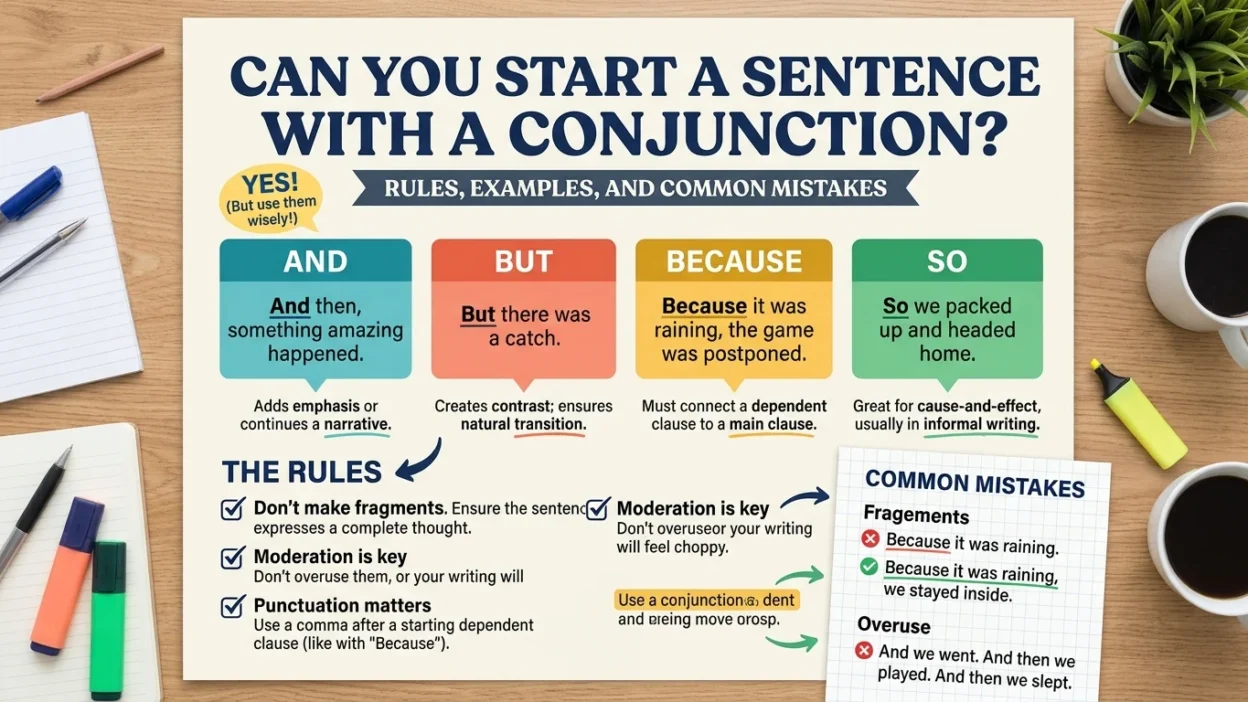
Yes, you can start a sentence with a conjunction. Words such as and, but, or, so, and yet can begin a sentence to connect it naturally with the previous idea. Even because can start a sentence, provided it introduces a dependent clause that is connected to an appropriate independent clause.
What Is a Conjunction?
A conjunction is a word that connects words, phrases, clauses, or sentences. It helps show the relationship between different parts of a sentence or between related ideas.
For example:
- I like tea and coffee.
- She wanted to go, but she was busy.
- We stayed home because it was raining.
- You can walk or take a bus.
In these examples, the conjunctions connect different parts of the sentences.
There are three main types of conjunctions:
1. Coordinating Conjunctions
Coordinating conjunctions connect words, phrases, or independent clauses of equal grammatical importance.
The seven common coordinating conjunctions are:
- For
- And
- Nor
- But
- Or
- Yet
- So
You can remember them using the acronym FANBOYS.
Examples:
- I wanted to call you, but I lost your number.
- She studied hard, so she passed the examination.
- He likes football and cricket.
2. Subordinating Conjunctions
Subordinating conjunctions introduce dependent clauses and show relationships such as cause, time, condition, and contrast.
Common examples include:
- Because
- Although
- Since
- While
- If
- Unless
- When
- Before
- After
- Though
Examples:
- Because it was raining, we stayed inside.
- Although she was tired, she continued working.
- If you need help, call me.
3. Correlative Conjunctions
Correlative conjunctions work in pairs to connect related grammatical elements.
Common pairs include:
- Either … or
- Neither … nor
- Both … and
- Not only … but also
- Whether … or
Examples:
- Either you can stay here or you can come with us.
- Both the teacher and the students attended the meeting.
- Not only did she apologize, but she also offered to help.
Can You Start a Sentence With a Coordinating Conjunction?
Yes. Starting a sentence with a coordinating conjunction is grammatically acceptable.
The most common examples are and, but, or, so, and yet.
Writers often use these conjunctions at the beginning of a sentence to connect it with the previous sentence and emphasize a relationship between ideas.
Starting a Sentence With And
And is used to add information or introduce another related point.
Examples:
- I finished my homework. And I helped my brother with his.
- She is intelligent. And she works extremely hard.
- We visited the museum. And we took several photographs.
- He apologized for his mistake. And everyone accepted his explanation.
Starting with and can create a natural conversational flow. However, avoid using it repeatedly when writing formal academic material.
Starting a Sentence With But
But introduces a contrast, disagreement, or unexpected point.
Examples:
- I wanted to attend the meeting. But I had another appointment.
- She is young. But she is very experienced.
- The task looked easy. But it was more difficult than expected.
- He studied for several hours. But he still felt unprepared.
Starting with but is useful when you want to emphasize a contrast.
Starting a Sentence With Or
Or presents an alternative, possibility, or consequence.
Examples:
- You should leave now. Or you may miss the train.
- We can discuss the issue today. Or we can arrange another meeting.
- You can submit the assignment online. Or you can deliver a printed copy.
The second sentence presents another option or possibility.
Starting a Sentence With So
So often introduces a result, conclusion, or consequence.
Examples:
- It was getting late. So we decided to go home.
- She had prepared thoroughly. So she felt confident.
- The road was blocked. So we took another route.
- Nobody answered the phone. So I sent a message.
In everyday writing, starting a sentence with so is natural and common. In formal writing, make sure the relationship between the ideas is clear.
Starting a Sentence With Yet
Yet introduces a contrast or an unexpected result.
Examples:
- He is very busy. Yet he always makes time for his family.
- The task was difficult. Yet she completed it successfully.
- They had little experience. Yet they performed remarkably well.
Yet can make a contrast more noticeable.
Can You Start a Sentence With Because?
Yes. You can start a sentence with because, but you must understand how it affects sentence structure.
Because is a subordinating conjunction. It introduces a dependent clause that explains a reason.
A dependent clause cannot normally stand alone as a complete sentence in standard formal writing.
Correct: Because it was raining, we stayed at home.
Here, the because clause explains why we stayed home. The independent clause completes the sentence.
Also correct: We stayed at home because it was raining.
The order changes, but the meaning remains the same.
Incorrect as a complete sentence: Because it was raining.
This is a sentence fragment when used alone without a suitable context.
However, a short because response can be acceptable in conversation or informal writing.
Example:
- Why did you leave early?
- Because I was feeling tired.
The answer is natural because the missing information is understood from the question.
Can You Start a Sentence With Although?
Yes. Although is a subordinating conjunction that introduces a contrast.
Examples:
- Although it was cold, we went outside.
- Although she was nervous, she delivered an excellent speech.
- Although he disagreed, he respected our decision.
- Although the journey was long, everyone enjoyed it.
Remember that although introduces a dependent clause. You need an independent clause to complete the sentence in standard writing.
Incorrect: Although she was tired.
Correct: Although she was tired, she continued working.
Can You Start a Sentence With a Conjunction in Formal Writing?
Yes. Starting a sentence with a conjunction is acceptable in formal writing when the structure is correct and the connection between ideas is clear.
However, the choice of conjunction should suit the purpose and tone of the writing.
For example:
Formal:
The results were encouraging. However, further research is necessary.
Less formal:
The results were encouraging. But we need more research.
Both are grammatically acceptable. However is a conjunctive adverb, not a conjunction, while but is a coordinating conjunction.
You can also begin formal sentences with coordinating conjunctions when doing so improves clarity or emphasis. There is no universal grammar rule that prohibits it.
Is It Wrong to Start a Sentence With And or But?
No. It is not grammatically wrong to begin a sentence with and or but.
The belief that these words should never start a sentence is a traditional writing rule sometimes taught to encourage students to connect ideas carefully.
However, modern English grammar recognizes that coordinating conjunctions can begin independent sentences.
Compare these examples:
Without starting a new sentence with a conjunction:
I wanted to attend the event, but I was feeling unwell.
Starting a new sentence with a conjunction:
I wanted to attend the event. But I was feeling unwell.
Both versions are correct. The second version places more emphasis on the contrast.
What Is the Difference Between Starting a Sentence With a Conjunction and Using a Comma?
When a coordinating conjunction connects two independent clauses within one sentence, a comma generally comes before the conjunction.
Example:
I wanted to go, but I was too tired.
When the conjunction begins a new sentence, you generally do not place a comma immediately after it.
Example:
I wanted to go. But I was too tired.
However, subordinating conjunctions follow a different pattern. When a dependent clause comes before an independent clause, a comma is generally used after the dependent clause.
Example:
Because I was tired, I went to bed early.
| Structure | Example | Punctuation |
|---|---|---|
| Coordinating conjunction within a sentence | I called, but nobody answered. | Comma before but |
| Coordinating conjunction at the beginning | But nobody answered. | No comma immediately after but |
| Subordinating conjunction at the beginning | Because it was late, we left. | Comma after the dependent clause |
| Subordinating conjunction in the middle | We left because it was late. | Usually no comma |
15 Examples of Sentences Starting With Conjunctions
Here are 15 practical examples showing how different conjunctions can begin sentences.
- And we decided to visit our grandparents the following weekend.
- But nobody knew what had happened.
- Or you could ask someone else for help.
- So we changed our plans.
- Yet he continued to believe in his abilities.
- Because she was ill, she could not attend the meeting.
- Although the weather was unpleasant, we enjoyed the trip.
- If you need additional information, please contact the office.
- When the bell rang, the students left the classroom.
- While I was cooking, my brother was setting the table.
- Unless you work hard, you may not achieve your goal.
- Since everyone was ready, we started the presentation.
- After the meeting ended, we went out for lunch.
- Though the road was narrow, the driver managed to pass safely.
- Before you make a decision, consider all the available options.
Common Mistakes When Starting a Sentence With a Conjunction
1. Believing That And and But Can Never Begin a Sentence
This is a common misconception. Both words can begin sentences when they connect ideas naturally.
2. Creating a Sentence Fragment With Because
A sentence beginning with because usually needs an independent clause to complete its meaning.
Incorrect: Because I missed the bus.
Correct: Because I missed the bus, I arrived late.
3. Overusing Conjunctions at the Beginning
Although beginning sentences with conjunctions is correct, using and or but in every sentence can make your writing repetitive.
Vary your sentence structures to maintain a natural flow.
4. Placing an Unnecessary Comma After a Conjunction
You do not normally need a comma immediately after and, but, or, or so when they begin a sentence.
Incorrect: But, I did not agree with him.
Correct: But I did not agree with him.
A comma may still be appropriate after a longer introductory expression or for a specific stylistic reason, but it is not required simply because the sentence begins with a conjunction.
5. Confusing Conjunctions With Conjunctive Adverbs
Words such as however, therefore, nevertheless, and consequently are conjunctive adverbs, not coordinating conjunctions.
They can connect ideas, but their punctuation rules differ.
Example:
The weather was unpleasant. However, we continued our journey.
Memory Trick
Remember these simple rules:
- And adds information.
- But introduces contrast.
- Or presents an alternative.
- So introduces a result.
- Yet introduces an unexpected contrast.
- Because explains a reason.
- Although introduces a contrast.
You can begin a sentence with these words when they help the reader understand how one idea relates to another.
American vs British English
There is no major difference between American and British English regarding the use of conjunctions at the beginning of sentences.
Both varieties allow writers to begin sentences with and, but, or, so, because, although, and other conjunctions.
| Feature | American English | British English |
|---|---|---|
| Starting with and | Acceptable | Acceptable |
| Starting with but | Acceptable | Acceptable |
| Starting with because | Acceptable | Acceptable |
| Starting with although | Acceptable | Acceptable |
| Formal writing | Allowed when appropriate | Allowed when appropriate |
| Main grammatical rules | Generally the same | Generally the same |
The choice depends more on writing style, clarity, and context than on regional differences.
Related Grammar Terms
Here are some useful grammar terms connected with starting sentences with conjunctions.
- Conjunction: A word that connects words, phrases, or clauses.
- Coordinating conjunction: A conjunction that connects elements of equal grammatical importance.
- Subordinating conjunction: A conjunction that introduces a dependent clause.
- Correlative conjunction: A pair of conjunctions that work together.
- Independent clause: A group of words containing a subject and a verb that can stand alone as a sentence.
- Dependent clause: A group of words containing a subject and a verb that cannot normally stand alone as a complete sentence.
- Sentence fragment: An incomplete sentence that does not express a complete grammatical thought.
- Conjunctive adverb: An adverb that connects ideas and shows relationships such as contrast or result.
Frequently Asked Questions
1. Is it grammatically correct to start a sentence with a conjunction?
Yes. It is grammatically acceptable to start a sentence with a conjunction. Words such as and, but, or, so, and because can begin sentences when used correctly.
2. Can you start a sentence with and?
Yes. And can begin a sentence when you want to add information or connect an idea with the previous sentence.
Example: And that is why we decided to stay.
3. Can you start a sentence with but?
Yes. But is commonly used at the beginning of a sentence to introduce a contrast or an unexpected point.
Example: But nobody was willing to help.
4. Can you start a sentence with because?
Yes. Because can begin a sentence when it introduces a dependent clause that is followed by an independent clause.
Example: Because it was raining, we stayed indoors.
5. Can you start a sentence with so?
Yes. So can begin a sentence to introduce a result or conclusion.
Example: So we decided to try again.
6. Should you avoid starting sentences with conjunctions in academic writing?
No universal rule requires you to avoid this structure. You can begin sentences with conjunctions in academic writing, provided the sentences are clear, grammatically correct, and appropriate for the context.
7. Is starting a sentence with but informal?
Not necessarily. Starting with but is acceptable in both formal and informal writing. However, its use should suit the tone and purpose of the text.
8. Do you need a comma after a conjunction at the beginning of a sentence?
Usually, no. You do not normally place a comma immediately after a coordinating conjunction such as and, but, or, or so. However, punctuation may depend on the rest of the sentence.
Remember This
- You can start a sentence with a conjunction.
- And adds information.
- But introduces contrast.
- Or presents an alternative.
- So introduces a result.
- Yet shows an unexpected contrast.
- Because and although can begin sentences that contain dependent clauses.
- A dependent clause usually needs an independent clause to complete the sentence.
- Starting with a conjunction is acceptable in both formal and informal writing.
- Use conjunctions naturally rather than beginning every sentence with one.
Conclusion
Starting a sentence with a conjunction is perfectly acceptable in modern English. Words such as and, but, or, so, yet, because, and although can appear at the beginning of a sentence when they help connect ideas and improve the flow of your writing. The important thing is to use each conjunction according to its grammatical function.
Do not avoid this structure simply because you were taught that sentences should never begin with conjunctions. Instead, focus on clarity, correct punctuation, and complete sentence structure. When used thoughtfully, beginning a sentence with a conjunction can make your writing sound more natural, engaging, and effective.

Adam Aaron is a language enthusiast and content writer at SimileHive, creating clear, engaging guides on similes, idioms, metaphors, and figurative language to help readers improve English confidently every day.