Is it ourselves or ourself? Both forms exist in English, but they are not used in exactly the same way. Ourselves is the standard reflexive and emphatic pronoun used with the plural pronoun we. It can refer to two or more people or represent a group speaking as one unit. Ourself is much less common and is generally used in specific contexts, particularly when a single person speaks on behalf of a group or uses we instead of I.
Understanding the difference can help you avoid grammatical mistakes in everyday conversations and formal writing. Although you will encounter ourselves far more often, ourself is not always incorrect. This guide explains their meanings, grammatical roles, differences, and practical examples so you can choose the right form confidently.
Quick Answer
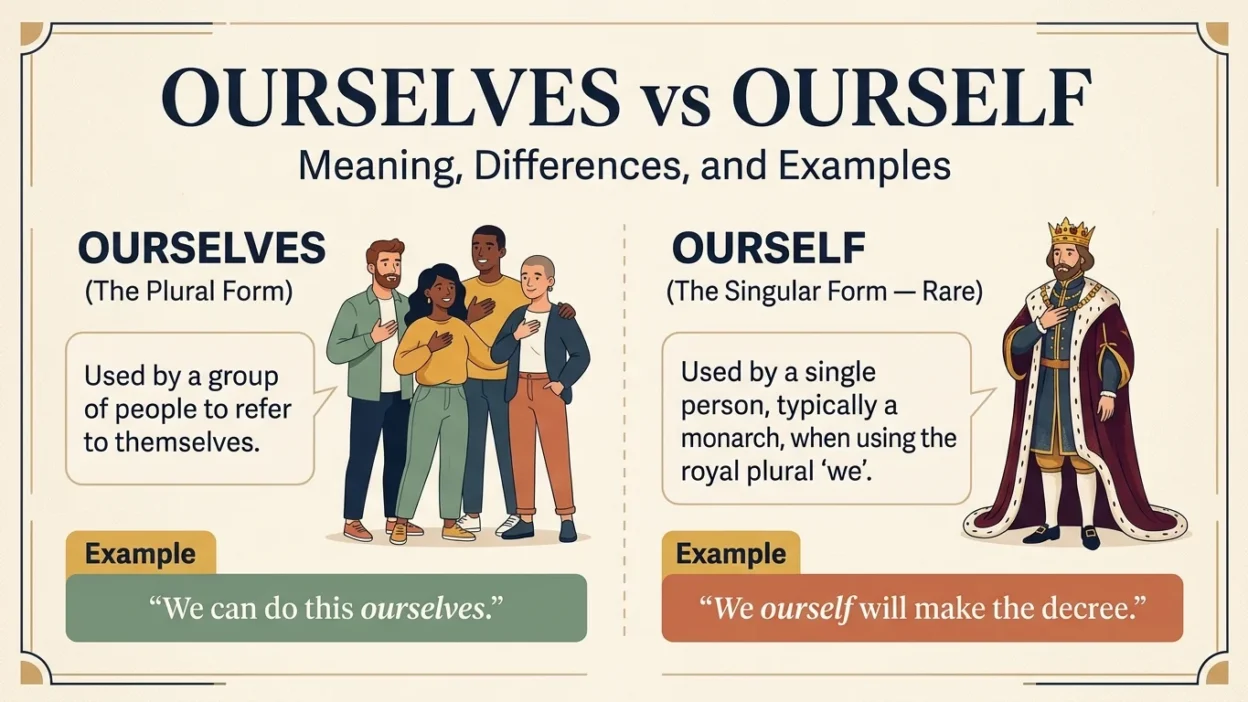
Ourselves is the standard reflexive pronoun used with we when referring to more than one person. Ourself is a rare singular form sometimes used when one person speaks as we, such as a monarch using the royal we. In ordinary modern English, ourselves is usually the correct choice.
What Does Ourselves Mean?
Ourselves is a reflexive and emphatic pronoun. It refers to the people represented by the pronoun we.
It is used when the subject and object of a sentence refer to the same people. It can also emphasize that the people represented by we performed an action personally.
Examples:
- We prepared ourselves for the examination.
- We should believe in ourselves.
- We introduced ourselves to the new neighbors.
- We completed the project ourselves.
- We need to take care of ourselves.
In these sentences, ourselves refers to the same people represented by we.
What Does Ourself Mean?
Ourself is a rare singular reflexive pronoun associated with the pronoun we when it refers to one person.
It may appear when a monarch, official, or other individual uses the royal we to speak about themselves. It can also occur in certain formal, historical, or specialized writing.
Examples:
- We must remind ourself of our responsibilities.
- We shall defend ourself against these accusations.
- We have promised ourself to remain committed to this goal.
These examples illustrate the rare singular use. However, in ordinary modern English, most writers would use myself if one person is speaking about themselves as I, or ourselves if we refers to multiple people.
What Is the Difference Between Ourselves and Ourself?
The main difference is that ourselves is the standard plural reflexive pronoun, whereas ourself is a rare singular form used in particular contexts.
| Feature | Ourselves | Ourself |
|---|---|---|
| Meaning | Refers to the people represented by we | Refers to one person represented by we |
| Usage | Standard and very common | Rare and specialized |
| Grammatical role | Reflexive and emphatic pronoun | Reflexive pronoun |
| Typical context | Groups of people | Royal we or specialized usage |
| Example | We introduced ourselves. | We must protect ourself. |
In ordinary writing, ourselves is the form you will need in most situations.
Ourselves vs Ourself: Which One Should You Use?
Use ourselves when we refers to two or more people.
Examples:
- We enjoyed ourselves at the party.
- We should respect ourselves.
- We prepared ourselves for the journey.
- We can solve the problem ourselves.
Use ourself only when a single person deliberately uses we to refer to themselves, particularly in a traditional royal or formal style.
For ordinary first person singular sentences, use myself with I.
Examples:
- I introduced myself.
- I prepared myself for the interview.
- I reminded myself to stay calm.
How to Use Ourselves in a Sentence
Ourselves has two common functions.
1. As a Reflexive Pronoun
Use ourselves when the subject and object refer to the same people.
Examples:
- We taught ourselves how to cook.
- We blamed ourselves for the mistake.
- We found ourselves in a difficult situation.
- We challenged ourselves to improve.
- We enjoyed ourselves during the trip.
2. As an Emphatic Pronoun
Use ourselves to emphasize that the people represented by we performed an action personally, rather than someone else doing it.
Examples:
- We painted the house ourselves.
- We organized the event ourselves.
- We completed the assignment ourselves.
- We built the furniture ourselves.
- We prepared the meal ourselves.
15 Examples of Ourselves and Ourself in Sentences
Here are practical examples showing the difference between the two forms.
Examples of Ourselves
- We introduced ourselves to everyone at the meeting.
- We should always believe in ourselves.
- We prepared ourselves for the unexpected challenges.
- We enjoyed ourselves during the holiday.
- We need to remind ourselves of our goals.
- We completed the entire project ourselves.
- We should take responsibility for ourselves.
- We found ourselves in an unfamiliar situation.
- We promised ourselves that we would work harder.
- We can improve ourselves through consistent practice.
- We taught ourselves to use the new software.
- We must protect ourselves from unnecessary risks.
Examples of Ourself
- We must remind ourself of the promise we made.
- We shall defend ourself against these allegations.
- We have a duty to protect ourself and our position.
The last three examples illustrate rare singular usage. They are not suitable replacements for ourselves when we refers to a group of people.
Ourselves vs Ourself vs Myself
These three pronouns are related, but they are used in different situations.
| Pronoun | Used With | Example |
|---|---|---|
| Myself | I | I prepared myself. |
| Ourselves | We referring to multiple people | We prepared ourselves. |
| Ourself | We referring to one person in rare usage | We prepared ourself. |
Remember that the choice depends on who the subject represents, not simply on the word we appearing in the sentence.
Common Expressions With Ourselves
Here are some common expressions that use ourselves:
- Believe in ourselves: Have confidence in our abilities.
- Take care of ourselves: Look after our own health and well being.
- Enjoy ourselves: Have a good time.
- Blame ourselves: Accept responsibility for something.
- Prepare ourselves: Get ready for a situation.
- Express ourselves: Communicate our thoughts and feelings.
- Challenge ourselves: Attempt something difficult to improve.
- Remind ourselves: Help ourselves remember something.
- Protect ourselves: Keep ourselves safe.
- Be proud of ourselves: Feel satisfaction about our achievements.
Common Mistakes When Using Ourselves and Ourself
1. Using Ourself for a Group
When we refers to multiple people, use ourselves.
Incorrect: We introduced ourself to the guests.
Correct: We introduced ourselves to the guests.
2. Using Ourselves With I
When the subject is I, the correct reflexive pronoun is myself.
Incorrect: I prepared ourselves for the interview.
Correct: I prepared myself for the interview.
3. Assuming Ourself Is Always Incorrect
Ourself is a recognized but uncommon form. It can be appropriate when one person uses we to refer to themselves.
4. Using Ourselves as a Replacement for We or Us
Ourselves is a reflexive or emphatic pronoun. It should not replace the ordinary subject or object pronouns.
Incorrect: Ourselves completed the assignment.
Correct: We completed the assignment ourselves.
5. Confusing Reflexive and Emphatic Usage
A reflexive pronoun refers back to the subject, while an emphatic pronoun adds emphasis.
Reflexive: We taught ourselves English.
Emphatic: We completed the work ourselves.
Memory Trick
Remember this simple distinction:
We + multiple people = Ourselves.
We + one person using the royal we = Ourself.
I + one person = Myself.
For everyday English, remember that ourselves is the standard choice whenever we refers to a group.
American vs British English
Ourselves is the standard form in both American and British English when referring to a group of people.
Ourself is rare in both varieties and may appear in specialized, historical, or formal contexts involving the singular use of we.
There is no significant difference between American and British English in the basic distinction.
Related Words and Expressions
Here are some useful reflexive pronouns and related forms:
- Myself: Refers back to the speaker represented by I.
- Yourself: Refers to one person represented by you.
- Yourselves: Refers to multiple people represented by you.
- Himself: Refers back to a male person.
- Herself: Refers back to a female person.
- Itself: Refers back to an animal, object, or other singular entity.
- Themselves: Refers back to people or things represented by they.
- One another: Refers to two or more people or things acting mutually.
- Each other: Refers to people or things in a reciprocal relationship.
Frequently Asked Questions
1. Is ourselves or ourself correct?
Both forms exist, but ourselves is the standard form used in ordinary modern English when we refers to multiple people. Ourself is a rare singular form used in specialized contexts.
2. What is the difference between ourselves and ourself?
Ourselves refers to multiple people represented by we. Ourself can refer to one person who uses we to speak about themselves, such as in the royal we.
3. Is ourself grammatically correct?
Yes. Ourself is recognized in English, but it is uncommon. It may be used when a single person refers to themselves using we rather than I.
4. Can I use ourselves for one person?
Usually, no. If one person is speaking as I, the correct reflexive pronoun is myself. Ourselves is generally used when we refers to more than one person.
5. Is ourselves singular or plural?
Ourselves is generally plural. It refers to the people represented by we.
6. What is the plural of ourself?
Ourselves is the standard plural counterpart of ourself.
7. Is ourself used in British English?
Yes. Ourself is recognized in British English, although it is rare. It may appear in traditional or specialized writing.
8. Should I use ourselves or ourself in formal writing?
Use ourselves when we refers to a group. Use ourself only when one person is deliberately speaking as we in a context where the singular form is appropriate.
Remember This
- Ourselves is the standard reflexive pronoun for groups represented by we.
- Ourself is a rare singular form.
- Ourself may be used with the royal we.
- Myself is the correct reflexive pronoun for I.
- Ourselves is common in both American and British English.
- In ordinary writing, ourselves is usually the safest choice when using we.
Conclusion
Ourselves and ourself are related reflexive pronouns, but they differ in their usual grammatical functions. Ourselves is the standard form used when we refers to two or more people. Ourself is much less common and is generally reserved for situations in which one person uses we to refer to themselves, such as the traditional royal we.
For everyday conversations, academic writing, and most professional communication, use ourselves when referring to a group. If you are speaking about yourself as I, choose myself instead. Understanding this distinction will help you write more naturally and avoid unnecessary pronoun errors.

Lucas Luke is a passionate language writer and content creator at SimileHive, specializing in similes, idioms, metaphors, and figurative language. He enjoys making complex English expressions simple, engaging, and easy to understand for students, writers, and language enthusiasts through well-researched, practical content.