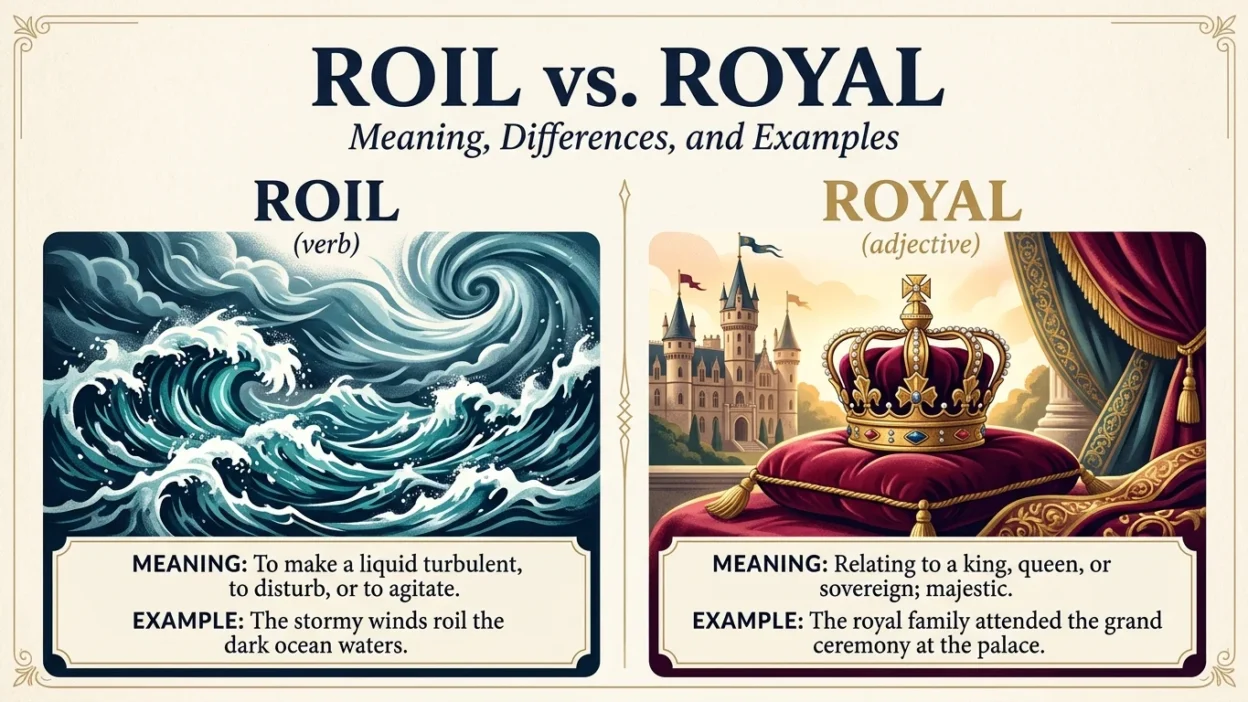
Have you ever come across the words roil and royal and wondered whether they have similar meanings? Although these words look and sound somewhat alike, they are completely different in meaning and usage. Roil is a verb that means to make a liquid cloudy, muddy, or turbulent.
It can also describe disturbing or upsetting a situation. Royal, on the other hand, is an adjective associated with kings, queens, monarchs, and their families. It can also describe something magnificent, grand, or fit for a king or queen.
Understanding the difference between roil and royal will help you avoid confusion in writing and everyday communication. In this guide, you will learn their definitions, pronunciations, grammatical roles, differences, and practical examples. You will also discover common expressions and mistakes to avoid.
Quick Answer
Roil is a verb meaning to stir up, disturb, or make something turbulent or cloudy. Royal is an adjective meaning related to a king, queen, or monarchy. For example, “The strong wind began to roil the water” and “The royal family attended the ceremony.” The words have different meanings and grammatical functions.
What Does Roil Mean?
Roil is a verb that means to disturb, agitate, stir up, or make a liquid cloudy by moving dirt or other particles through it.
It can describe physical movement, such as rough water, as well as emotional or social disturbance.
Examples:
- The strong wind began to roil the lake.
- Heavy rain roiled the muddy river.
- His comments roiled the political debate.
- The unexpected announcement roiled the financial markets.
- Her criticism seemed to roil his emotions.
In these examples, roil describes something being stirred up, disturbed, or made turbulent.
What Does Royal Mean?
Royal is an adjective that means connected with a king, queen, monarch, or royal family.
It can also describe something grand, magnificent, impressive, or suitable for a monarch.
Examples:
- The royal family attended the national celebration.
- They visited the royal palace.
- The king wore a royal robe.
- The guests received a royal welcome.
- She enjoyed a royal treatment at the hotel.
Royal is commonly used when discussing monarchy, history, ceremonies, and things associated with royalty.
What Is the Difference Between Roil and Royal?
The main difference is their meaning and grammatical function. Roil is a verb that describes an action or disturbance, while royal is an adjective that describes something associated with a monarch or something magnificent.
| Feature | Roil | Royal |
|---|---|---|
| Part of speech | Verb | Adjective |
| Meaning | To stir up, agitate, or disturb | Related to a king, queen, or monarchy |
| Common context | Water, emotions, debates, markets | Monarchs, families, palaces, ceremonies |
| Example | The wind roiled the water. | The royal family arrived. |
| Related word | Turbulent | Royalty |
The two words are not interchangeable because they serve different purposes in a sentence.
Roil vs Royal: Pronunciation
Although roil and royal have similar spellings, their pronunciations are different.
Roil: /rɔɪl/
It rhymes with words such as boil, coil, and soil. It has one syllable.
Royal: /ˈrɔɪ.əl/
It is commonly pronounced as two syllables, with the stress on the first syllable.
A simple way to remember the difference is that roil sounds like boil, while royal has an additional syllable.
How to Use Roil in a Sentence
Roil is generally used as a verb. It can describe physical agitation or emotional and social disturbance.
Common combinations include:
- Roil the water
- Roil the river
- Roil the sea
- Roil emotions
- Roil public opinion
- Roil the political debate
- Roil financial markets
- Roil a peaceful situation
Examples:
- The passing boats roiled the calm water.
- The scandal roiled the political community.
- His words roiled an already tense discussion.
- Strong winds roiled the sea.
- The news roiled investors.
How to Use Royal in a Sentence
Royal is an adjective and usually appears before a noun.
Common combinations include:
- Royal family
- Royal palace
- Royal wedding
- Royal ceremony
- Royal crown
- Royal tradition
- Royal heritage
- Royal residence
- Royal title
- Royal treatment
Examples:
- The royal family welcomed international guests.
- We visited a historic royal palace.
- The royal ceremony attracted thousands of visitors.
- She wore a beautiful royal blue dress.
- The hotel offered its guests royal treatment.
15 Examples of Roil and Royal in Sentences
Here are practical examples to help you understand both words.
Examples of Roil
- The storm began to roil the normally calm sea.
- Heavy rain roiled the water in the small pond.
- His controversial remarks roiled the political discussion.
- The sudden announcement roiled the financial markets.
- Strong winds continued to roil the lake throughout the night.
- The disagreement roiled an otherwise peaceful meeting.
- The boat’s engine roiled the water behind it.
- The decision roiled public opinion across the country.
Examples of Royal
- The royal family appeared at the public ceremony.
- They admired the beautiful royal palace.
- The princess wore a royal blue gown.
- The museum displayed several royal portraits.
- The king received a royal welcome.
- The historic building once served as a royal residence.
- The guests enjoyed royal treatment during their stay.
Roil vs Royal: Common Expressions
Both words appear in different expressions and contexts.
Expressions With Roil
- Roil the waters: To disturb a situation or create uncertainty.
- Roil emotions: To stir up strong feelings.
- Roil public opinion: To cause disagreement or controversy among the public.
- Roil the markets: To create instability or uncertainty in financial markets.
Expressions With Royal
- Royal family: A family belonging to a monarchy.
- Royal treatment: Special or luxurious treatment.
- Royal welcome: A particularly warm or impressive welcome.
- Royal blue: A deep, vivid shade of blue.
- Royal decree: An official order issued by a monarch.
Roil vs Royal vs Royalty
These three words are related in spelling or meaning, but they have different grammatical roles.
| Word | Part of Speech | Meaning | Example |
|---|---|---|---|
| Roil | Verb | To disturb or agitate | The wind roiled the water. |
| Royal | Adjective | Related to a monarch | The royal palace is beautiful. |
| Royalty | Noun | Kings, queens, and members of royal families | The event was attended by royalty. |
Remember that royal describes something, while royalty refers to people or the status associated with a royal family.
Common Mistakes When Using Roil and Royal
1. Confusing Their Meanings
Roil means to disturb or agitate, while royal refers to a monarch or something associated with royalty.
Incorrect: The roil family attended the ceremony.
Correct: The royal family attended the ceremony.
2. Using Roil as an Adjective
Roil is primarily a verb, not an adjective.
Incorrect: The lake looked roil.
Correct: The lake looked turbulent.
Correct: The wind began to roil the lake.
3. Using Royal When You Mean Turbulent
Royal does not mean rough, disturbed, or agitated.
Incorrect: The royal water became cloudy after the storm.
Correct: The water became roiled after the storm.
4. Confusing Royal With Royalty
Royal is an adjective, while royalty is a noun.
Example:
- The royal family attended the event.
- The event attracted members of royalty.
5. Ignoring the Pronunciation Difference
Roil has one syllable, while royal is commonly pronounced with two. Paying attention to this difference can help you recognize and use each word correctly.
Memory Trick
Remember this simple distinction:
Roil = Boil and disturb.
Think of water being stirred up until it becomes rough or cloudy.
Royal = King and queen.
Think of a royal family, royal palace, or royal crown.
This simple connection will help you remember which word to use.
American vs. British English
Roil and royal have essentially the same meanings and spellings in American and British English.
Both varieties use roil to describe something being stirred up or disturbed. Both also use royal to describe something connected with a monarch or monarchy.
There is no major regional difference in their basic usage.
Related Words and Expressions
Here are some useful words related to roil and royal.
Words Related to Roil
- Agitate: To disturb or stir up.
- Turbulent: Characterized by disorder or violent movement.
- Churn: To move or stir something vigorously.
- Disturb: To interrupt peace or calm.
- Ruffle: To upset or disturb.
- Upset: To make someone worried or unhappy.
Words Related to Royal
- Royalty: Kings, queens, and members of royal families.
- Monarch: A king or queen who rules a country.
- Monarchy: A system of government headed by a monarch.
- Regal: Having the appearance or dignity of a king or queen.
- Sovereign: A supreme ruler, such as a king or queen.
- Noble: Belonging to a high social class or having distinguished qualities.
Frequently Asked Questions
1. What is the difference between roil and royal?
Roil is a verb meaning to disturb, agitate, or make something turbulent. Royal is an adjective meaning related to a king, queen, or monarchy.
2. What does roil mean in simple English?
Roil means to stir up or disturb something. It can describe rough water, strong emotions, or an unsettled situation.
3. What does royal mean in simple English?
Royal means connected with a king, queen, or royal family. It can also describe something grand or magnificent.
4. Is roil a verb or an adjective?
Roil is primarily a verb. For example, “The storm roiled the sea.” Its past tense and past participle are both roiled.
5. Is royal a noun or an adjective?
Royal is primarily an adjective. It describes something associated with a monarch, as in “royal palace” or “royal wedding.”
6. What does roil the waters mean?
Roil the waters is an expression meaning to disturb a situation, create uncertainty, or cause disagreement.
7. What is the difference between royal and royalty?
Royal is an adjective that describes something connected with a monarch. Royalty is a noun referring to kings, queens, and members of royal families or their status.
8. Do roil and royal sound the same?
No. Roil is generally pronounced as one syllable, while royal is commonly pronounced as two syllables. Their pronunciation helps distinguish them.
Remember This
- Roil is a verb meaning to disturb, agitate, or stir up.
- Royal is an adjective meaning related to a king, queen, or monarchy.
- Roil can describe water, emotions, debates, and markets.
- Royal can describe families, palaces, ceremonies, and traditions.
- Royalty is a noun, while royal is an adjective.
- Roil and royal have different pronunciations and cannot be used interchangeably.
Conclusion
Roil and royal may look similar, but they have completely different meanings. Roil is a verb used to describe something being stirred up, disturbed, or made turbulent.
It can refer to physical things such as water and abstract situations such as emotions, public opinion, and financial markets. Royal is an adjective associated with kings, queens, monarchies, and anything considered grand or magnificent.
The easiest way to remember the difference is to connect roil with agitation and royal with royalty. Once you understand their meanings and grammatical roles, you can use both words confidently and avoid common spelling and vocabulary mistakes.

Charles Kevin is a passionate language writer and researcher at SimileHive, creating clear, engaging content about similes, idioms, metaphors, and figurative language to help readers improve English communication confidently every day.