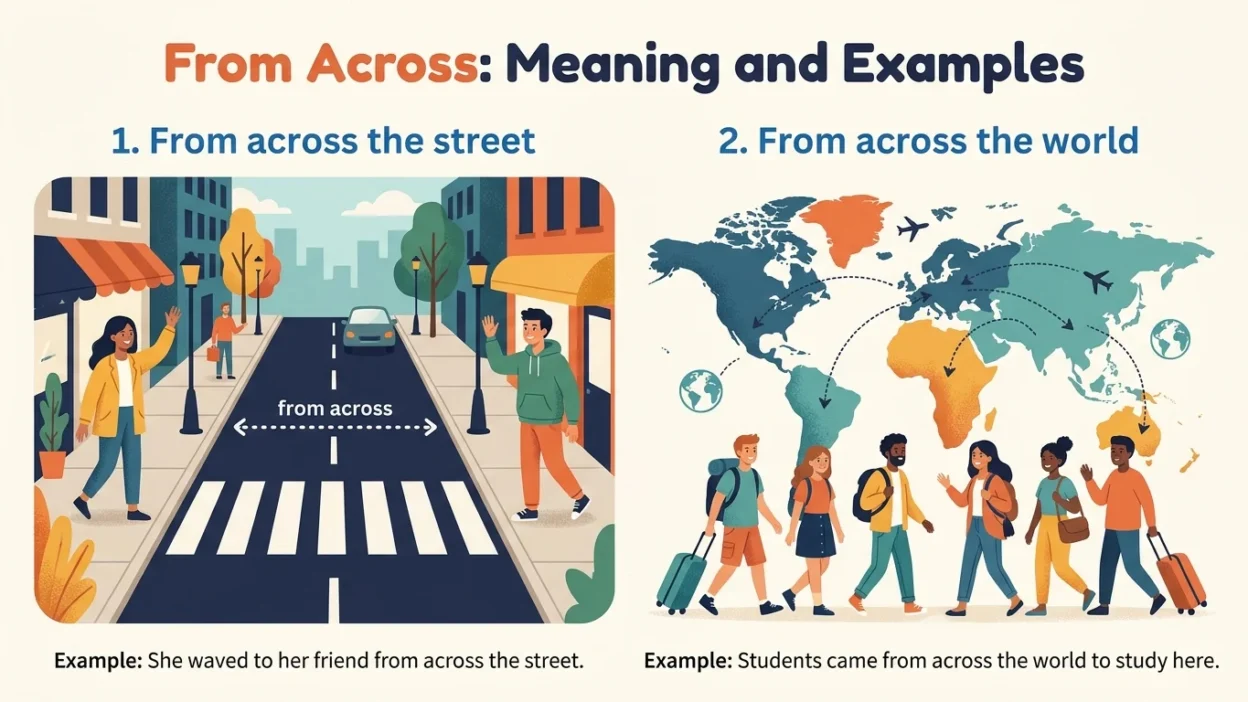
Have you ever heard someone say, “I saw her from across the street” or “People came from across the country”? The phrase from across is commonly used in English to describe the direction or place from which someone or something comes. It can refer to a position on the opposite side of a place, such as a road, room, or river, or indicate movement or origin from different parts of a larger area.
Although the phrase may look simple, its meaning depends on the words that follow it. You might encounter it in everyday conversations, stories, news reports, and formal writing. Understanding how to use from across correctly can help you describe locations, movement, and distance more naturally. This guide explains its meaning, grammatical structure, common uses, and differences from similar expressions.
Quick Answer
From across means originating or coming from the other side of something or from different parts of a particular area. It commonly describes a person or object seen or heard from the opposite side of a place. For example, “She waved at me from across the street.”
What Does From Across Mean?
From across is a phrase made up of the preposition from and the preposition across.
It generally indicates the starting point or source of something located on the other side of a place or spread throughout an area.
For example:
- He called to me from across the street.
- We received visitors from across the country.
- She could hear music from across the river.
- People from across the world attended the event.
In the first three examples, from across identifies a position on the other side of a physical location. In the final example, it refers to people originating from different parts of the world.
How Is From Across Used in a Sentence?
The phrase usually appears before a noun or noun phrase that identifies a location or area.
Common structures include:
From across + a physical place
Examples:
- From across the road
- From across the room
- From across the river
- From across the street
- From across the field
From across + a larger geographical area
Examples:
- From across the country
- From across the world
- From across Europe
- From across the city
- From across the continent
The phrase often follows verbs such as come, hear, see, call, wave, travel, and arrive.
15 Examples of From Across in Sentences
Here are practical examples showing how to use the phrase naturally.
- I saw my friend from across the street.
- Someone called my name from across the room.
- We heard a loud noise from across the river.
- She waved at us from across the road.
- People from across the country attended the festival.
- The announcement attracted visitors from across the world.
- He recognized her from across the crowded hall.
- A dog started barking from across the garden.
- We could see the mountains from across the lake.
- Students from across the city participated in the competition.
- Music was coming from across the street.
- The company received applications from across the region.
- I noticed someone watching me from across the restaurant.
- Representatives from across Europe attended the conference.
- Their products are popular with customers from across the globe.
From Across vs Across vs From
These expressions are related, but they serve different grammatical purposes.
| Expression | Meaning | Example |
|---|---|---|
| From across | Indicates a source or starting point on the other side or throughout an area | She waved from across the street. |
| Across | Indicates movement from one side to another or a position on the opposite side | She walked across the street. |
| From | Indicates origin, source, or starting point | She came from Lahore. |
From across combines the ideas of origin and position. It tells readers where someone or something is coming from.
From Across the Street: What Does It Mean?
From across the street means from the opposite side of the street.
It is commonly used when describing someone or something seen, heard, or noticed from the other side of a road.
Examples:
- I saw a familiar face from across the street.
- The children were playing from across the street.
- Someone shouted my name from across the street.
The phrase does not necessarily mean that someone is moving across the street. It identifies the side from which the person or sound originates.
From Across the World: What Does It Mean?
From across the world means originating from many different countries or regions around the world.
It is commonly used when discussing international visitors, customers, participants, opinions, or cultural influences.
Examples:
- Tourists from across the world visit the historic city.
- The conference attracted experts from across the world.
- We received messages from across the world.
In this context, the phrase does not refer to one particular opposite side. Instead, it emphasizes a wide geographical range.
Is From Across Grammatically Correct?
Yes. From across is grammatically correct when it clearly identifies the source or location of someone or something.
Correct examples:
- She called me from across the room.
- Visitors came from across the country.
- I heard the announcement from across the hall.
However, the phrase should not be used when you simply mean movement from one side to another.
For example:
Incorrect: He walked from across the road to reach the shop.
More natural: He walked across the road to reach the shop.
The correct choice depends on whether you are describing an origin or movement.
From Across vs. On the Other Side Of
Both expressions can describe a location opposite something, but their grammatical structures differ.
| Expression | Meaning | Example |
|---|---|---|
| From across | Indicates where something comes from | I heard her voice from across the room. |
| On the other side of | Identifies a position opposite something | She is on the other side of the room. |
Use from across when describing the source of an action, sound, or person. Use on the other side of when simply identifying a location.
Common Expressions With From Across
Here are some common combinations you may encounter:
- From across the street: From the opposite side of the street.
- From across the room: From the opposite side of a room.
- From across the river: From the other side of a river.
- From across the country: From different parts of a country.
- From across the world: From different countries around the world.
- From across the city: From different parts of a city.
- From across the border: From the other side of a national or regional border.
- From across the table: From the opposite side of a table.
Common Mistakes When Using From Across
1. Confusing From Across With Across
From across indicates a source or starting point, while across can describe movement from one side to another.
Correct: She waved at me from across the street.
Correct: She walked across the street.
2. Using It Without a Clear Reference Point
The word across usually needs a place or area to complete its meaning.
Unclear: He shouted from across.
Clear: He shouted from across the street.
3. Assuming It Always Refers to a Physical Location
From across can also refer to a wide geographical area.
Example: We received applications from across the country.
4. Confusing From Across With Across From
These expressions are different in common American English usage.
- From across the street means originating from the opposite side of the street.
- Across from the bank means located opposite the bank.
Example: The restaurant is across from the bank.
5. Using It When Movement Is Intended
If you want to describe someone moving from one side to another, across is usually the better choice.
Correct: The children ran across the field.
Less natural: The children ran from across the field.
Memory Trick
Remember this simple distinction:
From across = Source or starting point.
Across = Movement or position from one side to another.
For example:
- I heard him from across the room. This identifies where the sound came from.
- He walked across the room. This describes movement.
American vs. British English
From across is commonly used in both American and British English.
There is no significant difference in its basic meaning or grammatical structure between the two varieties.
Examples in both varieties include:
- She waved from across the street.
- Visitors came from across the country.
- We heard music from across the river.
The phrase is natural in everyday speech and writing in both varieties.
Related Words and Expressions
Here are some useful expressions related to from across:
- Across: From one side to another or on the opposite side.
- From: Indicating origin, source, or starting point.
- Across from: Opposite a particular place or object.
- On the other side of: Located opposite something.
- Over: Above something or from one side to another, depending on context.
- Throughout: In every part of a particular area.
- Around the world: In different parts of the world.
- Far side: The side that is farther away.
- Opposite: Situated facing or across from something.
- Beyond: At or to the farther side of something.
Frequently Asked Questions
1. What does from across mean?
From across indicates that someone or something comes from the other side of a place or from different parts of a larger area.
2. Is from across grammatically correct?
Yes. It is grammatically correct when used to identify the source or starting point of something, as in “She called me from across the street.”
3. What does from across the street mean?
It means from the opposite side of the street. For example, “I saw him from across the street” means that I saw him while he was on the other side of the street.
4. What does from across the world mean?
It means originating from different countries or regions around the world. For example, “Visitors came from across the world.”
5. What is the difference between from across and across?
From across identifies a source or starting point, while across commonly describes movement from one side to another or a position on the opposite side.
6. What is the difference between from across and across from?
From across indicates where someone or something comes from. Across from describes a position opposite something.
Example: I heard her voice from across the room. The office is across from the bank.
7. Can I use from across for countries and cities?
Yes. You can say “from across the country,” “from across the city,” and “from across Europe” to describe people or things originating from different parts of those areas.
8. Is from across used in both American and British English?
Yes. The expression is natural and widely understood in both American and British English.
Remember This
- From across indicates a source or starting point.
- It can refer to the opposite side of a physical place.
- It can also describe origins from different parts of a larger geographical area.
- Across can describe movement from one side to another.
- Across from means opposite a particular place.
- From across is grammatically correct in both American and British English.
Conclusion
From across is a useful English phrase that identifies where someone or something originates or where an action, sound, or movement comes from. It can refer to a physical location, such as the other side of a street or room, or a wider geographical area, such as a country, continent, or the world.
The key is to understand the difference between origin and movement. Use from across when identifying a source or starting point, and use across when describing movement from one side to another. With this distinction in mind, you can use the phrase naturally and confidently in everyday English.

Adam Aaron is a language enthusiast and content writer at SimileHive, creating clear, engaging guides on similes, idioms, metaphors, and figurative language to help readers improve English confidently every day.