Have you ever wondered what makes a group of words a phrase rather than a sentence? In English grammar, a phrase is a group of related words that work together as a unit but do not usually express a complete thought on their own. Phrases are essential parts of English because they add information, describe people and things, show actions, and make sentences more meaningful.
You use phrases every day, often without realizing it. Expressions such as in the morning, a beautiful garden, under the table, and has been working are all examples of phrases. Learning how phrases work can help you understand sentence structure, improve your writing, and communicate more effectively. This guide explains what a phrase is, explores its main types, provides practical examples, and clarifies the difference between phrases, clauses, and sentences.
Quick Answer
A phrase is a group of two or more related words that function together as a grammatical unit but do not usually contain a complete subject and predicate expressing a complete thought. Examples include a beautiful house, in the garden, and very quickly. Phrases add meaning and detail to sentences.
What Is a Phrase?
A phrase is a group of words that work together to perform a particular grammatical function in a sentence.
Unlike a complete sentence, a phrase does not normally express a complete thought. It may describe a noun, modify a verb, show a relationship between things, or function as a noun or adjective.
Consider these examples:
- A beautiful garden
- Under the bed
- Very slowly
- To learn English
- Has been sleeping
Each group of words is a phrase because its words work together as a unit. However, none of these examples expresses a complete thought independently.
Now consider this sentence:
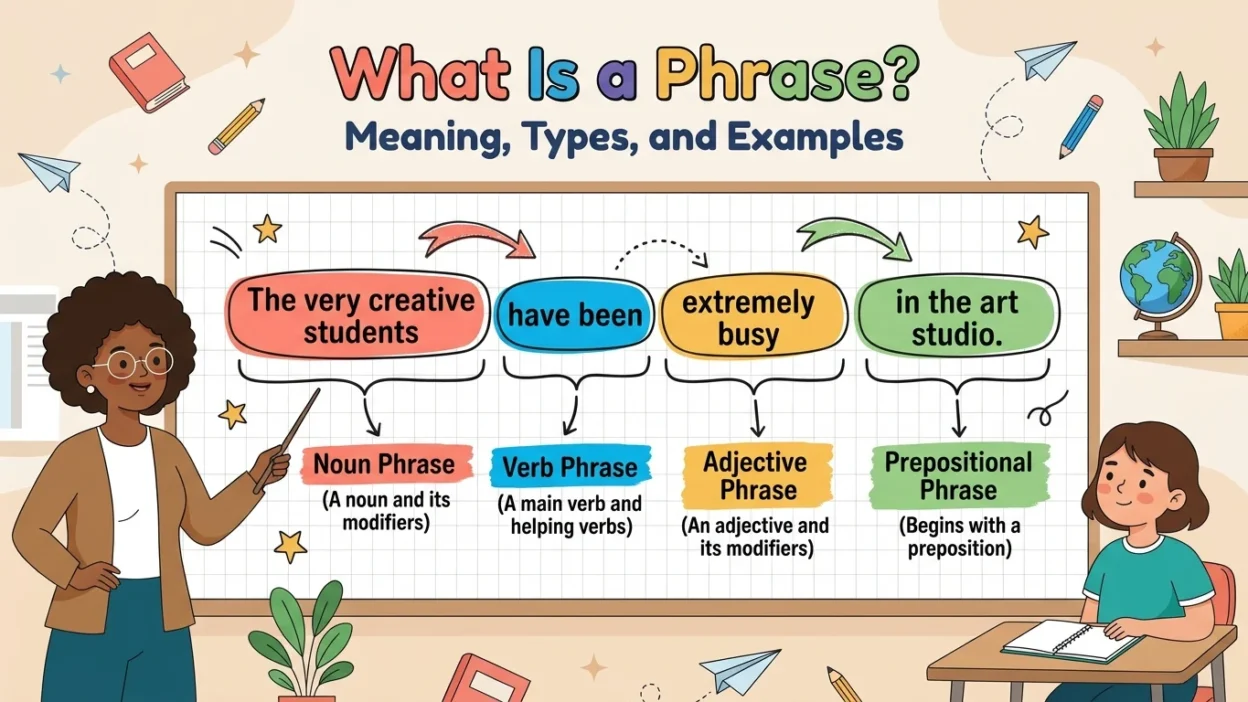
The children are playing in the garden.
In this sentence:
- The children is a noun phrase.
- Are playing is a verb phrase.
- In the garden is a prepositional phrase.
All three phrases work together to communicate a complete idea.
What Are the Main Types of Phrases?
English grammar contains several types of phrases. Each type performs a different function in a sentence.
The five commonly taught types are noun phrases, verb phrases, adjective phrases, adverb phrases, and prepositional phrases. Infinitive, gerund, and participial phrases are also important structures.
1. Noun Phrase
A noun phrase is a group of words that functions as a noun in a sentence. It usually has a noun or pronoun as its main word.
A noun phrase can identify a person, place, thing, or idea.
Examples:
- A beautiful flower
- The tall building
- My younger brother
- Several interesting books
- The girl with long hair
Examples in sentences:
- The little boy is playing outside.
- My best friend lives in London.
- A beautiful garden surrounds the house.
- The old wooden chair needs repair.
- Several students attended the meeting.
In these sentences, the bolded groups function as nouns.
2. Verb Phrase
A verb phrase consists of a main verb and any helping verbs that accompany it. It expresses an action, occurrence, or state.
Examples:
- Is sleeping
- Have finished
- Will be arriving
- Has been working
- Should have studied
Examples in sentences:
- She is reading a novel.
- They have completed the assignment.
- He will be arriving tomorrow.
- We should have prepared earlier.
- The children were playing outside.
The verb phrases help explain what the subjects are doing or what is happening.
3. Adjective Phrase
An adjective phrase is a group of words that describes or modifies a noun or pronoun.
It provides additional information about a person’s or thing’s qualities, appearance, condition, or characteristics.
Examples:
- Very beautiful
- Extremely intelligent
- Full of energy
- Afraid of spiders
- Ready for the examination
Examples in sentences:
- The girl is very intelligent.
- We visited a house full of beautiful paintings.
- He is afraid of dogs.
- The students are ready for the examination.
- She wore a dress extremely suitable for the occasion.
Adjective phrases make descriptions more specific and meaningful.
4. Adverb Phrase
An adverb phrase is a group of words that functions as an adverb. It can modify a verb, an adjective, or another adverb.
It often tells us how, when, where, or to what extent something happens.
Examples:
- Very quickly
- Quite slowly
- With great care
- In a hurry
- More carefully than before
Examples in sentences:
- She completed the task very quickly.
- He drove with great care.
- The children ran quite slowly.
- They left in a hurry.
- She spoke more confidently than before.
Adverb phrases provide additional information about actions and descriptions.
5. Prepositional Phrase
A prepositional phrase begins with a preposition and usually includes its object, along with any words describing that object.
Common prepositions include in, on, at, under, beside, behind, and between.
Examples:
- In the room
- Under the table
- Near the school
- Behind the house
- On the wooden shelf
Examples in sentences:
- The keys are on the table.
- The cat is sleeping under the bed.
- We met near the school.
- The children are playing in the garden.
- She placed the books on the wooden shelf.
Prepositional phrases can describe nouns or provide information about actions.
6. Infinitive Phrase
An infinitive phrase begins with an infinitive, which consists of to followed by the base form of a verb. It may include other words that complete its meaning.
Examples:
- To learn English
- To finish the assignment
- To help other people
- To become a doctor
- To improve your writing skills
Examples in sentences:
- She wants to learn English.
- He studies hard to become a doctor.
- To finish the assignment on time is important.
- They decided to visit the museum.
- I need to improve my writing skills.
An infinitive phrase can function as a noun, adjective, or adverb.
7. Gerund Phrase
A gerund phrase begins with a verb ending in ing that functions as a noun. It may include an object or other modifiers.
Examples:
- Reading interesting books
- Playing football with friends
- Learning a new language
- Swimming in cold water
- Writing short stories
Examples in sentences:
- Reading interesting books improves vocabulary.
- Playing football with friends is enjoyable.
- She enjoys learning a new language.
- Swimming in cold water can be challenging.
- Writing short stories is his favorite hobby.
Although gerunds look like present participles, they perform a different grammatical function.
8. Participial Phrase
A participial phrase begins with a present or past participle and functions as an adjective. It describes a noun or pronoun.
Examples:
- Walking along the road
- Covered in dust
- Sitting near the window
- Exhausted after the journey
- Smiling at the children
Examples in sentences:
- Walking along the road, the man noticed a wallet.
- The books covered in dust were old.
- The girl sitting near the window is my sister.
- Exhausted after the journey, we went straight to bed.
- Smiling at the children, the teacher entered the classroom.
A participial phrase adds descriptive information to a sentence.
Phrase vs. Clause vs. Sentence
A phrase, a clause, and a sentence are different grammatical units. Understanding their differences is important for building correct sentences.
| Grammatical unit | Meaning | Example |
|---|---|---|
| Phrase | A group of related words that functions as a unit | In the garden |
| Clause | A group of words containing a subject and a verb | When the sun sets |
| Sentence | A group of words expressing a complete thought | The sun sets in the evening. |
Phrase Example
Under the old bridge
This is a phrase because it does not contain a complete subject and predicate.
Clause Example
When the children arrived
This is a dependent clause. It contains a subject and a verb, but it does not express a complete thought by itself.
Sentence Example
The children played under the old bridge.
This is a complete sentence because it expresses a complete idea.
What Is the Difference Between a Phrase and a Clause?
The main difference is that a clause contains a subject and a verb, while a phrase does not usually contain both as a complete subject and predicate.
Compare these examples:
| Phrase | Clause |
|---|---|
| After the meeting | After the meeting ended |
| In the classroom | When the teacher entered |
| A beautiful flower | The flower looks beautiful |
| Walking down the street | She was walking down the street |
A clause may be independent or dependent. An independent clause can express a complete thought, while a dependent clause cannot stand alone as a complete sentence.
Can a Phrase Be One Word?
In traditional school grammar, a phrase is generally taught as a group of two or more related words. However, modern grammatical analysis sometimes recognizes a single word as a phrase because it can function as a complete grammatical unit.
For example, a single noun such as students can be analyzed as a noun phrase with the noun as its only word.
For beginner grammar lessons, it is useful to remember that phrases are usually introduced as groups of related words.
How to Identify a Phrase in a Sentence
You can identify a phrase by looking at how a group of words works together.
Follow these simple steps:
- Find a group of related words in the sentence.
- Identify the main word or grammatical element.
- Determine what function the group performs.
- Check whether it expresses a complete thought.
- Decide whether it is a noun, verb, adjective, adverb, or prepositional phrase.
Example:
The young girl with curly hair is singing beautifully.
This sentence contains several phrases:
- The young girl with curly hair: Noun phrase
- With curly hair: Prepositional phrase
- Is singing: Verb phrase
- Beautifully: A single adverb
Recognizing these structures helps you understand how different parts of a sentence work together.
15 Examples of Phrases in Sentences
Here are additional examples to help you recognize phrases in everyday English.
- The man in the black jacket is my uncle.
- She speaks with great confidence.
- The little girl is playing with her toys.
- We arrived at the railway station early.
- He wants to become a successful writer.
- Reading books every day improves your knowledge.
- The house near the river belongs to my friend.
- They have been waiting for an hour.
- The boy wearing a blue shirt is my cousin.
- She completed the examination very carefully.
- The flowers in the garden look beautiful.
- He is interested in learning foreign languages.
- Walking through the park, we saw several birds.
- The students ready for the competition gathered outside.
- My father has been working all day.
Common Mistakes When Using Phrases
1. Confusing a Phrase With a Sentence
A phrase does not usually express a complete thought on its own.
Incomplete: In the classroom.
Complete: The students are sitting in the classroom.
2. Confusing a Phrase With a Clause
A clause contains a subject and a verb, whereas a phrase does not normally contain a complete subject and predicate.
Phrase: Under the table.
Clause: The cat is under the table.
3. Assuming Every Group of Words Is a Complete Sentence
A group of words may have meaning without expressing a complete thought.
Example: Because she was tired.
This is a dependent clause, not a complete sentence.
4. Thinking a Phrase Cannot Contain a Verb
Some phrases contain verbs. For example, has been working is a verb phrase, and to learn English is an infinitive phrase.
5. Confusing Gerund Phrases With Participial Phrases
A gerund phrase functions as a noun, while a participial phrase functions as an adjective.
Gerund phrase: Reading books improves knowledge.
Participial phrase: Reading a book, the girl sat near the window.
The first phrase acts as the subject. The second describes the girl.
Memory Trick
Remember this simple rule:
Phrase = Related words working together.
A phrase performs a grammatical job but does not usually express a complete thought.
You can remember the difference this way:
- Phrase: A group of words working together.
- Clause: A group of words containing a subject and a verb.
- Sentence: A complete expression of a thought.
For example:
- In the garden: Phrase
- When the children play: Dependent clause
- The children play in the garden: Sentence
American vs. British English
The word phrase has the same spelling, pronunciation, and grammatical meaning in American and British English.
There is no significant difference between the two varieties in how phrases are defined or classified. Both use the same basic grammatical categories, including noun phrases, verb phrases, adjective phrases, adverb phrases, and prepositional phrases.
Some grammatical terminology may vary slightly between textbooks and teaching traditions, but the fundamental concept remains the same.
Related Grammar Terms
Here are some useful grammar terms related to phrases:
- Noun: A word that names a person, place, thing, or idea.
- Verb: A word that expresses an action, occurrence, or state.
- Adjective: A word that describes a noun or pronoun.
- Adverb: A word that modifies a verb, adjective, or another adverb.
- Preposition: A word that shows a relationship between a noun or pronoun and another part of a sentence.
- Clause: A group of words containing a subject and a verb.
- Sentence: A grammatical unit that expresses a complete thought.
- Subject: The person or thing that a sentence or clause is about.
- Predicate: The part of a clause that says something about the subject.
- Modifier: A word or group of words that provides additional information about another element.
Frequently Asked Questions
1. What is a phrase in simple words?
A phrase is a group of related words that work together to perform a grammatical function. It does not usually express a complete thought by itself. For example, a beautiful house and under the table are phrases.
2. What are five examples of phrases?
Five examples are in the garden, a beautiful flower, very quickly, to learn English, and has been working. Each group of words functions as a grammatical unit.
3. What are the five main types of phrases?
The five commonly taught types are noun phrases, verb phrases, adjective phrases, adverb phrases, and prepositional phrases. Other important types include infinitive, gerund, and participial phrases.
4. What is the difference between a phrase and a clause?
A phrase is a group of related words that does not normally contain a complete subject and predicate. A clause contains a subject and a verb. For example, in the room is a phrase, while when she entered the room is a dependent clause.
5. Can a phrase be a complete sentence?
A phrase is not normally a complete sentence because it does not express a complete thought. However, a phrase can sometimes be used as a conversational response or an intentional sentence fragment.
6. Can a phrase contain a verb?
Yes. A verb phrase contains a main verb and may include helping verbs. Examples include is sleeping, has finished, and will be arriving.
7. How many words are in a phrase?
There is no fixed number of words in a phrase. Some phrases contain two words, while others contain several words. For example, very quickly is a short phrase, while the beautiful house near the river is a longer one.
8. Is a phrase the same as an idiom?
No. A phrase is a grammatical group of words, while an idiom is an expression whose meaning cannot always be understood from the individual words. For example, in the garden is a phrase, while spill the beans is an idiom. An idiom can also function as a phrase.
Remember This
- A phrase is a group of related words that functions as a grammatical unit.
- It does not usually express a complete thought on its own.
- A phrase can function as a noun, verb, adjective, or adverb.
- Common types include noun, verb, adjective, adverb, and prepositional phrases.
- Infinitive, gerund, and participial phrases are also important.
- A clause contains a subject and a verb.
- A sentence expresses a complete thought.
Conclusion
A phrase is an important part of English grammar because it allows words to work together and perform specific grammatical functions. Phrases can name people and things, describe nouns, modify actions, and provide additional information about time, place, manner, and purpose. Understanding their different types makes it easier to recognize sentence structures and write more clearly.
Remember that a phrase is not usually a complete sentence. It is a grammatical unit that contributes meaning to a larger structure. Once you understand the difference between phrases, clauses, and sentences, you will find it easier to analyze English grammar, construct correct sentences, and improve your communication skills.

Adam Aaron is a language enthusiast and content writer at SimileHive, creating clear, engaging guides on similes, idioms, metaphors, and figurative language to help readers improve English confidently every day.