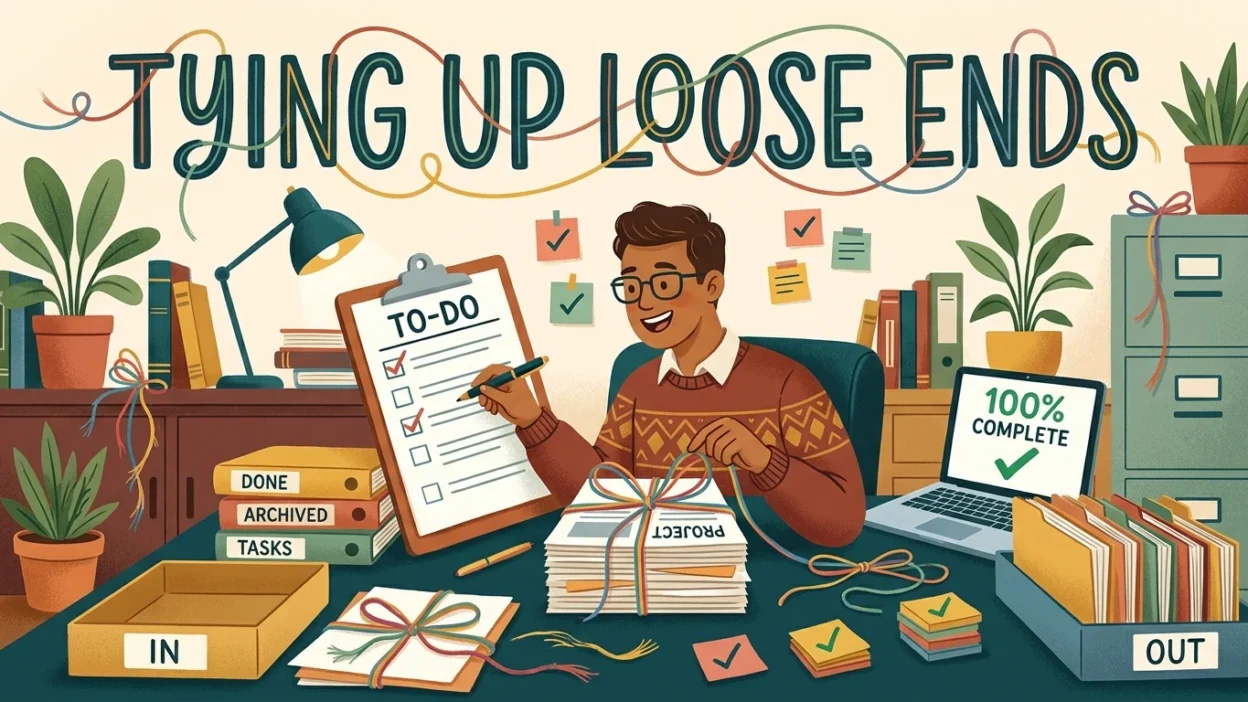
Have you ever finished an important project but still had a few small tasks to complete? Perhaps you needed to confirm an appointment, send a final email, organize some documents, or resolve an unfinished issue. In English, the expression tying up loose ends describes exactly this kind of situation. It refers to completing unfinished tasks, resolving outstanding matters, or dealing with small details before considering something fully finished.
This expression is commonly used in everyday conversations, workplaces, business communication, and writing. It can describe the final steps of a project, the resolution of personal matters, or the completion of arrangements before an important event. Understanding its meaning and correct usage will help you communicate more naturally and express the idea of bringing something to a satisfactory conclusion.
Quick Answer
Tying up loose ends means completing unfinished tasks, resolving outstanding issues, or taking care of remaining details before something is considered finished. It is commonly used when someone is preparing to complete a project, finalize arrangements, or settle matters that have not yet been resolved.
What Does Tying Up Loose Ends Mean?
Tying up loose ends is an idiomatic expression that means dealing with unfinished business or remaining details.
A loose end is something that has not been completed, settled, or properly addressed. When you tie up loose ends, you take the necessary steps to make sure nothing important remains unfinished.
For example:
- I am tying up loose ends before leaving the office.
- We need to tie up a few loose ends before launching the website.
- She spent the afternoon tying up loose ends after the meeting.
In these examples, the expression refers to completing the remaining tasks or resolving outstanding matters.
What Does Tie Up Loose Ends Mean in Different Contexts?
The expression can be used in several situations.
1. At Work
In a professional environment, tying up loose ends usually means completing the final tasks of a project or assignment.
Examples:
- The team is tying up loose ends before submitting the report.
- I need to tie up a few loose ends before taking my vacation.
- We should tie up all loose ends before the client meeting.
2. In Personal Life
The expression can also refer to resolving personal matters or completing arrangements.
Examples:
- She is tying up loose ends before moving to another city.
- I need to tie up some loose ends before getting married.
- He returned home to tie up a few loose ends.
3. In Business
In business, tying up loose ends often means finalizing agreements, checking documents, or resolving outstanding issues.
Examples:
- The company is tying up loose ends before signing the contract.
- We have a few financial matters to settle before closing the deal.
- The management team is tying up loose ends before the announcement.
4. In Stories and Discussions
The expression can describe resolving unanswered questions or unfinished parts of a story.
Examples:
- The final chapter ties up all the loose ends.
- The author left several loose ends unresolved.
- The sequel explains what happened to the remaining characters.
Tying Up Loose Ends vs. Tie Up Loose Ends
Both expressions are correct, but they are used in different grammatical situations.
| Expression | Grammatical use | Example |
|---|---|---|
| Tie up loose ends | Base form of the verb | We need to tie up loose ends. |
| Tying up loose ends | Present participle or gerund | I am tying up loose ends. |
| Tied up loose ends | Past tense or past participle | She tied up loose ends yesterday. |
| Ties up loose ends | Present tense with a singular subject | He ties up loose ends before every project. |
The phrase changes according to the tense and structure of the sentence, but its basic meaning remains the same.
15 Examples of Tying Up Loose Ends in Sentences
Here are practical examples showing how to use this expression naturally.
- I am tying up loose ends before heading home.
- We need to tie up a few loose ends before the event begins.
- She spent the morning tying up loose ends at work.
- The manager is tying up loose ends before approving the project.
- They returned to the office to tie up some loose ends.
- I have several loose ends to deal with before my vacation.
- The team tied up all the loose ends before submitting the proposal.
- He is busy tying up loose ends before starting his new job.
- We should tie up these loose ends as soon as possible.
- The final episode ties up most of the loose ends in the series.
- She called the clients to tie up a few remaining loose ends.
- The company is tying up loose ends before completing the merger.
- I cannot leave until I have tied up all the loose ends.
- They spent the weekend tying up loose ends before moving house.
- The investigation helped tie up several loose ends.
Is Tying Up Loose Ends Positive or Negative?
Tying up loose ends is generally neutral or positive.
It usually suggests that someone is being responsible by completing unfinished work and resolving outstanding matters.
For example:
- Positive: She is tying up loose ends before beginning her new position.
- Neutral: I have a few loose ends to deal with this afternoon.
However, the expression can sometimes imply that something has been left incomplete or that additional work is still required.
Tying Up Loose Ends vs. Wrapping Up
Both expressions can refer to finishing something, but there is a slight difference.
| Expression | Meaning | Example |
|---|---|---|
| Tying up loose ends | Completing remaining details or resolving unfinished matters | I need to tie up a few loose ends. |
| Wrapping up | Bringing an activity, meeting, or project to an end | We are wrapping up the meeting. |
| Finishing up | Completing the final part of a task | I am finishing up my assignment. |
| Settling matters | Resolving outstanding issues | They are settling their financial matters. |
| Putting things in order | Organizing things properly | She is putting everything in order. |
You can use these expressions in similar situations, but they do not always communicate exactly the same idea.
Common Mistakes When Using Tying Up Loose Ends
1. Thinking It Only Refers to Physical Objects
The expression is usually figurative. It does not mean tying actual pieces of string or rope.
Incorrect understanding: Someone is literally tying pieces of rope.
Correct understanding: Someone is completing unfinished tasks or resolving outstanding issues.
2. Using It Only for Professional Situations
Although common at work, the expression is also appropriate for personal matters, family arrangements, travel plans, and other situations.
3. Confusing It With Finishing Everything
Tying up loose ends usually refers to the remaining details or unfinished matters, not necessarily completing every part of a larger activity.
4. Forgetting the Plural Form
The established expression is usually loose ends, not loose end, when referring to unfinished matters generally.
Correct: I need to tie up a few loose ends.
Less natural: I need to tie up a few loose end.
5. Confusing Loose With Lose
Loose means not tight or not firmly fixed. Lose means to misplace something or fail to keep it.
The correct expression is tying up loose ends, not tying up lose ends.
Is Tying Up Loose Ends Formal or Informal?
Tying up loose ends is a common idiom that works in both informal and professional communication.
You can use it in:
- Everyday conversations
- Workplace discussions
- Business emails
- Project updates
- Professional meetings
- Articles and reports
For example:
Professional: We are tying up the remaining loose ends before submitting the final report.
Informal: I just need to tie up a few loose ends before I go.
The expression sounds natural in both situations.
American vs. British English
Tying up loose ends is widely understood and used in both American and British English.
There is no significant difference in its spelling or meaning between the two varieties. Both use the expression to describe completing unfinished tasks or resolving outstanding matters.
Related Words and Expressions
Here are some expressions with similar meanings:
- Wrap things up: To bring an activity or project to an end.
- Finish up: To complete the remaining part of something.
- Clear things up: To resolve confusion or misunderstandings.
- Settle outstanding matters: To resolve issues that remain unfinished.
- Put things in order: To organize or arrange matters properly.
- Complete the final details: To finish the remaining parts of a task.
- Close the loop: To complete a process by providing a final update or response.
- Take care of unfinished business: To deal with matters that still need attention.
Frequently Asked Questions
1. What does tying up loose ends mean in simple English?
It means finishing unfinished tasks, resolving outstanding problems, or taking care of remaining details before considering something complete.
2. Is tying up loose ends an idiom?
Yes. It is an idiomatic expression because its usual meaning is figurative. It refers to completing unfinished matters rather than physically tying loose objects.
3. What is another way to say tying up loose ends?
You can say finishing up, wrapping things up, completing the final details, settling outstanding matters, or taking care of unfinished business.
4. Is it correct to say tying up loose ends?
Yes. Tying up loose ends is grammatically correct and commonly used. It is the present participle form of the expression tie up loose ends.
5. Can tying up loose ends be used in a professional email?
Yes. It is suitable for professional emails when discussing remaining tasks, final arrangements, or outstanding issues.
Example: We are tying up a few loose ends and will send the completed document shortly.
6. What does it mean to tie up loose ends before leaving a job?
It means completing unfinished responsibilities, handing over important information, organizing documents, and resolving outstanding work before departing.
7. What is the difference between loose ends and unfinished business?
Loose ends usually refer to smaller remaining details or unresolved matters. Unfinished business can refer to broader tasks, responsibilities, or issues that still need attention.
Remember This
- Tying up loose ends means completing unfinished tasks or resolving outstanding matters.
- It is an idiomatic expression.
- It can be used in personal and professional situations.
- It is generally neutral or positive in tone.
- It is common in both American and British English.
- The correct expression uses loose, not lose.
Conclusion
Tying up loose ends is a useful English expression that describes the final steps needed to complete something properly. It can refer to finishing workplace responsibilities, resolving personal matters, finalizing business arrangements, or answering unanswered questions in a story. The phrase emphasizes dealing with the remaining details rather than simply stopping an activity.
When you have a few tasks left before completing a project, preparing for a trip, or moving on to something new, you can naturally say that you are tying up loose ends. Understanding this expression will help you communicate more clearly and use everyday English more confidently.

Adam Aaron is a language enthusiast and content writer at SimileHive, creating clear, engaging guides on similes, idioms, metaphors, and figurative language to help readers improve English confidently every day.