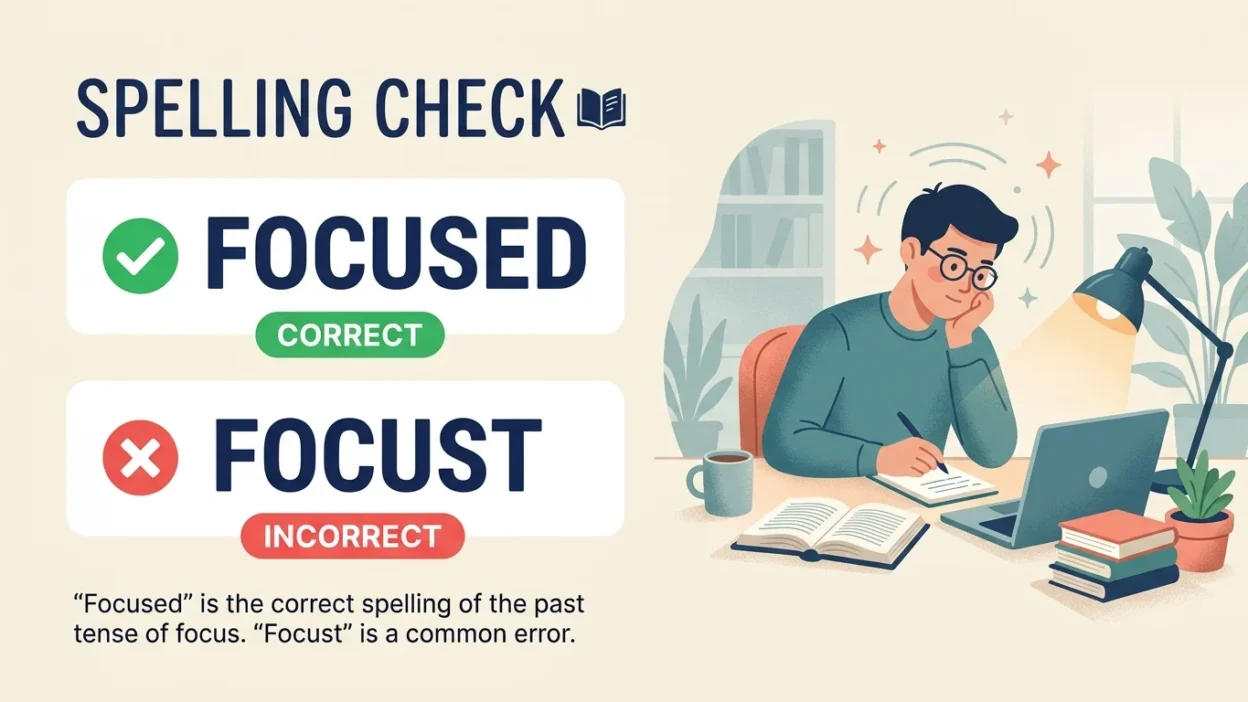
Is it focused or focust? The correct spelling is focused. The word focust is a misspelling and is not accepted as the standard past tense or past participle of the verb focus. Focused means giving attention to something, concentrating on a task, or directing attention toward a particular goal.
For example, you can say, “She focused on her studies” or “He remained focused during the meeting.” The word can also describe something adjusted to produce a clear image, such as a focused camera lens.
Confusion often arises because English spelling patterns can be unpredictable, especially when verbs ending in s or us form their past tense. Understanding the correct spelling and its grammatical uses will help you write more accurately in emails, essays, professional documents, and everyday communication.
Quick Answer: Is It Focused or Focust?
Focused is the correct spelling. It is the past tense and past participle of focus, and it can also function as an adjective. For example, “I focused on my work” and “She is a focused student” are correct. Focust is not a standard English spelling.
Why Do People Confuse Focused and Focust?
People may confuse these spellings because they are unsure how to form the past tense of focus. English has several spelling patterns, and the pronunciation of the ending can make the correct form less obvious.
However, the standard forms are straightforward:
- Base form: focus
- Third person singular: focuses
- Present participle: focusing
- Past tense: focused
- Past participle: focused
The word focust does not belong to this standard set of forms.
1. What Does Focused Mean?
Focused means concentrating attention or effort on something. It can also describe a person who is attentive and determined, or an image or beam that has been directed precisely.
Examples of focused in a sentence
- She focused on completing her assignment.
- He remained focused throughout the examination.
- The team focused its efforts on improving customer service.
- I focused on the speaker’s main points.
- The student was focused and prepared for the test.
- They focused their attention on the problem.
- The camera produced a sharply focused image.
- We stayed focused on our long term goals.
Common expressions with focused
Focused on: Giving attention to a particular subject, task, or goal.
Example: She focused on learning new vocabulary.
Stay focused: Continue paying attention without becoming distracted.
Example: Try to stay focused while studying.
Highly focused: Concentrating strongly on a task or objective.
Example: The researcher remained highly focused on the experiment.
Focused approach: A method that concentrates on a specific goal or problem.
Example: The company adopted a focused approach to customer support.
2. What Does Focust Mean?
Focust is not a standard English word. It should not be used as the past tense, past participle, or adjective derived from focus.
Incorrect: She focust on her homework.
Correct: She focused on her homework.
Incorrect: I have focust on improving my writing.
Correct: I have focused on improving my writing.
If you see focust in a message or document, it is most likely a spelling mistake or a typing error.
Focused vs. Focust: Comparison Table
| Feature | Focused | Focust |
|---|---|---|
| Correct spelling | Yes | No |
| Standard English word | Yes | No |
| Past tense of focus | Yes | No |
| Past participle of focus | Yes | No |
| Can be used as an adjective | Yes | No |
| Example | She focused on her goals. | Incorrect: She focust on her goals. |
3. When Should You Use Focused?
Use focused when describing past concentration, completed attention, or a state of being attentive.
As a past tense verb
The word describes an action that happened in the past.
Examples:
- I focused on the assignment yesterday.
- She focused on her career after graduation.
- They focused on finding a solution.
As a past participle
It can appear with helping verbs such as have, has, and had.
Examples:
- I have focused on improving my English.
- He has focused on his training.
- We had focused on the wrong issue.
As an adjective
It can describe a person, effort, or image.
Examples:
- She is a focused learner.
- The team needs a focused strategy.
- The photograph is sharply focused.
4. Focused vs. Focussed: Are Both Correct?
Although focust is incorrect, focused and focussed are both accepted spellings.
- Focused is the standard spelling in American English and is also widely used in British English.
- Focussed is an accepted alternative, especially in British, Australian, and some other varieties of English.
The same spelling variation appears in related forms:
| American English and widely used form | Alternative British spelling |
|---|---|
| Focused | Focussed |
| Focusing | Focussing |
For most writing, focused and focusing are safe choices. The important point is to remain consistent with the spelling convention you follow.
5. More Examples of Focused in Sentences
Here are 12 examples that show how focused is used in different contexts.
- I focused on my studies to improve my grades.
- The manager focused on solving the team’s problems.
- She stayed focused despite the noise.
- He focused his attention on the presentation.
- The photographer took a sharply focused picture.
- We focused on the most urgent tasks first.
- The discussion focused on environmental protection.
- They have focused on building stronger relationships.
- The teacher encouraged students to remain focused.
- The company focused its resources on product development.
- I had focused on the wrong details before reviewing the report.
- A focused plan can make a difficult project easier to manage.
6. Common Mistakes With Focused
Mistake 1: Writing focust instead of focused
Incorrect: He focust on his work.
Correct: He focused on his work.
Mistake 2: Confusing focused with focusing
Use focused for the past tense and past participle. Use focusing for an ongoing action or as a gerund.
Examples:
- Past: She focused on the task.
- Ongoing: She is focusing on the task.
Mistake 3: Confusing focused with focuses
Use focuses with a third person singular subject in the simple present tense.
Examples:
- He focuses on his studies.
- She focuses on her goals.
For a completed past action, use focused.
Mistake 4: Mixing spelling styles
Both focused and focussed are accepted, but avoid switching between them without a reason in the same document.
7. An Easy Memory Trick
Remember this simple rule:
Focus + ed = focused.
The past tense and past participle of focus use the ending ed in the standard spelling.
Think of these three forms:
- Today: I focus.
- Right now: I am focusing.
- Yesterday: I focused.
The ending in focused is spelled ed, not t.
8. American vs. British English
American English generally prefers focused and focusing. British English accepts both these forms and the alternatives focussed and focussing, although preferences vary among writers and publishers.
Examples:
- American English: She focused on her studies.
- British English: She focused on her studies.
- Alternative British spelling: She focussed on her studies.
In all cases, focust is not the standard spelling.
9. Similar Words to Know
| Word | Meaning | Example |
|---|---|---|
| Concentrated | Gave close attention or effort | He concentrated on the problem. |
| Attentive | Paying attention | The attentive student listened carefully. |
| Dedicated | Committed to a purpose | She is dedicated to her work. |
| Determined | Firmly committed to achieving something | He was determined to succeed. |
| Distracted | Unable to maintain attention | I became distracted by the noise. |
| Focusing | Giving attention to something now or over a period | She is focusing on her goals. |
These words have related meanings, but they are not always interchangeable. For example, a person can be dedicated to a goal but temporarily distracted while working toward it.
Frequently Asked Questions
Is focust a real word?
No. Focust is not a standard English spelling. The correct past tense and past participle of focus are focused.
Is focused or focussed correct?
Both are correct. Focused is the standard spelling in American English and is widely used in British English. Focussed is an accepted alternative, particularly in British and Australian usage.
What is the past tense of focus?
The past tense is focused. For example: “I focused on my homework last night.”
Is it focusing or focussing?
Both spellings are accepted. Focusing is standard in American English and widely used elsewhere, while focussing is common in some British and Australian writing.
How do you use focused in a sentence?
You can write, “She focused on her studies,” or “He remained focused during the meeting.” The word can describe a past action or a state of concentration.
Why is focused spelled with ed instead of t?
The standard past tense of focus is formed with the ending ed, giving focused. Although the final sound may be pronounced like a t in some speech patterns, the spelling remains ed.
Is focused an adjective or a verb?
It can be both. In “She focused on her work,” it is the past tense verb. In “She is a focused student,” it is an adjective describing the student.
Remember This
Focused is correct. Focust is incorrect.
Use focused as the past tense and past participle of focus, or as an adjective describing concentration. You may also encounter focussed, an accepted alternative spelling, particularly in British and Australian English.
Conclusion
The correct spelling is focused, not focust. It is used to describe concentration, attention, and the act of directing effort toward a particular goal. The word can function as a past tense verb, a past participle, or an adjective, depending on the sentence.
Remember that focussed is also accepted in some varieties of English, but focust is not standard. If you want a spelling that works well in American English and is widely understood internationally, choose focused.

Charles Kevin is a passionate language writer and researcher at SimileHive, creating clear, engaging content about similes, idioms, metaphors, and figurative language to help readers improve English communication confidently every day.