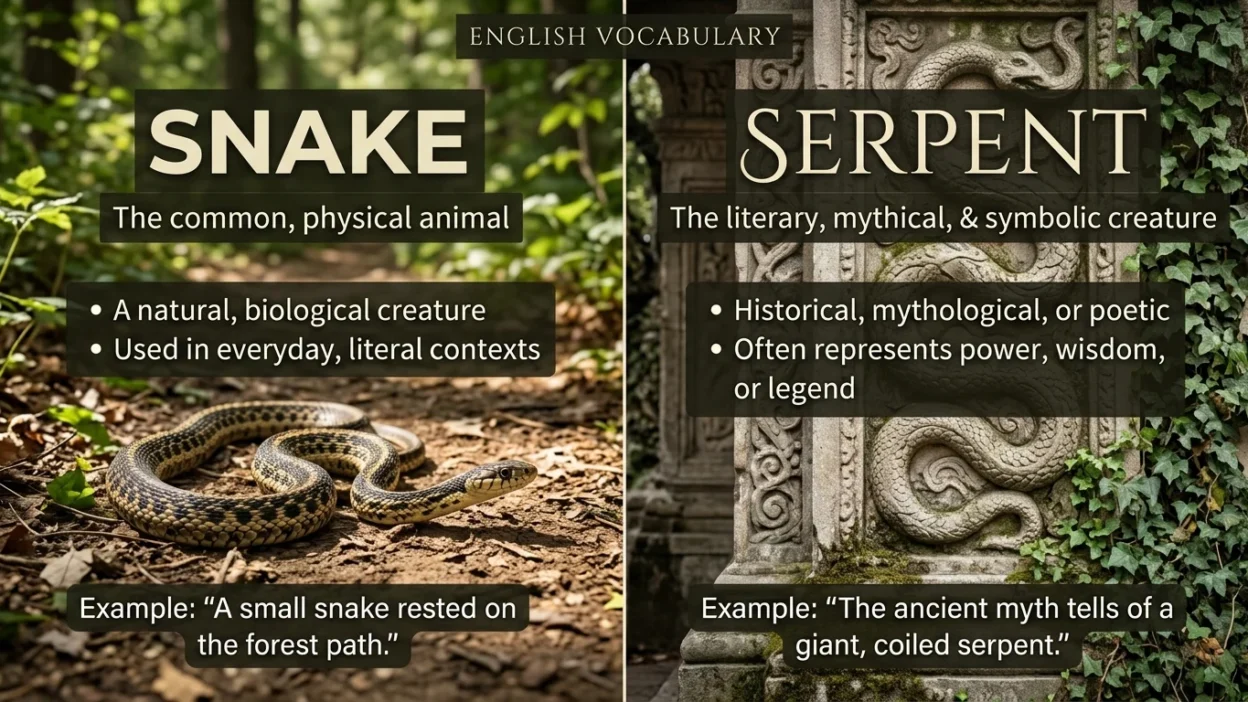
The words serpent and snake refer to the same general type of animal, but they differ in tone, usage, and associations. A snake is the common word for a long, legless reptile, while a serpent is a more formal, literary, or symbolic term for a snake. Both words can describe real animals, but serpent often appears in mythology, religious texts, poetry, and stories.
For example, a person might say, “A snake was hiding in the grass,” in everyday conversation. In a literary description, the same animal might be called “a serpent slithering through the forest.” The word serpent can also suggest danger, mystery, wisdom, or deception, depending on the context. Understanding these differences will help you choose the right word for ordinary conversation, creative writing, academic work, or discussions of myths and symbolism.
Quick Answer: What Is the Difference Between Serpent and Snake?
A snake is the ordinary English word for a long, legless reptile. A serpent is another word for a snake, often used in formal writing, literature, mythology, and religious contexts. The two words can refer to the same animal, but serpent usually sounds more dramatic, elevated, or symbolic than snake.
Why Do People Confuse Serpent and Snake?
People confuse these words because they refer to the same group of reptiles. In many situations, they can be used interchangeably without changing the basic meaning.
However, their tone is different.
Snake is the everyday term used in conversation, science, wildlife education, and general descriptions.
Serpent is more common in literary, historical, religious, and symbolic contexts. It may create a sense of mystery or danger, especially in stories and legends.
For example:
- The snake moved across the path.
- The serpent emerged from the shadows.
Both sentences can describe a snake, but the second sounds more dramatic.
1. What Does Snake Mean?
A snake is a legless reptile with an elongated body. Snakes belong to the suborder Serpentes and are found in many environments, including forests, grasslands, deserts, wetlands, and oceans.
The word snake is the standard term for these animals in everyday English and scientific communication.
Examples of snake in a sentence
- A snake was resting beneath a rock.
- We saw a small snake near the garden fence.
- Some snakes use venom to capture prey.
- The snake slithered into the bushes.
- A wildlife expert identified the snake as a harmless species.
- The farmer noticed a snake near the barn.
- Snakes shed their skin as they grow.
- The child learned how snakes move without legs.
Common expressions with snake
Snake bite: A wound caused by a snake biting someone or something.
Example: The hiker received treatment after a snake bite.
Snake charmer: A performer traditionally associated with handling or appearing to control snakes.
Example: The festival featured a performance by a snake charmer.
Snake in the grass: An expression describing a person who secretly acts dishonestly or betrays others.
Example: He trusted his colleague until he discovered that he was a snake in the grass.
2. What Does Serpent Mean?
A serpent is another word for a snake. It is often used in elevated, literary, poetic, religious, or mythological language.
The word can describe a real snake, but it frequently appears when writers want to create a particular atmosphere or emphasize symbolic meaning.
For example, a writer might describe a dangerous snake as a serpent to make a scene sound mysterious or dramatic.
Examples of serpent in a sentence
- A serpent lay coiled beneath the ancient tree.
- The legend described a golden serpent guarding a hidden treasure.
- The hero faced a giant serpent in the old tale.
- The serpent appeared as a symbol of transformation in the story.
- A stone serpent decorated the entrance to the temple.
- The poem described a serpent moving silently through the grass.
- In the myth, the serpent possessed supernatural powers.
- The artist carved a serpent into the wooden door.
Common expressions with serpent
Ancient serpent: A phrase often used in myths and stories to describe a mysterious or powerful snake.
Example: The ancient serpent guarded the entrance to the lost kingdom.
Serpent of wisdom: A symbolic expression that may represent knowledge, mystery, or spiritual insight in a particular story or tradition.
Example: The novel portrayed the serpent as a guardian of hidden wisdom.
Serpent symbolism: The use of a snake as a symbol in literature, religion, mythology, or art.
Example: The researcher studied serpent symbolism in ancient cultures.
These expressions depend on context and are not all fixed idioms in everyday English.
Serpent vs. Snake: Comparison Table
| Feature | Snake | Serpent |
|---|---|---|
| Basic meaning | A legless reptile | Another word for a snake |
| Common usage | Everyday speech and general writing | Literature, mythology, religion, and formal descriptions |
| Tone | Neutral and direct | Often elevated, dramatic, or symbolic |
| Scientific use | Standard common name | Less common as an everyday scientific term |
| Symbolic meaning | Depends on context | Often associated with mystery, danger, wisdom, or deception |
| Example | A snake crossed the road. | A serpent guarded the sacred temple. |
When Should You Use Serpent or Snake?
Use snake when you are talking about the animal in ordinary conversation, scientific explanations, news reports, or practical situations.
Examples:
- A snake was found in the garage.
- The snake belongs to a nonvenomous species.
- Scientists are studying how snakes detect their surroundings.
- Keep a safe distance from an unidentified snake.
Use serpent when you want a literary tone or are discussing mythology, symbolism, religious stories, or artistic representations.
Examples:
- The serpent tempted the hero in the ancient tale.
- The statue depicted a serpent wrapped around a pillar.
- The poet compared the river to a silver serpent.
- The legend told of a giant serpent beneath the mountain.
Remember that serpent is not necessarily a different biological kind of snake. The difference is mainly in language and context.
12 Examples of Serpent vs. Snake in Sentences
- Snake: A snake slipped beneath the garden shed.
- Serpent: A serpent guarded the entrance to the mythical palace.
- Snake: The scientist studied how the snake responded to temperature changes.
- Serpent: The poet described the creature as a dark serpent moving through the night.
- Snake: We spotted a snake near the hiking trail.
- Serpent: The ancient story featured a serpent with magical powers.
- Snake: Some snakes can detect vibrations through the ground.
- Serpent: A carved serpent decorated the walls of the temple.
- Snake: The zookeeper explained how the snake catches its prey.
- Serpent: The legend described a serpent rising from the sea.
- Snake: The snake curled up beneath a warm rock.
- Serpent: The author used the serpent as a symbol of temptation.
Common Mistakes With Serpent and Snake
Mistake 1: Assuming a serpent is a different species
Incorrect idea: A serpent is a different animal from a snake.
Correct understanding: Serpent is another word for a snake. The difference lies mainly in usage and tone.
Mistake 2: Using serpent in every everyday situation
Less natural: I saw a serpent in my backyard this morning.
More natural: I saw a snake in my backyard this morning.
The first sentence is grammatically correct, but snake is more common in ordinary conversation.
Mistake 3: Assuming serpent always means evil
A serpent may symbolize evil or deception in some stories, but it can also represent wisdom, healing, renewal, power, or transformation in other cultural contexts.
Mistake 4: Assuming snake always has a negative meaning
The word snake can refer neutrally to an animal. Although it can be used figuratively to describe a dishonest person, that meaning depends on the context.
Mistake 5: Confusing the words with venomous and nonvenomous
Serpent and snake do not indicate whether an animal is venomous. Both words can refer to venomous and nonvenomous snakes.
An Easy Memory Trick
Remember these simple associations:
Snake equals everyday language.
Use snake when discussing the animal in ordinary conversation or factual descriptions.
Serpent equals stories and symbolism.
Use serpent when writing poetry, describing a mythical creature, or discussing religious and literary imagery.
For example, you might see a snake in your garden, but encounter a serpent in a legend.
American vs. British English
American and British English use snake and serpent in broadly the same way.
In both varieties, snake is the usual everyday word for the animal, while serpent often appears in literary, historical, religious, and symbolic contexts.
Examples:
- American English: A snake was spotted near the trail.
- British English: A snake was spotted near the footpath.
- Literary usage in either variety: The serpent coiled around the ancient pillar.
There is no major spelling difference between the two words in American and British English.
Similar Words to Know
| Word | Meaning | Example |
|---|---|---|
| Reptile | A group of vertebrate animals that includes snakes, lizards, turtles, and crocodilians | A snake is a reptile. |
| Viper | A type of venomous snake | The viper rested among the rocks. |
| Cobra | A type of venomous snake known for its hood | The cobra raised its head. |
| Python | A group of nonvenomous constricting snakes | The python wrapped around a branch. |
| Adder | A name for certain snakes, especially in British usage | The walker spotted an adder in the grass. |
| Basilisk | A mythical creature sometimes depicted as a serpent or reptile | The legend described a basilisk with deadly powers. |
These terms are not interchangeable. Snake and serpent are broad terms, while viper, cobra, python, and adder refer to particular groups of snakes. Basilisk usually refers to a mythical creature in traditional legends, although the word also names a real lizard.
Frequently Asked Questions
Is a serpent the same as a snake?
Yes. Serpent is another word for a snake. The main difference is that snake is more common in everyday English, while serpent is often used in literature, mythology, religious writing, and symbolic descriptions.
Is a serpent more dangerous than a snake?
No. The word serpent does not indicate that an animal is more dangerous. A serpent can be venomous or nonvenomous, just like a snake.
Why is the word serpent used in the Bible?
The word serpent appears in many English Bible translations, including the account of the serpent in the Garden of Eden. In that context, it is part of a religious narrative and carries symbolic significance. The exact interpretation depends on the passage and religious tradition.
Does serpent mean evil?
Not always. In some stories, a serpent represents evil, temptation, or deception. In other traditions, snakes and serpents can symbolize healing, wisdom, renewal, or transformation.
Which word is more common, serpent or snake?
Snake is much more common in everyday conversation and general descriptions of the animal. Serpent is more common in literary, poetic, religious, historical, and mythological contexts.
Can serpent be used for a real snake?
Yes. Serpent can describe a real snake, although the word may sound more formal or dramatic than snake.
Is serpent a scientific term?
Serpent is a recognized word for a snake, but snake is the more common general term in modern scientific and educational writing. Serpentes is the scientific name of the snake suborder.
What is the difference between a serpent and a viper?
A serpent is another word for a snake in general. A viper is a particular group of venomous snakes. Therefore, all vipers are snakes, but not all snakes are vipers.
Remember This
A snake is the common word for a long, legless reptile. A serpent is another word for the same kind of animal, often used in literary, religious, mythological, or symbolic contexts.
Use snake for everyday descriptions and serpent when the context calls for a more formal, dramatic, or symbolic tone. Neither word automatically tells you whether the animal is venomous or dangerous.
Conclusion
Serpent and snake refer to the same general group of reptiles, but they differ in tone and common usage. Snake is the standard word for everyday conversation, scientific explanations, and ordinary descriptions. Serpent often appears in myths, religious texts, poetry, and stories where writers want to create a more dramatic or symbolic effect.
The easiest way to remember the distinction is to associate snake with everyday language and serpent with literary or symbolic language. Both words are correct, so choose the one that best suits your context and intended tone.

Lucas Luke is a passionate language writer and content creator at SimileHive, specializing in similes, idioms, metaphors, and figurative language. He enjoys making complex English expressions simple, engaging, and easy to understand for students, writers, and language enthusiasts through well-researched, practical content.