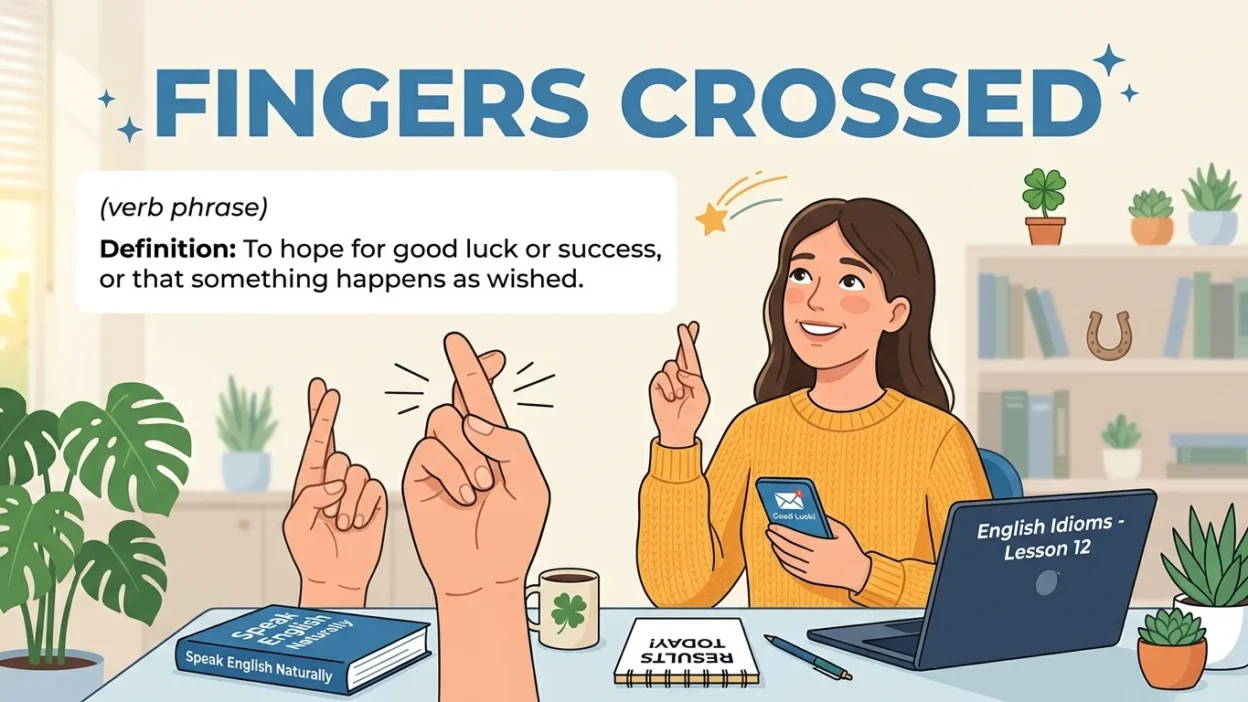
“Fingers crossed” is a common English expression that means hoping that something will happen the way you want. People often say it when they are hoping for good luck or a positive result. For example, if someone is waiting to hear whether they got a job, you might say, “Fingers crossed!” This means you hope they get the job.
The expression is often accompanied by physically crossing the index and middle fingers, although you do not need to make the gesture when using the phrase. Fingers crossed is common in everyday conversation, text messages, social media posts, and informal writing. It usually expresses hope rather than certainty. In other words, you want something to happen, but you do not know whether it will.
Quick Answer
“Fingers crossed” means “I hope things go well” or “I hope the desired result happens.” It is commonly used when someone is waiting for good news or hoping for a positive outcome. For example, “I have an interview tomorrow. Fingers crossed!” means the speaker hopes the interview goes well.
Why Do People Say “Fingers Crossed”?
People say fingers crossed to express hope for good luck or a favorable result.
For example:
I applied for the job. Fingers crossed!
The speaker does not know whether they will get the job, but they hope they will.
The expression is often used when the outcome is uncertain.
You might hear it before:
- an exam
- a job interview
- a medical appointment
- a competition
- an important meeting
- a trip
- an application result
- an important decision
The phrase is usually optimistic and informal.
What Does “Fingers Crossed” Mean?
Fingers crossed means:
- I hope it works out.
- I hope we get good news.
- I hope everything goes well.
- Let’s hope for the best.
- I hope the desired result happens.
For example:
Fingers crossed, we get the tickets.
This means:
I hope we get the tickets.
It does not guarantee that the desired result will happen.
First Word: Fingers
Fingers refers to the digits on your hands.
In the expression fingers crossed, the word is connected to the traditional physical gesture of crossing two fingers.
For example, someone might physically cross their index and middle fingers while saying:
Fingers crossed!
The gesture reinforces the idea of hoping for good luck.
However, you can also use the expression without making the gesture.
Second Word: Crossed
Crossed means that two things have been placed across each other.
When people make the traditional gesture, they cross the index finger over the middle finger or place the fingers together in a crossed position.
In the idiomatic expression, however, crossed is not simply describing the physical position. Together, fingers crossed expresses hope or a wish for good luck.
Fingers Crossed vs Good Luck
These expressions are similar but not identical.
Good luck directly wishes someone success.
Good luck with your exam!
Fingers crossed expresses hope that the result will be positive.
Fingers crossed you pass your exam!
You can also combine them:
Good luck! Fingers crossed!
Both expressions are common in informal English.
| Expression | Meaning | Example |
|---|---|---|
| Fingers crossed | I hope things go well | Fingers crossed, we get the job. |
| Good luck | I wish you success | Good luck with your interview. |
| Let’s hope for the best | We hope for a positive result | Let’s hope for the best. |
| Hopefully | It is hoped that something happens | Hopefully, everything goes well. |
| Knock on wood | A phrase associated with avoiding bad luck | I hope nothing goes wrong, knock on wood. |
When Should You Use “Fingers Crossed”?
Use fingers crossed when the result of something is uncertain and you hope for a positive outcome.
It is especially natural in informal conversation.
Before an exam
I have my final exam tomorrow. Fingers crossed!
Before a job interview
My interview is tomorrow. Fingers crossed!
When waiting for news
We should hear back next week. Fingers crossed!
When hoping for good weather
We’re going to the beach tomorrow. Fingers crossed for good weather!
When hoping for success
She applied for her dream job. Fingers crossed she gets it!
15 Examples of “Fingers Crossed”
- I have an exam tomorrow. Fingers crossed!
- Fingers crossed, everything goes well.
- We are waiting for the results. Fingers crossed!
- I applied for the job, so fingers crossed.
- Fingers crossed we get the tickets.
- She has an interview tomorrow. Fingers crossed for her!
- Fingers crossed, the weather stays nice.
- We’re hoping to hear some good news today. Fingers crossed!
- Fingers crossed that our plan works.
- I hope they accept my application. Fingers crossed!
- The team needs one more win. Fingers crossed they make it.
- Fingers crossed you get the promotion.
- We’re leaving early tomorrow. Fingers crossed there isn’t much traffic.
- I sent the proposal yesterday. Fingers crossed they like it.
- Fingers crossed everything works out.
“Fingers Crossed” in a Sentence
The expression can appear at the beginning, middle, or end of a sentence.
At the beginning
Fingers crossed, we get there on time.
At the end
We should get an answer tomorrow, fingers crossed.
As a standalone expression
“How did your interview go?”
“Pretty well. Fingers crossed!”
This standalone use is extremely common in casual conversation.
Can You Say “Keep Your Fingers Crossed”?
Yes. Keep your fingers crossed is another common expression.
It means continue hoping for a positive result.
For example:
Keep your fingers crossed that I get the job.
Keep your fingers crossed for good weather tomorrow.
It is often used when the outcome has not been decided yet.
You can also say:
I’m keeping my fingers crossed.
This means:
I am hoping that things turn out well.
Fingers Crossed vs I Hope
Both can express hope, but they have slightly different tones.
I hope I get the job.
This is a direct statement of hope.
Fingers crossed I get the job.
This is more casual and conversational.
Fingers crossed often sounds friendly and informal, making it particularly common in everyday speech and messages.
Can “Fingers Crossed” Be Used in Formal Writing?
It is generally considered informal.
It works well in:
- text messages
- social media
- friendly emails
- casual conversations
- informal posts
For formal writing, clearer alternatives may be better:
We hope the application is successful.
We hope for a positive outcome.
We are hopeful that the project will succeed.
However, using fingers crossed in a casual professional message may be perfectly natural depending on the relationship and workplace culture.
Common Mistakes
1. Thinking “fingers crossed” guarantees success
It does not.
Fingers crossed, I get the job.
The speaker is expressing hope, not certainty.
2. Using it when the result is already known
If you already know the result, fingers crossed is usually unnecessary.
For example, if you already received the job offer, you would not normally say:
Fingers crossed, I got the job.
You could say it before receiving the result:
Fingers crossed, I get the job!
3. Thinking you must physically cross your fingers
You do not have to make the physical gesture.
You can simply write:
Fingers crossed!
The meaning is understood from the expression itself.
4. Confusing it with “cross your fingers”
Fingers crossed expresses your hope.
Cross your fingers is often an instruction asking someone else to hope for a positive result.
Fingers crossed!
Cross your fingers for me!
Both are common.
Memory Trick
Think:
Fingers crossed = hope for good luck.
Imagine someone physically crossing two fingers and silently hoping:
“Please let this work out!”
So whenever you see fingers crossed, think:
I hope it goes well.
American vs British English
Fingers crossed is common in both American and British English.
The meaning is essentially the same:
I hope something goes well.
The expression is informal and widely understood in both varieties.
The physical gesture associated with crossing the fingers is also familiar in both cultures, although gestures and superstitions can vary between individuals and cultures.
Similar Expressions
Good luck
A direct wish for someone’s success.
Good luck with your interview!
Hopefully
Means that something is desired or expected to happen.
Hopefully, we will get good news.
Let’s hope for the best
Expresses hope when the outcome is uncertain.
Let’s hope for the best.
Keep your fingers crossed
Asks someone to continue hoping for a positive result.
Keep your fingers crossed for me.
I hope it works out
A direct expression of hope.
I hope everything works out.
Knock on wood
An expression traditionally associated with avoiding bad luck after mentioning something positive.
I’ve never been late for work, knock on wood.
Final Verdict
“Fingers crossed” means “I hope things go well” or “I hope the desired result happens.” It is an informal English expression used when an outcome is uncertain and someone wants to express hope for good luck.
You can use it by itself:
Fingers crossed!
or in a sentence:
Fingers crossed, I get the job.
You can also say:
Keep your fingers crossed for me.
The expression is friendly, natural, and very common in everyday English.
Frequently Asked Questions
What does “fingers crossed” mean?
Fingers crossed means I hope things go well or I hope the result is positive. It is commonly used when the outcome is uncertain.
Is “fingers crossed” an idiom?
Yes. Fingers crossed is a common English idiomatic expression associated with hoping for good luck or a favorable result.
What does “fingers crossed” mean in texting?
In texting, fingers crossed usually means I hope it works out or I hope we get good news. It is informal and friendly.
What is another way to say “fingers crossed”?
You can say good luck, hopefully, let’s hope for the best, I hope it works out, or keep your fingers crossed, depending on the context.
Can I say “fingers crossed for you”?
Yes. Fingers crossed for you! means that you hope something goes well for another person.
What does “keep your fingers crossed” mean?
Keep your fingers crossed means continue hoping that something good will happen.
Is “fingers crossed” formal or informal?
Fingers crossed is generally informal. It is especially common in conversations, text messages, social media, and friendly communication.
Do you have to physically cross your fingers?
No. You can use fingers crossed as a spoken or written expression without making the physical gesture.
Remember This
Fingers crossed = I hope it goes well.
Use it when:
The result is uncertain + you want a positive outcome.
For example:
I have an interview tomorrow. Fingers crossed!
This means:
I hope the interview goes well.
You can also say:
Keep your fingers crossed for me!
Conclusion
“Fingers crossed” is a common informal English expression used to show hope for a positive outcome. It is often said when someone is waiting for news, facing an uncertain situation, or hoping that something will go according to plan. The expression can stand alone or be included in a longer sentence.
The phrase is closely connected with the physical gesture of crossing two fingers, traditionally associated with hoping for good luck. However, you do not need to make the gesture to use the expression. Whether you are waiting for exam results, hoping to get a job, or wishing for good weather, “fingers crossed” is a natural way to say that you hope everything works out.

Charles Kevin is a passionate language writer and researcher at SimileHive, creating clear, engaging content about similes, idioms, metaphors, and figurative language to help readers improve English communication confidently every day.