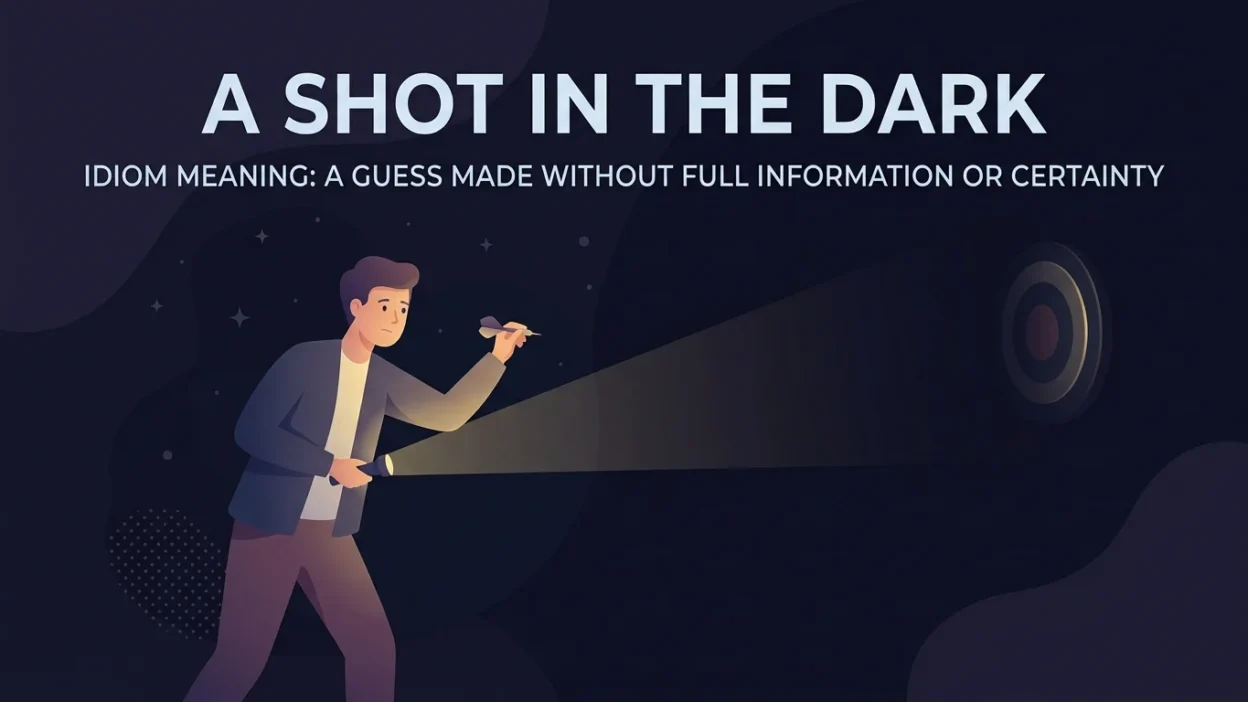
“A shot in the dark” is an English idiom that means a guess or attempt made without enough information or without knowing whether it will be correct or successful. When someone takes a shot in the dark, they are making their best guess even though they do not have much evidence to guide them. For example, if someone asks, “Who broke the vase?” and you answer, “John?” you might add, “That’s just a shot in the dark.”
The expression is common in everyday English and can describe both guesses and attempts. It does not usually mean that someone is being careless. Instead, it suggests that the person has limited information and is trying anyway. You can use it in conversations, emails, discussions, and informal writing. It is especially useful when you want to make it clear that you are not certain about your answer.
Quick Answer
“A shot in the dark” means a guess or attempt made without enough information to know whether it will be correct or successful. For example, “I don’t know the answer, but I’ll take a shot in the dark” means the speaker will make a guess even though they are not sure. It is an informal English idiom.
Why Do People Say “A Shot in the Dark”?
The expression comes from the idea of trying to hit a target when you cannot see it because it is dark.
If you cannot see the target, you have very little information about where to aim. You might take a shot anyway, but you do not know whether you will hit the target.
The idiom uses this image to describe a situation where someone makes a guess or attempt without knowing the likely result.
For example:
I don’t know who sent the message. Maybe Sarah? That’s a shot in the dark.
The speaker has little evidence but is offering a possibility.
What Does “A Shot in the Dark” Mean?
A shot in the dark can mean:
- a guess made without much information
- an uncertain answer
- an attempt without knowing the likely outcome
- a possibility suggested without strong evidence
- a trial or effort based mainly on hope
For example:
I’m just taking a shot in the dark, but I think the meeting is at 3 p.m.
The speaker is not certain and is making a guess.
First Word: A
A is an indefinite article.
In a shot in the dark, it introduces one possible shot.
The phrase is normally used with a:
a shot in the dark
You would not normally say:
❌ the shot in the dark
unless you are referring to a specific literal or previously mentioned shot.
Second Word: Shot
A shot can literally mean an attempt to hit a target with a gun or another object.
For example:
He took a shot at the target.
In the idiom, however, shot is being used figuratively.
A shot can also mean an attempt:
I’ll take a shot at solving the problem.
This meaning connects naturally with the idiom a shot in the dark.
Third Phrase: In the Dark
In the dark literally means being somewhere without light.
In the idiom, however, it emphasizes the lack of information.
If you are in the dark about something, you do not know what is happening or do not have the necessary information.
For example:
I’m in the dark about the company’s plans.
This means:
I do not know what the company’s plans are.
In a shot in the dark, the lack of information explains why the guess is uncertain.
A Shot in the Dark vs A Guess
These expressions are similar, but a shot in the dark usually emphasizes uncertainty or a lack of information.
I guessed that the answer was 25.
This simply tells us that the answer was a guess.
I took a shot in the dark and guessed that the answer was 25.
This emphasizes that the speaker had little or no evidence for the answer.
| Expression | Meaning | Example |
|---|---|---|
| a shot in the dark | A guess or attempt without enough information | That’s just a shot in the dark. |
| a guess | An answer given without certainty | My guess is 25. |
| a wild guess | A very uncertain guess | That’s just a wild guess. |
| an educated guess | A guess based on some knowledge or evidence | It’s an educated guess. |
| a stab in the dark | An uncertain guess or attempt | I’ll take a stab in the dark. |
When Should You Use “A Shot in the Dark”?
Use a shot in the dark when you want to show that you are making a guess or attempting something without enough information to be confident.
It is especially useful when:
- you do not know the answer
- you have limited evidence
- you are making a prediction
- you are trying something for the first time
- you are suggesting a possibility
- you are estimating something
For example:
I don’t know her exact age. I’m taking a shot in the dark, but I’d say she’s about 30.
15 Examples of “A Shot in the Dark”
- That’s just a shot in the dark, but I think the answer is 42.
- I’m taking a shot in the dark, but maybe the meeting starts at noon.
- My answer is only a shot in the dark.
- I don’t know where he lives, so that’s a shot in the dark.
- I’m going to take a shot in the dark and say that she is from Canada.
- That’s a shot in the dark, but I think we should try it.
- I have no idea, so I’ll take a shot in the dark.
- His prediction was basically a shot in the dark.
- I’m just taking a shot in the dark, but could the password be your birthday?
- We don’t have enough information, so any answer would be a shot in the dark.
- That’s a complete shot in the dark, but it might work.
- I took a shot in the dark and contacted the first company on the list.
- Her estimate was a shot in the dark.
- I’ll take a shot in the dark and guess that he is already there.
- It was a shot in the dark, but luckily, I was right.
Take a Shot in the Dark
You may also hear the expression as:
Take a shot in the dark
This means make a guess or attempt despite not having enough information.
For example:
I don’t know the answer, but I’ll take a shot in the dark.
This means:
I don’t know the answer, but I’ll make a guess.
You can also say:
Take a wild shot in the dark.
This emphasizes that the guess is especially uncertain.
A Shot in the Dark vs A Stab in the Dark
A shot in the dark and a stab in the dark have very similar meanings.
Both describe a guess or attempt made without enough information.
That’s a shot in the dark.
That’s a stab in the dark.
Both are natural expressions.
A shot in the dark is especially common in American English, while a stab in the dark is also widely used, particularly in British English.
The exact preference depends on the speaker and context.
A Shot in the Dark vs an Educated Guess
These expressions describe almost opposite levels of certainty.
A shot in the dark
You have little information.
It’s a shot in the dark, but I think she’s the manager.
An educated guess
You have some knowledge or evidence.
It’s an educated guess, based on the available data.
An educated guess is still uncertain, but it has a stronger basis.
Can “A Shot in the Dark” Describe an Attempt?
Yes. It can describe more than just an answer or guess.
For example:
Applying for that job was a shot in the dark.
This means the person applied without knowing whether they had a realistic chance.
Another example:
Calling that number was a shot in the dark, but someone answered.
Here, the person made an attempt without knowing whether it would work.
Common Mistakes
1. Thinking it means a literal gunshot
In everyday usage, a shot in the dark is usually an idiom.
That’s just a shot in the dark.
It normally means an uncertain guess or attempt, not a literal shot.
2. Using it when you are certain
If you know the answer with confidence, a shot in the dark is not appropriate.
Instead:
I’m certain the meeting starts at 10.
The idiom suggests uncertainty.
3. Confusing it with “in the dark”
The expressions are related but different.
In the dark means lacking information.
I was in the dark about the changes.
A shot in the dark means making a guess or attempt despite lacking information.
My answer was a shot in the dark.
4. Forgetting the article “a”
The standard expression is:
a shot in the dark
Not:
❌ shot in the dark
when using the full idiom as a noun phrase.
Comparison Table: Related Expressions
| Expression | Level of Certainty | Meaning |
|---|---|---|
| a shot in the dark | Very uncertain | A guess or attempt with little information |
| a wild guess | Very uncertain | A guess without reliable information |
| an educated guess | Moderately uncertain | A guess based on some knowledge |
| a good guess | Somewhat confident | A reasonable guess |
| an informed opinion | More supported | An opinion based on relevant information |
Memory Trick
Think of a person trying to hit a target in complete darkness.
They cannot see the target clearly, so they do not know exactly where to aim.
That is the idea behind:
A shot in the dark = an uncertain guess or attempt.
Remember:
Dark = little information.
Shot = attempt.
So:
A shot in the dark = an attempt made without knowing the likely result.
American vs British English
A shot in the dark is used in both American and British English.
The meaning is essentially the same:
an uncertain guess or attempt made without enough information.
Another expression, a stab in the dark, is also common in British English and is understood in American English as well.
For example:
That’s just a shot in the dark.
That’s just a stab in the dark.
Both communicate uncertainty.
Similar Words and Expressions
A wild guess
A very uncertain guess.
That’s just a wild guess.
A stab in the dark
An uncertain attempt or guess.
I’ll take a stab in the dark.
An educated guess
A guess based on some knowledge or evidence.
That’s an educated guess.
Take a chance
Attempt something despite uncertainty.
I’ll take a chance and apply.
In the dark
Not having information.
We were kept in the dark about the decision.
Guess
Give an answer without being certain.
I can only guess.
Final Verdict
“A shot in the dark” means an uncertain guess or attempt made without enough information to know whether it will be correct or successful.
It is often used when someone knows that their answer may be wrong:
I’m taking a shot in the dark, but I think the answer is John.
It can also describe an uncertain attempt:
Applying for the position was a shot in the dark.
The expression is informal and natural in everyday English.
Frequently Asked Questions
What does “a shot in the dark” mean?
A shot in the dark means a guess or attempt made without enough information to know whether it will be correct or successful.
Is “a shot in the dark” an idiom?
Yes. A shot in the dark is a common English idiom meaning an uncertain guess or attempt.
What is another word for “a shot in the dark”?
Similar expressions include a wild guess, a stab in the dark, an uncertain guess, and an educated guess, although an educated guess is based on more information.
What does “take a shot in the dark” mean?
Take a shot in the dark means to make a guess or attempt something even though you have little information or are unsure of the result.
Is “a shot in the dark” negative?
Not necessarily. It simply indicates uncertainty. Someone can make a shot in the dark and still be correct or successful.
Can “a shot in the dark” describe an attempt?
Yes. It can describe an uncertain attempt as well as a guess.
What is the difference between “a shot in the dark” and “a wild guess”?
Both describe uncertain guesses. A shot in the dark can also describe an attempt, while a wild guess usually refers specifically to a guess.
Is “a shot in the dark” formal or informal?
It is generally informal and is especially common in conversation and other everyday communication.
Remember This
A shot in the dark = an uncertain guess or attempt.
Use it when:
You have little information + you still try.
For example:
I don’t know the answer, but I’ll take a shot in the dark.
Think of trying to hit a target when you cannot see it. You make an attempt, but you do not know exactly where the target is.
Conclusion
“A shot in the dark” is a useful English idiom for describing an uncertain guess or attempt. It suggests that someone does not have enough information to be confident but decides to try anyway. The expression can be used for answers, predictions, estimates, decisions, and attempts.
For example, if someone asks you a question and you are unsure of the answer, you can say, “I’ll take a shot in the dark.” This tells the listener that you are guessing rather than claiming to know the answer. Similar expressions include “a wild guess” and “a stab in the dark,” while “an educated guess” suggests that the person has more information to support the answer.

Adam Aaron is a language enthusiast and content writer at SimileHive, creating clear, engaging guides on similes, idioms, metaphors, and figurative language to help readers improve English confidently every day.