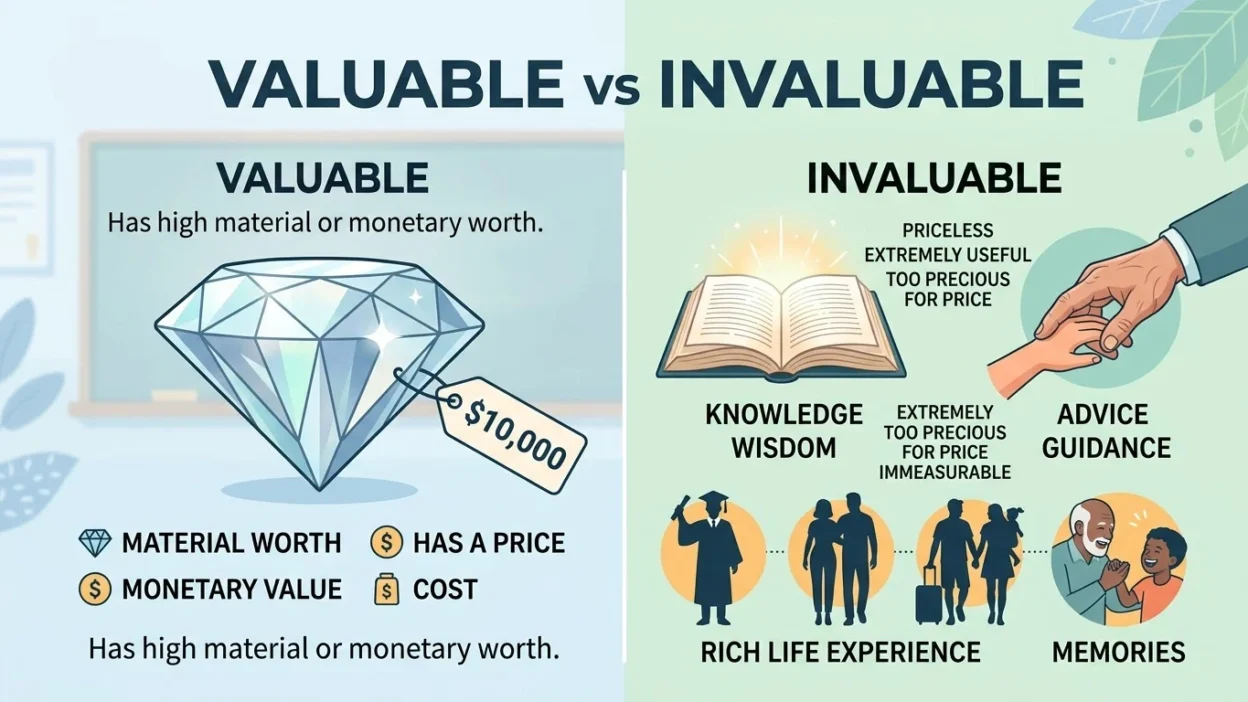
Valuable and invaluable are both positive words, but they have different meanings and levels of emphasis. Valuable means something is worth a lot, is useful, or is important. Invaluable means something is extremely useful or important and cannot easily be replaced or measured in terms of value. For example, a valuable piece of advice is useful, while invaluable advice can be so helpful that it is difficult to put a price on it.
The confusing part is the prefix in-. In many English words, in- means “not,” but invaluable does not normally mean “not valuable.” Instead, invaluable has developed the meaning of extremely valuable or priceless in usefulness or importance. Understanding this difference will help you choose the right word in academic writing, professional communication, everyday conversation, and formal descriptions.
Quick Answer
Valuable means worth a lot, useful, or important. Invaluable means extremely valuable, useful, or important. Despite the prefix in-, invaluable does not normally mean “not valuable.” For example, “Her advice was valuable” means it was helpful, while “Her advice was invaluable” means it was exceptionally helpful or important.
Why Do People Confuse “Invaluable” and “Valuable”?
The confusion comes mainly from the prefix in-.
Usually, in- can create a negative meaning:
accurate → inaccurate
complete → incomplete
visible → invisible
So it is understandable to think:
valuable → invaluable = not valuable
But that is not how invaluable normally works.
Invaluable means extremely valuable, useful, or important.
For example:
Her experience was invaluable to the project.
This means her experience was extremely useful or important.
It does not mean:
Her experience had no value.
First Word: Valuable
Valuable means having considerable worth, usefulness, or importance.
It can describe both physical things and abstract things.
Physical value
This is a valuable painting.
The painting has a high monetary or artistic value.
Usefulness
Her advice was valuable.
Her advice was useful.
Importance
He is a valuable member of the team.
He is an important and useful member of the team.
So valuable can refer to:
- monetary worth
- usefulness
- importance
- benefit
Second Word: Invaluable
Invaluable means extremely useful, important, or helpful.
It often describes something that is so useful or important that its value is difficult to measure.
For example:
Her support was invaluable during the project.
This means her support was extremely important and helpful.
Other examples include:
His experience proved invaluable.
The information was invaluable to the researchers.
Her guidance was invaluable to the new employees.
Valuable vs Invaluable
| Word | Meaning | Strength | Example |
|---|---|---|---|
| Valuable | Worth a lot, useful, or important | Positive | Her advice was valuable. |
| Invaluable | Extremely useful or important | Stronger emphasis | Her advice was invaluable. |
| Priceless | So valuable that it cannot be assigned a price | Very strong | The memory is priceless. |
| Worthless | Having little or no value | Negative | The damaged item was worthless. |
The important point is that invaluable is positive, not negative.
When Should You Use “Valuable”?
Use valuable when something has significant worth, usefulness, or importance.
For money
The museum contains several valuable paintings.
For advice
She gave me some valuable advice.
For information
The report contains valuable information.
For a person
He is a valuable member of the team.
For experience
This experience was valuable to my career.
Valuable is a flexible and common word.
When Should You Use “Invaluable”?
Use invaluable when you want to emphasize that something is extremely useful, important, or helpful.
It is particularly common when describing:
- expert advice
- experience
- support
- guidance
- assistance
- information
- contributions
- knowledge
- resources
Examples:
Her guidance was invaluable.
His experience was invaluable to the team.
Your support has been invaluable.
The research provided invaluable information.
Can “Invaluable” Mean “Not Valuable”?
In modern standard English, invaluable generally does not mean “not valuable.”
Instead, it normally means:
extremely valuable
This is an example of a word whose meaning cannot always be predicted from its prefix.
For example:
Her assistance was invaluable.
This means:
Her assistance was extremely useful.
It does not mean:
Her assistance was useless.
If you want to say that something has little or no value, use words such as:
- worthless
- useless
- valueless
- insignificant
depending on the context.
Valuable vs Invaluable: A Closer Comparison
| Feature | Valuable | Invaluable |
|---|---|---|
| Basic meaning | Worth a lot or useful | Extremely useful or important |
| Positive or negative? | Positive | Positive |
| Monetary value | Common | Less common |
| Usefulness | Common | Very common |
| Emphasis | Strong | Stronger |
| Means “not valuable”? | No | Usually no |
| Example | Valuable information | Invaluable guidance |
One important distinction is that valuable can naturally describe something with a high monetary price:
a valuable diamond
But invaluable is much more commonly used for things whose importance or usefulness is difficult to measure:
invaluable experience
invaluable advice
15 Examples of “Valuable”
- She gave me some valuable advice.
- This painting is extremely valuable.
- The course provided valuable information.
- He is a valuable member of the team.
- We gained valuable experience from the project.
- Your feedback is very valuable to us.
- The book contains valuable lessons.
- The company has several valuable assets.
- His knowledge is valuable to the organization.
- We received valuable support from our partners.
- The museum protects many valuable objects.
- Her comments provided valuable insight.
- This training is a valuable opportunity.
- The research produced valuable results.
- He offered some valuable suggestions.
15 Examples of “Invaluable”
- Her advice was invaluable.
- His experience proved invaluable to the team.
- Your support has been invaluable.
- She provided invaluable guidance.
- His knowledge was invaluable during the project.
- The information was invaluable to our research.
- Her assistance was invaluable.
- The training provided invaluable experience.
- His contribution was invaluable to the organization.
- Their expertise proved invaluable.
- She offered invaluable support during the difficult period.
- The mentor’s advice was invaluable to the students.
- The research team gained invaluable insights.
- Her leadership was invaluable to the project.
- The volunteers provided invaluable help.
Valuable Advice vs Invaluable Advice
Both phrases are correct, but they communicate different degrees of emphasis.
Valuable advice
She gave me valuable advice.
This means her advice was useful and important.
Invaluable advice
She gave me invaluable advice.
This means her advice was exceptionally useful or important.
So invaluable generally carries stronger emphasis.
However, the difference is not a precise measurement. It depends on the speaker’s judgment and the context.
Valuable Experience vs Invaluable Experience
Both are natural expressions.
The internship gave me valuable experience.
This means the experience was useful for my development.
The internship gave me invaluable experience.
This strongly emphasizes how important and useful the experience was.
Invaluable is especially common when talking about experience that would be difficult to replace or obtain elsewhere.
Common Mistakes
1. Thinking “invaluable” means “worthless”
This is the most common mistake.
❌ His advice was invaluable, so it was useless.
That interpretation is incorrect in normal modern English.
Instead:
His advice was invaluable.
means:
His advice was extremely useful.
2. Using “invaluable” for every valuable object
You can technically describe something as invaluable, but the word is especially common for abstract things such as experience, guidance, advice, and support.
For example:
valuable jewelry
is natural.
invaluable jewelry
is possible in a different sense, but less natural if you simply mean that the jewelry is expensive.
3. Assuming the prefix always changes the word to its opposite
English prefixes do not always work in a simple mathematical way.
The meaning of invaluable has to be learned as a whole word.
4. Confusing invaluable with valueless
These words have very different meanings.
Invaluable = extremely valuable.
Valueless = having no value.
For example:
Her experience was invaluable.
The damaged document was valueless.
Memory Trick
Remember:
Valuable = very useful or worth a lot.
Invaluable = so useful or important that it is difficult to measure its value.
A simple memory sentence is:
Invaluable means “extremely valuable,” not “not valuable.”
Think of invaluable as a strong compliment.
If someone’s help is described as invaluable, you are saying their help was extremely important.
American vs British English
Valuable and invaluable have essentially the same meanings in American and British English.
Both varieties use:
valuable advice
invaluable experience
valuable information
invaluable support
There is no significant difference in the basic meaning or spelling of these words between American and British English.
Similar Words
Priceless
Extremely valuable or impossible to assign a price to.
The family photograph is priceless.
Worthwhile
Worth the time, money, or effort spent.
The course was worthwhile.
Useful
Helpful or practical.
The information was useful.
Beneficial
Producing a helpful or positive result.
Exercise is beneficial to your health.
Important
Having significant value or meaning.
Her contribution was important.
Worthless
Having little or no value.
The broken device was worthless.
Valueless
Having no value.
The item was considered valueless.
Valuable vs Priceless vs Invaluable
These three words are sometimes confused.
Valuable means worth a lot or very useful.
This painting is valuable.
Invaluable means extremely useful or important.
Her expertise was invaluable.
Priceless can mean extremely valuable or impossible to put a price on.
The memory is priceless.
Notice that invaluable is especially common for abstract qualities, while valuable can easily refer to monetary worth.
Final Verdict
Valuable means worth a lot, useful, or important. Invaluable means extremely useful, important, or helpful.
The most important thing to remember is that invaluable does not normally mean “not valuable.” It is a positive word that usually expresses a very high degree of usefulness or importance.
Use valuable for things that have significant worth or usefulness. Use invaluable when you want to emphasize that something is exceptionally useful or important.
For example:
Her advice was valuable.
means it was useful.
Her advice was invaluable.
means it was extremely useful or important.
Frequently Asked Questions
Does “invaluable” mean “not valuable”?
No. In modern standard English, invaluable generally means extremely valuable, useful, or important. It does not normally mean worthless.
What is the difference between valuable and invaluable?
Valuable means worth a lot, useful, or important. Invaluable means extremely useful or important, often emphasizing that something is difficult to replace or measure.
Is invaluable a positive word?
Yes. Invaluable is a positive word. Saying that someone’s help was invaluable means that the help was extremely useful or important.
Can I say “invaluable advice”?
Yes. Invaluable advice is a common and natural phrase meaning advice that is extremely useful or important.
Is “valuable” stronger than “invaluable”?
Generally, invaluable expresses stronger emphasis than valuable, but there is no exact scale of value between the two words.
What is the opposite of invaluable?
Depending on the intended meaning, possible opposites include worthless, useless, valueless, or insignificant.
Can “invaluable” describe money or objects?
It can, but it is especially common for abstract things such as advice, experience, support, knowledge, and guidance. Valuable is more natural when talking about monetary worth.
Is “invaluable” formal?
Invaluable is somewhat formal but is also common in everyday English, especially when praising someone’s help, advice, experience, or contribution.
Remember This
Valuable = useful, important, or worth a lot.
Invaluable = extremely useful or important.
Do not read invaluable as “not valuable.”
Remember:
Invaluable = extremely valuable.
For example:
Her advice was valuable.
Her advice was invaluable.
Both are positive, but invaluable gives stronger emphasis.
Conclusion
The difference between valuable and invaluable is mainly one of degree and emphasis. Valuable describes something that has significant worth, usefulness, or importance. Invaluable goes further and describes something that is extremely useful or important, often to the point that its value is difficult to measure.
The word invaluable can be confusing because the prefix in- often creates a negative meaning in other English words. In this case, however, invaluable is a positive word. If someone says that your support, advice, experience, or guidance was invaluable, they are saying that it was exceptionally useful and important.

Lucas Luke is a passionate language writer and content creator at SimileHive, specializing in similes, idioms, metaphors, and figurative language. He enjoys making complex English expressions simple, engaging, and easy to understand for students, writers, and language enthusiasts through well-researched, practical content.