Change is a natural part of life. People change, ideas grow, seasons come and go, and every new experience teaches us something. Sometimes, however, it can be difficult to describe change using plain words.
That is where metaphors become helpful. A metaphor compares one thing to another without using words like “as” or “like.” It creates a strong picture in the reader’s mind and makes writing more interesting.
Learning metaphors for change can improve your speaking, creative writing, storytelling, and everyday conversations. These figurative language examples help explain personal growth, new beginnings, challenges, and life changes in a memorable way.
Writers, students, teachers, and English learners often use metaphors because they make emotions and ideas easier to understand.
In this guide, you will learn the meaning of metaphors for change, how to use them correctly, and discover 20 original metaphors with simple explanations and example sentences. By the end, you will feel more confident using these literary devices in your own writing.
Quick Answer
Metaphors for change are figures of speech that describe change by comparing it to something else without using “like” or “as.” They help readers picture growth, transformation, fresh starts, and new experiences in a creative and meaningful way.
What Are Metaphors for Change?
A metaphor for change is a creative way to describe transformation, growth, or a new beginning.
Instead of saying someone changed, you compare that change to something more visual.
For example:
- She is a butterfly leaving the cocoon.
This does not mean she is really a butterfly. It means she has transformed into a stronger and more confident person.
Metaphors make writing more colorful and easier to imagine.
Why Writers Use Metaphors for Change
Writers use metaphors because they:
- Make ideas easier to understand.
- Create strong mental pictures.
- Express emotions clearly.
- Improve creative writing.
- Make stories and speeches more memorable.
20 Metaphors for Change
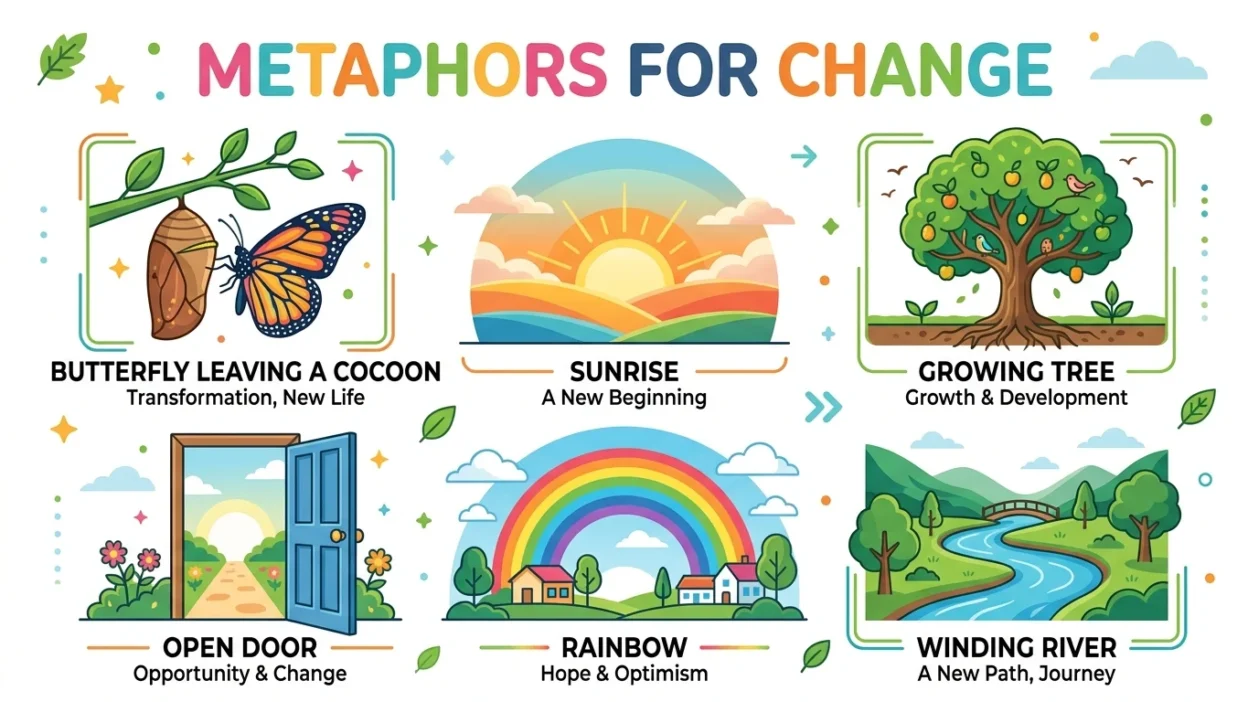
1. A New Dawn
Meaning: A fresh beginning.
Explanation: Just as the sun rises to start a new day, life sometimes offers a fresh start.
Example Sentences:
- Moving to a new city was a new dawn for her.
- Graduation became a new dawn in his life.
2. A Butterfly Leaving the Cocoon
Meaning: Personal transformation.
Explanation: Growth often takes time before someone becomes stronger.
Example Sentences:
- She became a butterfly leaving the cocoon after years of hard work.
- His confidence was a butterfly leaving the cocoon.
3. Turning the Page
Meaning: Starting a new chapter.
Explanation: It represents leaving the past behind.
Example Sentences:
- She decided it was time to turn the page.
- The company turned the page after hiring new leaders.
4. A River Finding a New Path
Meaning: Adapting to change.
Explanation: Rivers naturally find another route when blocked.
Example Sentences:
- His career became a river finding a new path.
- Families often become rivers finding new paths during difficult times.
5. A Seed Becoming a Tree
Meaning: Growth over time.
Explanation: Small beginnings can lead to great success.
Example Sentences:
- Her dream became a seed growing into a tree.
- Every skill starts as a seed becoming a tree.
6. Opening a New Door
Meaning: New opportunities.
Explanation: Every new chance leads somewhere different.
Example Sentences:
- The scholarship opened a new door.
- Learning English opened many new doors.
7. A Bridge to Tomorrow
Meaning: Moving toward a better future.
Explanation: Bridges connect one place to another.
Example Sentences:
- Education became a bridge to tomorrow.
- Hope was their bridge to tomorrow.
8. A Blank Canvas
Meaning: Unlimited possibilities.
Explanation: A blank canvas can become anything.
Example Sentences:
- Retirement felt like a blank canvas.
- Every new year is a blank canvas.
9. A Phoenix Rising
Meaning: Recovery after hardship.
Explanation: The mythical phoenix represents renewal.
Example Sentences:
- After failure, she became a phoenix rising.
- The town was a phoenix rising after the disaster.
10. A Fresh Chapter
Meaning: Beginning again.
Explanation: Life can be viewed as a book with many chapters.
Example Sentences:
- Marriage marked a fresh chapter.
- The new job started a fresh chapter.
11. A Tree Growing New Branches
Meaning: Expanding and improving.
Explanation: Growth creates new possibilities.
Example Sentences:
- The business grew new branches.
- His interests became new branches on a strong tree.
12. Breaking the Chains
Meaning: Freedom from old habits.
Explanation: It represents leaving limits behind.
Example Sentences:
- She broke the chains of fear.
- Education helped him break the chains of poverty.
13. A Rising Tide
Meaning: Positive progress.
Explanation: A rising tide lifts everything around it.
Example Sentences:
- Innovation became a rising tide.
- Confidence was the rising tide of the team.
14. A Garden in Bloom
Meaning: Personal growth.
Explanation: Care and patience create beautiful results.
Example Sentences:
- Her life became a garden in bloom.
- Their friendship was a garden in bloom.
15. Climbing a New Mountain
Meaning: Facing new challenges.
Explanation: Every mountain represents another goal.
Example Sentences:
- Starting college was climbing a new mountain.
- The project became a new mountain to climb.
16. A Wheel Turning
Meaning: Life moving forward.
Explanation: Wheels never stay still.
Example Sentences:
- Time is a wheel turning.
- Success came as the wheel kept turning.
17. A Window Opening
Meaning: Seeing new possibilities.
Explanation: Windows let in light and fresh ideas.
Example Sentences:
- The workshop opened a new window.
- Reading opened a window to different cultures.
18. A Fire Rekindled
Meaning: Renewed passion.
Explanation: Old excitement returns.
Example Sentences:
- The trip rekindled her fire.
- His dream became a fire rekindled.
19. A Compass Finding North
Meaning: Discovering direction.
Explanation: Change often brings clarity.
Example Sentences:
- Mentorship became a compass finding north.
- The experience was a compass finding north.
20. A Rainbow After the Rain
Meaning: Hope after difficult times.
Explanation: Better days often follow challenges.
Example Sentences:
- Their success was a rainbow after the rain.
- Peace became a rainbow after years of struggle.
Common Mistakes
- Mixing metaphors in one sentence.
- Using too many metaphors together.
- Choosing a metaphor that does not match the situation.
- Explaining the metaphor too much.
- Repeating the same metaphor many times.
Similar Expressions
- Fresh start
- New beginning
- Turning point
- New chapter
- New direction
- Personal growth
- Transformation
- Second chance
- Renewal
- Moving forward
Practical Tips for Creative Writing
- Choose metaphors that match your topic.
- Keep your comparisons simple.
- Use original ideas instead of overused phrases.
- Let the metaphor support your message.
- Read your sentence aloud to see if it sounds natural.
Practice Questions
1. Which metaphor means a fresh beginning?
Answer: A new dawn.
Explanation: It represents the start of something new.
2. Which metaphor describes personal transformation?
Answer: A butterfly leaving the cocoon.
Explanation: It symbolizes growth and change.
3. Which metaphor represents new opportunities?
Answer: Opening a new door.
Explanation: It shows that new chances are available.
4. Which metaphor means hope after difficult times?
Answer: A rainbow after the rain.
Explanation: It represents better times ahead.
5. Which metaphor symbolizes recovery after hardship?
Answer: A phoenix rising.
Explanation: It represents starting again after failure.
6. Which metaphor means discovering your direction?
Answer: A compass finding north.
Explanation: It symbolizes guidance and purpose.
7. Which metaphor represents growth over time?
Answer: A seed becoming a tree.
Explanation: Great success often begins small.
8. Which metaphor means facing a new challenge?
Answer: Climbing a new mountain.
Explanation: Mountains symbolize difficult goals.
9. Which metaphor represents unlimited possibilities?
Answer: A blank canvas.
Explanation: It shows that the future can be shaped in many ways.
10. Which metaphor means moving into a better future?
Answer: A bridge to tomorrow.
Explanation: It represents progress and hope.
FAQs
What are metaphors for change?
They are figurative language expressions that compare change to something else to create a vivid picture.
Why are metaphors useful in writing?
They make writing more interesting, emotional, and easier to imagine.
Are metaphors and similes the same?
No. Metaphors make direct comparisons, while similes use the words “like” or “as.”
Can students use metaphors in school writing?
Yes. They make stories, essays, and creative assignments more engaging.
How do I create my own metaphor?
Think about the idea you want to explain and compare it to something with similar qualities.
Can metaphors improve creative writing?
Yes. They add emotion, imagery, and stronger descriptions.
What is the easiest metaphor for change?
“A new dawn” is one of the simplest and easiest to understand.
Conclusion
Change is part of everyone’s journey, and metaphors help us describe that journey in a creative and meaningful way. If you are writing a story, giving a speech, or improving your English skills, learning metaphors for change can make your words more powerful and memorable.
From a new dawn to a phoenix rising, each metaphor paints a different picture of growth, hope, and transformation. Practice using these examples in your own sentences, and soon they will become a natural part of your creative writing.
The more you use figurative language, the more vivid and engaging your communication will become.

Charles Kevin is a passionate language writer and researcher at SimileHive, creating clear, engaging content about similes, idioms, metaphors, and figurative language to help readers improve English communication confidently every day.