Chaos is hard to explain with plain words. It can be loud, confusing, fast, messy, or completely out of control. That is why writers often use metaphors for chaos. A metaphor compares one thing to another without using “like” or “as.” This makes writing more colorful and helps readers picture the scene clearly.
For example, saying “The office was a tornado” creates a stronger image than simply saying “The office was messy”. Metaphors are common in stories, poems, speeches, and everyday conversations. They are also useful in creative writing because they add emotion, energy, and detail.
In this guide, you will learn the meaning of metaphors for chaos, how to use them, and see 20 original examples with sentences. You will also find common mistakes, similar expressions, practice questions, and FAQs to help you understand figurative language more confidently.
Quick Answer
40 60 words
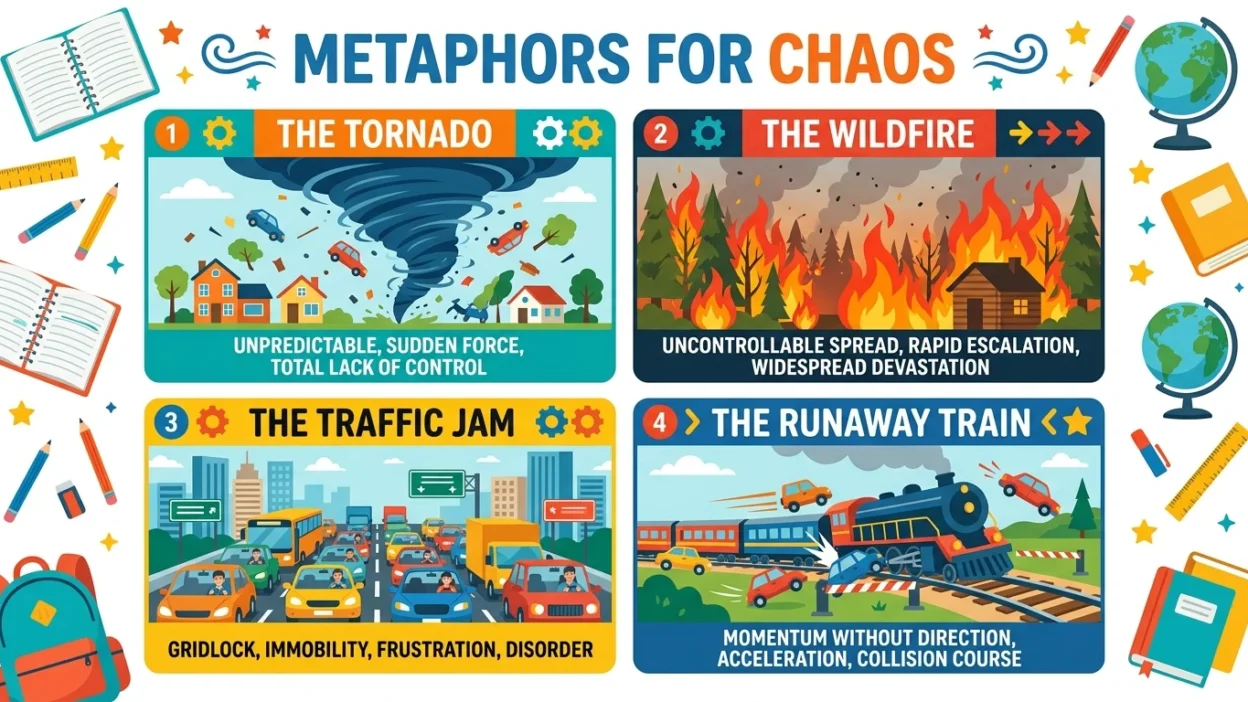
Metaphors for chaos are figurative expressions that compare disorder to something vivid, such as a tornado, wildfire, traffic jam, or battlefield. They help readers imagine confusion and lack of control. These literary devices make creative writing stronger by adding clear images, emotion, and energy to descriptions of chaotic situations.
What Are Metaphors for Chaos?
A metaphor for chaos is a figurative expression that compares a chaotic situation to something else that is known for disorder or destruction.
Examples:
- “The classroom was a tornado.”
- “The city became a battlefield.”
- “Her thoughts were a tangled forest.”
These metaphors do not mean the classroom is really a tornado. They simply create a strong mental image of confusion.
Why Writers Use Metaphors for Chaos
Metaphors help readers see and feel the chaos.
They can show:
- Noise
- Confusion
- Speed
- Disorder
- Danger
- Emotional stress
- Loss of control
Using metaphors makes writing more memorable and engaging.
20 Original Metaphors for Chaos
| Metaphor | Meaning |
|---|---|
| 1. A tornado in a room | Extreme disorder |
| 2. A wildfire without a boundary | Chaos spreading rapidly |
| 3. A traffic jam of thoughts | Mental confusion |
| 4. A broken compass | No direction |
| 5. A battlefield at dawn | Conflict and disorder |
| 6. A crashing wave | Overwhelming confusion |
| 7. A tangled forest | Complicated chaos |
| 8. A shattered mirror | Broken order |
| 9. A runaway train | Out of control |
| 10. A storm of voices | Loud confusion |
| 11. A swarm of bees | Busy, noisy disorder |
| 12. A spinning carousel | Dizzy confusion |
| 13. A volcano of problems | Explosive chaos |
| 14. A maze with no exit | Confusing situation |
| 15. A sinking ship | Collapsing control |
| 16. A circus without a ringmaster | Unmanaged chaos |
| 17. A river in flood | Uncontrolled movement |
| 18. A cloud of sparks | Dangerous confusion |
| 19. A house of falling cards | Unstable disorder |
| 20. A drumline gone wild | Chaotic noise |
Detailed Meanings and Example Sentences
1
A tornado in a room
Meaning: Extreme disorder
Example 1: After the children finished playing, the living room was a tornado in a room.
Example 2: Her desk became a tornado in a room during exam week.
2
A wildfire without a boundary
Meaning: Chaos spreading rapidly
Example 1: Rumors moved through the office like a wildfire without a boundary.
Example 2: Panic became a wildfire without a boundary after the announcement.
3
A traffic jam of thoughts
Meaning: Mental confusion
Example 1: Before the interview, my mind was a traffic jam of thoughts.
Example 2: Stress turned her mind into a traffic jam of thoughts.
4
A broken compass
Meaning: No direction
Example 1: The team was a broken compass after the manager left.
Example 2: Without a plan, the project became a broken compass.
5
A battlefield at dawn
Meaning: Conflict and disorder
Example 1: The meeting turned into a battlefield at dawn.
Example 2: The comment section was a battlefield at dawn.
6
A crashing wave
Meaning: Overwhelming confusion
Example 1: New tasks hit me like a crashing wave.
Example 2: The sudden changes were a crashing wave.
7
A tangled forest
Meaning: Complicated chaos
Example 1: The instructions were a tangled forest.
Example 2: His explanation became a tangled forest of details.
8
A shattered mirror
Meaning: Broken order
Example 1: The schedule was a shattered mirror after the delay.
Example 2: The event became a shattered mirror of canceled plans.
9
A runaway train
Meaning: Out of control
Example 1: The argument became a runaway train.
Example 2: The project turned into a runaway train.
10
A storm of voices
Meaning: Loud confusion
Example 1: The cafeteria was a storm of voices.
Example 2: The crowd became a storm of voices after the game.
11
A swarm of bees
Meaning: Busy, noisy disorder
Example 1: The office was a swarm of bees on Monday morning.
Example 2: Students rushed around like a swarm of bees.
12
A spinning carousel
Meaning: Dizzy confusion
Example 1: Too many decisions made my mind a spinning carousel.
Example 2: The fast changes felt like a spinning carousel.
13
A volcano of problems
Meaning: Explosive chaos
Example 1: The project became a volcano of problems overnight.
Example 2: One mistake created a volcano of problems.
14
A maze with no exit
Meaning: Confusing situation
Example 1: The paperwork was a maze with no exit.
Example 2: The rules turned the process into a maze with no exit.
15
A sinking ship
Meaning: Collapsing control
Example 1: The failing business was a sinking ship.
Example 2: The event became a sinking ship after the power outage.
16
A circus without a ringmaster
Meaning: Unmanaged chaos
Example 1: The classroom was a circus without a ringmaster.
Example 2: The office felt like a circus without a ringmaster during the move.
17
A river in flood
Meaning: Uncontrolled movement
Example 1: Emails became a river in flood.
Example 2: Questions poured in like a river in flood.
18
A cloud of sparks
Meaning: Dangerous confusion
Example 1: The debate became a cloud of sparks.
Example 2: The negotiation turned into a cloud of sparks.
19
A house of falling cards
Meaning: Unstable disorder
Example 1: The plan was a house of falling cards.
Example 2: One delay turned the schedule into a house of falling cards.
20
A drumline gone wild
Meaning: Chaotic noise
Example 1: The hallway sounded like a drumline gone wild.
Example 2: The party became a drumline gone wild by midnight.
Common Mistakes
Avoid these errors
Important
| Incorrect | Better |
|---|---|
| The room was chaos. | The room was a tornado in a room. |
| His mind was chaos. | His mind was a traffic jam of thoughts. |
| The office was very chaotic. | The office was a swarm of bees. |
Tip: Choose a metaphor that matches the type of chaos. Use noise metaphors for loud places and movement metaphors for fast-changing situations.
Similar Expressions
- Pandemonium
- Mayhem
- Disorder
- Confusion
- Turmoil
- Uproar
- Bedlam
- Havoc
These words can often be used alongside metaphors for chaos in creative writing.
Creative Writing Tips
- Match the metaphor to the scene. A school hallway may be a storm of voices, while a failing project may be a sinking ship.
- Use one strong metaphor. Too many metaphors in one sentence can confuse readers.
- Think about the senses. Does the chaos sound loud, look messy, or feel overwhelming?
- Keep it original. Fresh metaphors make writing more memorable.
Practice Questions
Questions
Try first
- Choose a metaphor for a noisy crowd.
- Choose a metaphor for a confusing set of instructions.
- Choose a metaphor for a business losing control.
- Choose a metaphor for many thoughts at once.
- Choose a metaphor for a rapidly spreading problem.
- Choose a metaphor for a classroom without discipline.
- Choose a metaphor for a collapsing plan.
- Choose a metaphor for overwhelming changes.
- Choose a metaphor for dangerous conflict.
- Choose a metaphor for a fast-moving stream of emails.
Answers with Explanations
Check your work
| Question | Answer |
|---|---|
| 1 | A storm of voices |
| 2 | A maze with no exit |
| 3 | A sinking ship |
| 4 | A traffic jam of thoughts |
| 5 | A wildfire without a boundary |
| 6 | A circus without a ringmaster |
| 7 | A house of falling cards |
| 8 | A crashing wave |
| 9 | A cloud of sparks |
| 10 | A river in flood |
FAQs
What are metaphors for chaos?
They are figurative expressions that compare disorder or confusion to something vivid, such as a tornado or wildfire.
Why are metaphors useful in creative writing?
They create strong mental images and help readers feel the scene more clearly.
Can I use metaphors in school assignments?
Yes, if the assignment allows descriptive or creative writing.
What is the difference between a metaphor and a simile?
A metaphor says something is another thing, while a simile uses like or as.
Which metaphor is best for mental confusion?
A traffic jam of thoughts is a strong choice.
Which metaphor works for noisy places?
A storm of voices or a drumline gone wild works well.
Can metaphors make writing too complicated?
Yes. Use one clear metaphor at a time for the strongest effect.
How can I create my own metaphor for chaos?
Think of something that is naturally messy, loud, fast, or out of control, then compare the chaotic situation to it.
Conclusion
Metaphors for chaos are powerful tools in figurative language. They turn simple descriptions of confusion into vivid images that readers can easily imagine. Instead of saying a room was messy or a situation was confusing, you can describe it as a tornado in a room, a traffic jam of thoughts, or a circus without a ringmaster. These literary devices make creative writing more engaging and emotional.
When using metaphors, choose one that matches the type of chaos you want to show. Use noise metaphors for loud scenes, movement metaphors for fast changes, and disaster metaphors for serious problems. With practice, you will be able to create your own original metaphors and make your writing stronger, clearer, and more memorable.

Lucas Luke is a passionate language writer and content creator at SimileHive, specializing in similes, idioms, metaphors, and figurative language. He enjoys making complex English expressions simple, engaging, and easy to understand for students, writers, and language enthusiasts through well-researched, practical content.