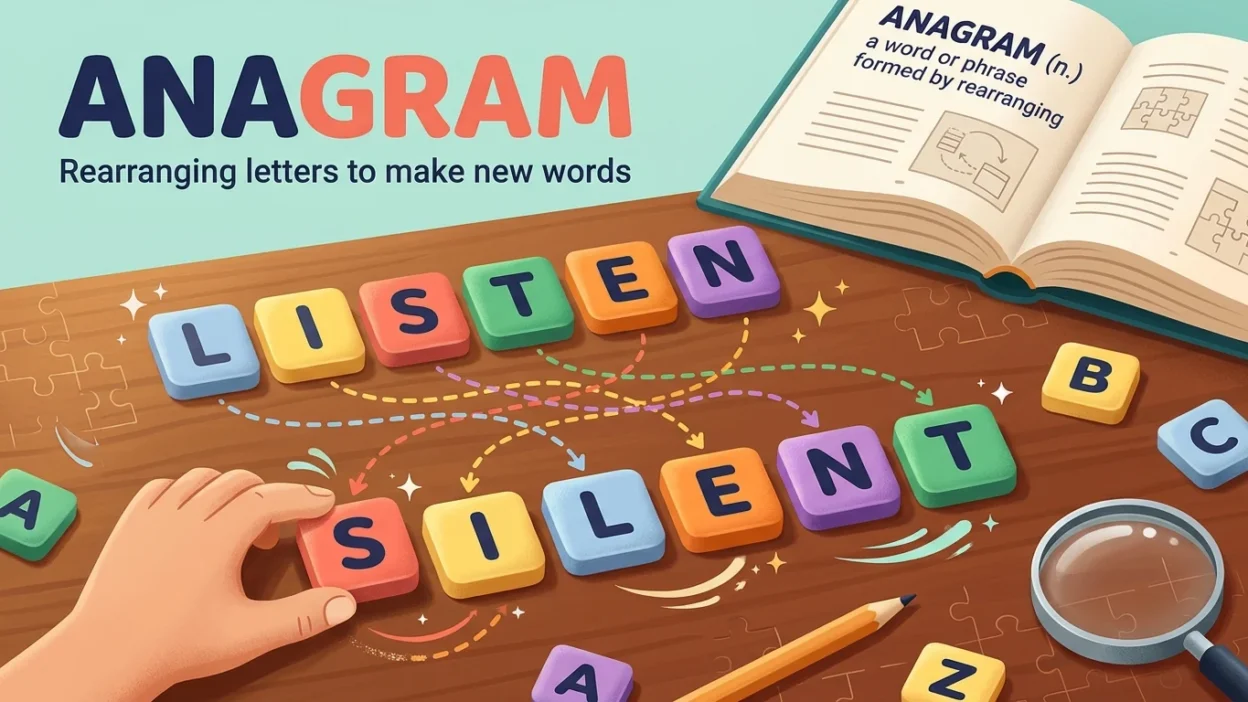
Have you ever rearranged the letters of a word to create another word? If so, you have already experienced an interesting part of the English language called an anagram. An anagram is a word or phrase formed by rearranging all the letters of another word or phrase, using each original letter exactly the same number of times. For example, listen is an anagram of silent, and heart is an anagram of earth. The letters remain unchanged, but their order creates a different word or expression.
Anagrams are popular in word games, puzzles, literature, creative writing, and language learning. They challenge the mind, improve spelling awareness, and encourage people to explore different combinations of letters. Some anagrams are simple, while others involve entire phrases and clever wordplay. Understanding what an anagram is, how it works, and how to recognize one can help you expand your vocabulary and enjoy the creative side of English. Let’s explore its meaning, rules, types, and examples.
Quick Answer
An anagram is a word or phrase created by rearranging all the letters of another word or phrase without adding or removing any letters. For example, listen and silent are anagrams because they contain exactly the same letters. Anagrams are commonly used in word puzzles, games, literature, and creative writing.
Why Do People Confuse Anagrams With Other Word Patterns?
People sometimes confuse anagrams with other word-related terms because they all involve letters, spelling, or word arrangements.
However, an anagram has a specific rule: every letter in the original word or phrase must be used exactly the same number of times in the new arrangement.
For example:
- Listen → Silent
- Earth → Heart
- Below → Elbow
- Inch → Chin
These are genuine anagrams because the letters are rearranged without changing their quantities.
An anagram is different from a palindrome, an acronym, or a simple word scramble. Each term describes a different language concept.
First Word: Anagram
Anagram is a noun that describes a word or phrase formed by rearranging the letters of another word or phrase.
The new arrangement usually creates a different word or expression, although the original letters remain exactly the same.
Meaning of Anagram
According to its general definition, an anagram is a rearrangement of letters that produces another meaningful word or phrase.
For example:
- Listen → Silent
- Angel → Glean
- Below → Elbow
- State → Taste
In each example, the original letters are used without adding or removing any.
How Does an Anagram Work?
Creating an anagram involves three basic steps:
- Choose a word or phrase.
- Rearrange its letters without changing the number of each letter.
- Form another meaningful word or phrase.
For example, consider the word care.
Its letters are C, A, R, and E.
Rearranging them gives:
Care → Race
Both words contain exactly the same four letters.
This is what makes them anagrams.
Types of Anagrams
Anagrams can take different forms depending on how the letters are rearranged and how many words are involved.
1. Word Anagrams
A word anagram is created by rearranging the letters of a single word to form another word.
Examples:
- Listen → Silent
- Heart → Earth
- Below → Elbow
- Night → Thing
- Save → Vase
These are among the easiest anagrams to recognize.
2. Phrase Anagrams
A phrase anagram is created by rearranging all the letters of an entire phrase to produce another phrase.
Examples:
- The eyes → They see
- A gentleman → Elegant man
- Schoolmaster → The classroom
In phrase anagrams, spaces and punctuation are generally ignored. The letters must still match exactly.
3. Name Anagrams
Name anagrams are created by rearranging the letters of a person’s name to produce another name or meaningful phrase.
For example:
- William Shakespeare → I am a weakish speller
This is a famous example of an anagram associated with the name of the English playwright.
4. Multiword Anagrams
Multiword anagrams use the letters of one word or phrase to create several different words.
For example:
- Astronomer → Moon starer
Both expressions use the same letters.
5. Creative or Literary Anagrams
Writers sometimes use anagrams to create humor, hidden messages, fictional names, and clever literary effects.
They can make writing more interesting by connecting words that appear unrelated but share the same letters.
Anagram Examples: 25 Words and Their Anagrams
Here are 25 useful examples to help you understand how anagrams work.
| Original Word | Anagram |
|---|---|
| Listen | Silent |
| Heart | Earth |
| Below | Elbow |
| Night | Thing |
| Angel | Glean |
| Care | Race |
| Act | Cat |
| Tea | Eat |
| Arc | Car |
| Dusty | Study |
| Save | Vase |
| Brag | Grab |
| Stressed | Desserts |
| Inch | Chin |
| State | Taste |
| File | Life |
| Evil | Vile |
| Post | Stop |
| Flow | Wolf |
| Secure | Rescue |
| Master | Stream |
| Fowl | Wolf |
| Bow | Bow |
| Least | Stale |
| Players | Parsley |
Note: Each example must use exactly the same letters. An anagram can have a different number of words, but it cannot add, remove, or duplicate letters.
When Do We Use Anagrams?
Anagrams are used in several areas of language, entertainment, and creative expression.
1. Word Games and Puzzles
Anagrams are common in crossword puzzles, word searches, and spelling games.
For example, a puzzle might ask you to rearrange the letters in listen to find another word.
Answer: Silent.
2. Creative Writing
Writers use anagrams to create interesting character names, hidden meanings, jokes, and literary effects.
They can make stories more imaginative and entertaining.
3. Literature and Poetry
Anagrams can add clever wordplay to poems, stories, and other literary works.
Writers may use them to create connections between different words or reveal hidden meanings.
4. Education and Vocabulary Building
Teachers use anagram activities to help students recognize spelling patterns, develop vocabulary, and improve their understanding of letters.
For English learners, anagrams can be an enjoyable way to practise spelling.
5. Entertainment and Brain Training
Solving anagrams is a popular mental activity. It encourages people to recognize patterns, remember vocabulary, and think creatively.
15 Examples of Anagrams in Sentences
Here are practical examples showing how anagrams can be discussed and used in everyday English.
- Listen and silent are two common examples of anagrams.
- My teacher asked us to create an anagram using the word heart.
- The puzzle required me to rearrange the letters of angel to form glean.
- She enjoys solving anagrams in her free time.
- Night and thing contain exactly the same letters.
- The word elbow is an anagram of below.
- We played an anagram game during our English lesson.
- The author used an anagram to create a fictional character’s name.
- Can you find an anagram of the word race?
- The letters in dusty can be rearranged to form study.
- He solved the difficult anagram in less than a minute.
- Anagrams are useful for practising spelling and vocabulary.
- The word desserts is an anagram of stressed.
- The students competed to solve the most anagrams.
- She discovered that secure and rescue are anagrams.
Common Mistakes to Avoid
Although anagrams are easy to understand, people sometimes make mistakes when identifying or creating them.
1. Adding or Removing Letters
A genuine anagram must contain exactly the same letters as the original word.
Incorrect example:
Listen → Listens
These are not anagrams because the second word contains an additional letter.
Correct example:
Listen → Silent
2. Repeating a Letter Unnecessarily
You cannot use a letter more times than it appears in the original word.
For example, the word heart contains only one A. Therefore, an anagram cannot contain two As.
3. Confusing Anagrams With Palindromes
An anagram rearranges letters to create another word or phrase.
A palindrome is a word or phrase that reads the same forward and backward.
Examples:
- Anagram: Listen → Silent.
- Palindrome: Level.
These are different language concepts.
4. Thinking Every Rearrangement Is an Anagram
Simply changing the order of letters does not automatically create a meaningful anagram.
The rearranged letters must form a recognizable word or meaningful phrase.
5. Ignoring Letter Frequency
Anagrams must preserve the number of each letter.
For example, earth and heart are anagrams because both contain E, A, R, T, and H exactly once.
Memory Trick: How to Remember Anagram
Use this simple trick:
Anagram = Same letters, different arrangement.
Remember the following examples:
- Listen → Silent
- Heart → Earth
- Below → Elbow
- Night → Thing
Think of an anagram as a letter-rearranging puzzle. You do not add or remove letters; you simply change their positions to create another meaningful word or phrase.
American vs British English: Anagram
There is no significant difference between American and British English when it comes to the word anagram.
Both varieties use the same spelling, pronunciation, and basic meaning.
American English
In American English, anagram refers to a word or phrase formed by rearranging the letters of another word or phrase.
Example: Listen and silent are anagrams.
British English
British English uses anagram in exactly the same way.
Example: The students solved several anagrams during the lesson.
Which Spelling Should International Writers Use?
Use anagram in both American and British English. The spelling does not change between the two varieties.
Similar Words Related to Anagram
Several English terms describe different ways of arranging, shortening, or playing with words and letters.
- Palindrome: A word or phrase that reads the same forward and backward, such as level or madam.
- Acronym: A word formed from the initial letters of a group of words, such as NASA.
- Abbreviation: A shortened form of a word or phrase.
- Initialism: An abbreviation pronounced letter by letter, such as FBI.
- Homophone: A word that sounds like another word but has a different meaning or spelling, such as their and there.
- Homonym: A word that shares its spelling or pronunciation with another word but has a different meaning.
- Synonym: A word with the same or nearly the same meaning as another word.
- Antonym: A word with the opposite meaning of another word.
- Word scramble: A set of letters presented in a mixed order that must be rearranged to form a word.
These terms are related to language and word structure, but they describe different concepts.
Final Verdict: What Is an Anagram?
An anagram is a word or phrase created by rearranging the letters of another word or phrase without adding or removing any letters.
For example, listen and silent, heart and earth, and below and elbow are all anagrams.
Anagrams are useful in word games, puzzles, creative writing, literature, and vocabulary development. They help people recognize spelling patterns and explore the flexibility of the English language.
The easiest way to remember the term is that an anagram uses the same letters in a different order to create another meaningful word or phrase.
Frequently Asked Questions (FAQs)
1. What is an anagram in simple words?
An anagram is a word or phrase made by rearranging all the letters of another word or phrase. For example, listen and silent are anagrams because they contain exactly the same letters.
2. What are five examples of anagrams?
Five examples are:
- Listen → Silent
- Heart → Earth
- Below → Elbow
- Night → Thing
- Angel → Glean
Each pair uses exactly the same letters.
3. What is the difference between an anagram and a palindrome?
An anagram rearranges letters to create another word or phrase, while a palindrome reads the same forward and backward. For example, listen and silent are anagrams, whereas level is a palindrome.
4. Can an anagram be a phrase?
Yes. An anagram can be a single word or an entire phrase. For example, “The eyes” and “They see” are anagrams because they contain exactly the same letters when spaces are ignored.
5. What is the purpose of an anagram?
Anagrams are used in word games, puzzles, literature, creative writing, and educational activities. They encourage vocabulary development, spelling practice, and creative thinking.
6. Can an anagram have more than one word?
Yes. An anagram can contain one word or multiple words. For example, astronomer and moon starer are anagrams.
7. Is anagram a noun or a verb?
Anagram is primarily a noun. It refers to a word or phrase created by rearranging letters. The related verb is anagram, meaning to rearrange the letters of a word or phrase to form another.
Remember This
- An anagram is a rearrangement of letters.
- It can be a word or a phrase.
- All original letters must be used.
- No letters can be added or removed.
- Listen and silent are anagrams.
- Heart and earth are anagrams.
- Anagrams are common in puzzles, games, and creative writing.
- A palindrome is different from an anagram.
Conclusion
Anagrams are an interesting part of the English language because they show how rearranging the same letters can create entirely different words and expressions. From simple examples such as listen and silent to more creative phrase combinations, anagrams make language learning enjoyable and encourage people to think about spelling in new ways.
Whether you encounter them in puzzles, classroom activities, literature, or word games, understanding anagrams can improve your vocabulary and spelling awareness. Remember the basic rule: an anagram uses exactly the same letters as the original word or phrase, but arranges them differently to create another meaningful expression.

Charles Kevin is a passionate language writer and researcher at SimileHive, creating clear, engaging content about similes, idioms, metaphors, and figurative language to help readers improve English communication confidently every day.