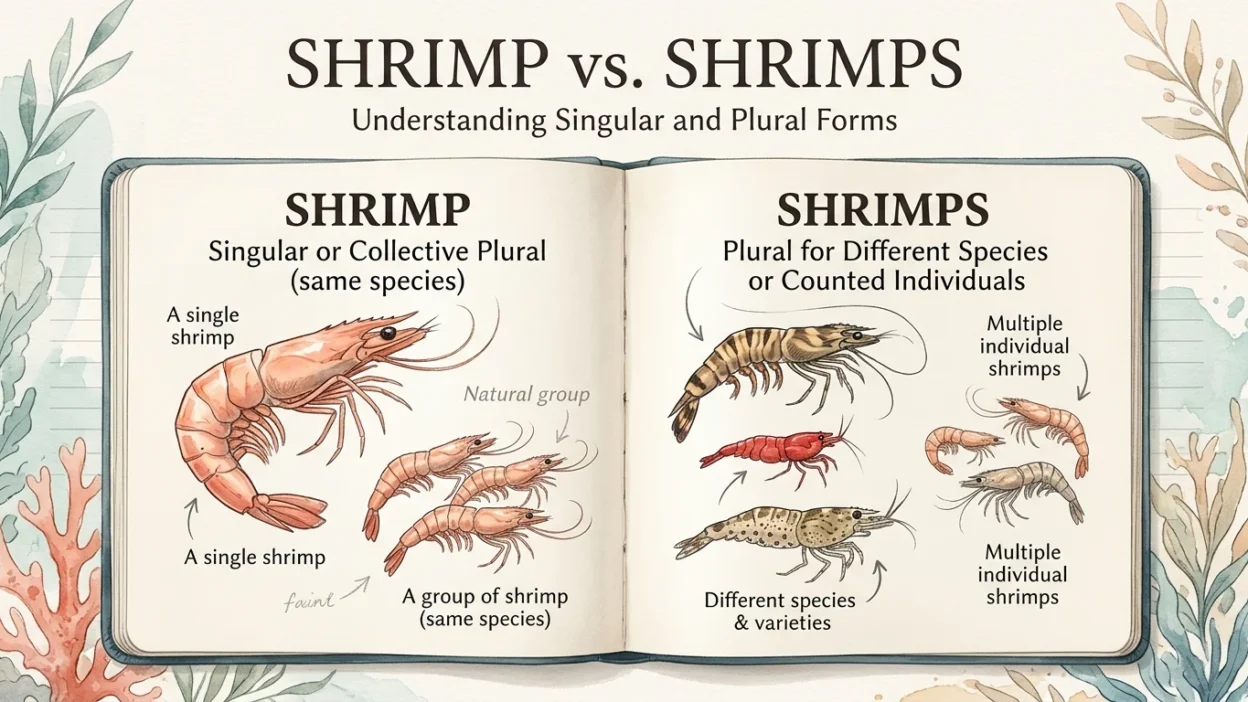
Is the plural of shrimp shrimp or shrimps? Both forms are correct, but their usage depends on context, regional preferences, and the type of English being used. Shrimp can function as both a singular and plural noun, while shrimps is also an accepted plural form, particularly when referring to different species or individual animals. For example, you can say, “I caught three shrimp” or “I caught three shrimps.” Both sentences are grammatically acceptable.
The confusion arises because shrimp belongs to a group of English nouns that can have unchanged plural forms. However, unlike some nouns with only one accepted plural, shrimp also has a regular plural form ending in -s. Understanding when to use shrimp and shrimps will help you write naturally, whether you are discussing seafood, cooking, marine animals, or different shrimp species. Let’s explore their meanings, grammatical differences, examples, and usage rules.
Quick Answer
Shrimp and shrimps are both correct plural forms of shrimp. Shrimp is the more common plural form, especially when discussing seafood or referring to shrimp collectively. Shrimps is also correct and is often used when emphasizing individual animals or different species. For example, “I bought ten shrimp” and “I bought ten shrimps” are both grammatically acceptable.
Why Do People Confuse Shrimp and Shrimps?
People confuse shrimp and shrimps because English has different ways of forming plural nouns.
Most countable nouns become plural by adding -s or -es.
Examples:
- Book becomes books.
- Car becomes cars.
- Dish becomes dishes.
- Shrimp can become shrimps.
However, some nouns have the same singular and plural forms.
Examples:
- One sheep, two sheep.
- One deer, two deer.
- One fish, two fish.
- One shrimp, two shrimp.
This is why both shrimp and shrimps can be used as plurals.
The important thing to remember is that shrimp is commonly used as an unchanged plural, while shrimps is an accepted regular plural.
First Word: Shrimp
Shrimp is a noun referring to a small aquatic crustacean with an elongated body, a flexible shell, and several pairs of legs. It is commonly found in oceans, rivers, and other bodies of water.
The word shrimp can be both singular and plural.
Meaning of Shrimp
Shrimp has two main grammatical uses:
- Singular: Referring to one individual shrimp.
- Plural: Referring to two or more shrimp without changing the word’s form.
It is especially common in everyday English, seafood discussions, restaurant menus, and cooking instructions.
Examples of Shrimp
- I bought a pound of shrimp from the market.
- We ordered grilled shrimp for dinner.
- She caught three shrimp near the shore.
- This shrimp is larger than the others.
- The aquarium has several species of shrimp.
Notice that shrimp can refer to one animal or multiple animals. The surrounding sentence makes its number clear.
Second Word: Shrimps
Shrimps is the regular plural form of shrimp. It is grammatically correct and can refer to multiple individual shrimp.
Although it is less common than the unchanged plural shrimp in many everyday contexts, it is frequently used when emphasizing individual animals or different species.
Meaning of Shrimps
Shrimps refers to more than one shrimp.
It is particularly useful when:
- Emphasizing individual shrimp as separate animals.
- Discussing different types or species of shrimp.
- Describing multiple shrimp in biological or scientific contexts.
- Following a regular plural pattern in a sentence.
Examples of Shrimps
- The shrimps were swimming near the rocks.
- Several shrimps were caught in the fishing net.
- Different shrimps have different body patterns.
- The scientist studied the shrimps in the aquarium.
- Small shrimps were hiding among the sea plants.
Shrimps is not incorrect or grammatically inferior. It is simply less common in some everyday uses.
Shrimp vs Shrimps: Comparison Table
| Feature | Shrimp | Shrimps |
|---|---|---|
| Singular form | Yes | No |
| Plural form | Yes | Yes |
| Grammatical status | Correct | Correct |
| Everyday usage | More common | Less common |
| Seafood context | Very common | Also acceptable |
| Individual animals | Common | Common |
| Different species | Acceptable | Often useful |
| Example | Five shrimp | Five shrimps |
The main difference is usage preference, not grammatical correctness. Both forms can refer to multiple shrimp.
When Should You Use Shrimp or Shrimps?
Choosing between shrimp and shrimps is easy once you understand the context.
When to Use Shrimp
Use shrimp when referring to seafood collectively or when discussing a number of shrimp in everyday English.
Examples:
- We had shrimp for lunch.
- I bought twelve shrimp from the seafood market.
- The restaurant serves delicious shrimp.
- There are several shrimp in the tank.
- She cooked shrimp with garlic and butter.
Shrimp is generally the safer and more natural choice for everyday communication.
When to Use Shrimps
Use shrimps when you want to emphasize individual animals or distinguish different types or species.
Examples:
- The researchers examined several shrimps.
- These shrimps live in freshwater.
- Different shrimps have different feeding habits.
- The small shrimps gathered near the rocks.
- Several shrimps were found in the coral reef.
However, shrimp would also be grammatically acceptable in most of these examples.
Is Shrimp or Shrimps More Common?
Shrimp is generally more common, particularly in American English and everyday seafood-related language.
For example:
- Natural: I ordered grilled shrimp.
- Also correct: I ordered grilled shrimps.
The first sentence is more conventional in everyday communication.
12 Examples of Shrimp vs Shrimps in Sentences
Here are practical examples showing how both forms work.
- Shrimp: I bought five shrimp from the market.Shrimps: I bought five shrimps from the market.
- Shrimp: The shrimp were fresh and delicious.Shrimps: The shrimps were fresh and delicious.
- Shrimp: We ordered shrimp for dinner.Shrimps: We ordered shrimps for dinner.
- Shrimp: Several shrimp were swimming in the aquarium.Shrimps: Several shrimps were swimming in the aquarium.
- Shrimp: The fisherman caught many shrimp.Shrimps: The fisherman caught many shrimps.
- Shrimp: These shrimp live in freshwater.Shrimps: These shrimps live in freshwater.
- Shrimp: The chef prepared spicy shrimp.Shrimps: The chef prepared spicy shrimps.
- Shrimp: Small shrimp were hiding beneath the rocks.Shrimps: Small shrimps were hiding beneath the rocks.
- Shrimp: The aquarium contains different shrimp species.Shrimps: The aquarium contains different shrimps.
- Shrimp: I saw three shrimp near the shore.Shrimps: I saw three shrimps near the shore.
- Shrimp: The shrimp were moving around the sea plants.Shrimps: The shrimps were moving around the sea plants.
- Shrimp: Scientists studied the shrimp in their natural habitat.Shrimps: Scientists studied the shrimps in their natural habitat.
Both forms are correct, although shrimp is often the more natural choice in general writing.
Common Mistakes to Avoid
Although shrimp and shrimps are both correct, some mistakes can create confusion.
1. Assuming Shrimps Is Incorrect
Some people believe shrimp is the only acceptable plural form.
This is incorrect. Shrimps is also a recognized plural form.
2. Assuming Shrimp Is Always Singular
Shrimp can refer to one animal or several animals.
Examples:
- Singular: This shrimp is delicious.
- Plural: These shrimp are delicious.
The verb and surrounding words help identify whether the noun is singular or plural.
3. Using the Wrong Verb
When shrimp refers to multiple animals, use a plural verb.
Incorrect: The shrimp is swimming in the aquarium. (When referring to several shrimp.)
Correct: The shrimp are swimming in the aquarium.
4. Confusing Shrimp With Fish
Shrimp and fish are different types of aquatic animals. Although both words can have unchanged plural forms, their meanings are different.
Example:
- Three shrimp are swimming in the tank.
- Three fish are swimming in the tank.
5. Thinking Both Forms Always Have Identical Usage
Although both forms can refer to multiple animals, their frequency and contextual preferences can differ. Shrimp is more common in general seafood references, while shrimps can be useful when discussing individual animals or species.
Memory Trick: How to Remember Shrimp vs Shrimps
Use this simple trick:
Shrimp = The common plural form.
Shrimps = The regular plural form with -s.
Remember these examples:
- One shrimp.
- Two shrimp.
- Two shrimps.
All three expressions are grammatically correct.
If you are writing a restaurant menu, recipe, everyday conversation, or general article, shrimp is usually the most natural choice.
American vs British English: Shrimp or Shrimps?
Both American and British English recognize shrimp and shrimps as plural forms. However, their usage preferences can vary.
American English
American English commonly uses shrimp as both singular and plural.
Examples:
- I bought a pound of shrimp.
- We ordered shrimp tacos.
- Several shrimp were swimming in the aquarium.
Shrimps is also accepted, although it is less common in everyday seafood references.
British English
British English also uses shrimp and shrimps. The unchanged plural is common, but shrimps can appear when referring to individual animals or different species.
Examples:
- We bought some shrimp for dinner.
- Several shrimps were found in the water.
It is also worth noting that prawns are commonly used in British English for many larger crustaceans sold as seafood. However, shrimp and prawn are not always interchangeable in scientific classification or commercial usage.
Which Form Should International Writers Choose?
If you are writing for an international audience, shrimp is generally the safest choice as a plural noun.
Use shrimps when the context makes the regular plural more suitable.
Similar Words With Unchanged or Alternative Plural Forms
English contains several nouns that have unchanged plural forms or more than one accepted plural.
Understanding these examples can help you recognize similar grammatical patterns.
- Fish / Fishes: Fish is the usual plural, while fishes often refers to different species.
- Sheep / Sheep: The singular and plural forms are identical.
- Deer / Deer: The same form is used for one or multiple animals.
- Salmon / Salmon: Salmon commonly remains unchanged in the plural.
- Trout / Trout: Trout can refer to one or multiple fish.
- Squid / Squids: Both forms are used, depending on context.
- Octopus / Octopuses: Octopuses is the standard English plural.
- Species / Species: The singular and plural forms are identical.
These examples show that English does not follow one universal rule for forming plural nouns.
Final Verdict: Shrimp vs Shrimps
Both shrimp and shrimps are grammatically correct plural forms of shrimp. The word shrimp can function as both singular and plural, making it especially common in everyday English, seafood discussions, and cooking contexts.
Shrimps is also correct and is sometimes preferred when emphasizing individual animals or discussing different species. However, shrimp remains the more widely used and generally preferred plural form.
If you are unsure which one to choose, use shrimp. It is natural, widely accepted, and suitable for most everyday and formal writing.
Frequently Asked Questions (FAQs)
1. Is it shrimp or shrimps?
Both are correct. Shrimp is commonly used as both singular and plural, while shrimps is an accepted regular plural form.
2. What is the plural of shrimp?
The plural of shrimp can be shrimp or shrimps. For example, “I caught five shrimp” and “I caught five shrimps” are both correct.
3. Is shrimps grammatically correct?
Yes. Shrimps is a grammatically correct plural form of shrimp. It is less common in some everyday contexts but is accepted in standard English.
4. Why do people say shrimp instead of shrimps?
People commonly use shrimp because it is an unchanged plural noun in English. It is particularly common when discussing seafood, recipes, and multiple shrimp collectively.
5. Do Americans say shrimp or shrimps?
Americans generally use shrimp as both singular and plural. Shrimps is also correct but is less common in everyday conversation.
6. Do British people say shrimp or shrimps?
British English recognizes both forms. Shrimp is common, while shrimps can be used when referring to individual animals or different species.
7. Is it five shrimp or five shrimps?
Both expressions are grammatically correct. However, five shrimp is generally more common and natural in everyday English.
Remember This
- Shrimp and shrimps are both correct.
- Shrimp can be singular or plural.
- Shrimps is the regular plural form.
- Shrimp is more common in everyday English.
- Shrimps can emphasize individual animals or different species.
- Both forms are recognized in American and British English.
- When unsure, choose shrimp.
Conclusion
The difference between shrimp and shrimps is mainly a matter of usage and preference. Both are accepted plural forms, and neither should automatically be considered incorrect. Shrimp is particularly common in everyday English because it can refer to one animal or multiple animals without changing its form. Shrimps follows the regular plural pattern and is also acceptable.
Remember that you can say both “I bought five shrimp” and “I bought five shrimps.” However, if you want your writing to sound natural and familiar to a broad English-speaking audience, shrimp is generally the better choice.

Adam Aaron is a language enthusiast and content writer at SimileHive, creating clear, engaging guides on similes, idioms, metaphors, and figurative language to help readers improve English confidently every day.