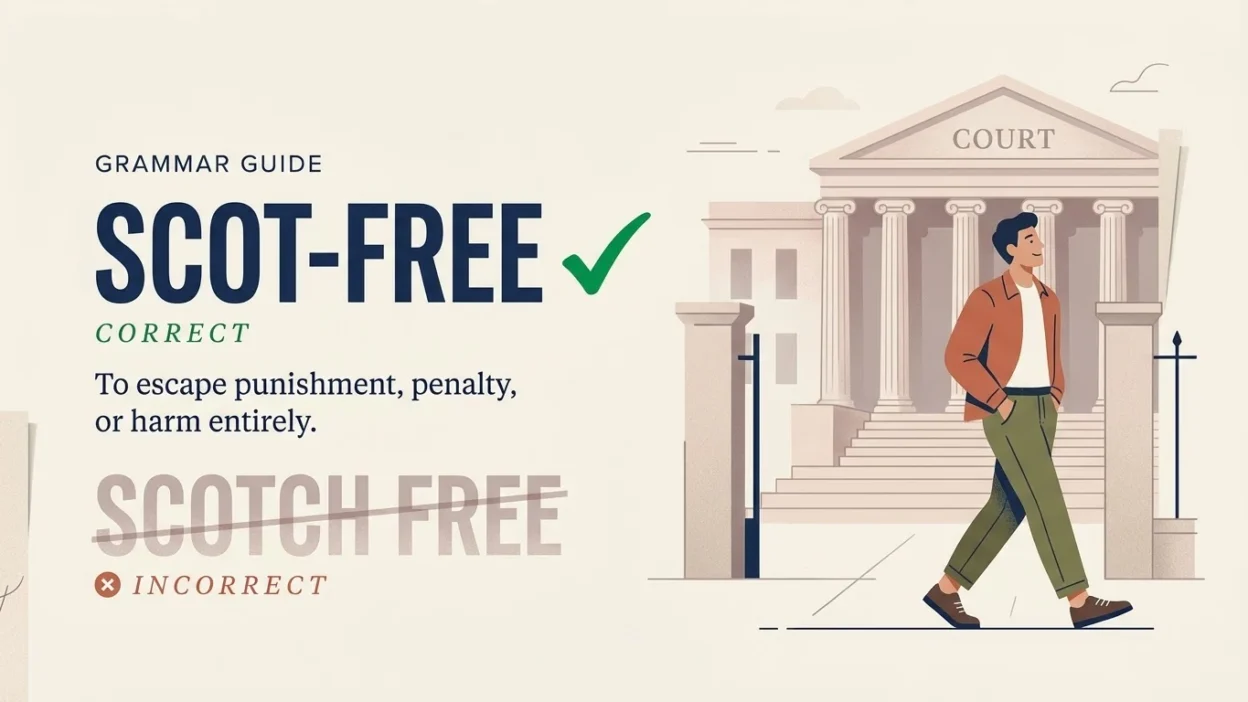
Is it scotch free or scot-free? If you have encountered both expressions, you may wonder whether they mean the same thing or whether one is a spelling mistake. The correct expression is scot-free, written as one word with a hyphen. It means escaping punishment, responsibility, or an unpleasant consequence without suffering any penalty. For example, “The thief escaped scot-free despite being caught on camera.”
The confusion often arises because people mistakenly write scotch free instead of scot-free. Although Scotch is a real English word, it does not form part of this expression. Understanding the correct spelling, meaning, origin, and usage of scot-free will help you avoid this common mistake. In this guide, we will explore the difference, provide practical examples, explain common errors, and show you how to use the expression naturally in everyday and formal writing.
Quick Answer
Scot-free is the correct spelling. It is a hyphenated expression meaning to escape punishment, blame, payment, or an unpleasant consequence. Scotch free is incorrect when used with this intended meaning. For example, “He broke the rules but walked away scot-free.” Remember to write scot-free, not scotch free.
Why Do People Confuse Scotch Free and Scot-Free?
People confuse these expressions mainly because the word scot is less familiar in modern English than Scotch.
Scotch is commonly associated with Scotch whisky and things related to Scotland. As a result, some writers mistakenly replace the unfamiliar word scot with Scotch.
However, the expression has a different historical origin. The word scot once referred to a tax, payment, or contribution. Therefore, getting off scot-free originally meant escaping a required payment or financial obligation.
Over time, the expression developed its modern meaning of escaping punishment or avoiding an unpleasant consequence.
The distinction is simple: scot-free is the established expression, while scotch free is not a correct alternative.
First Word: Scot-Free
Scot-free is an idiomatic expression that means escaping punishment, blame, responsibility, or payment without suffering the expected consequences.
It is an adjective and is commonly used after verbs such as go, get away, walk, and escape.
Meaning of Scot-Free
Scot-free can describe someone who:
- Escapes punishment after doing something wrong.
- Avoids responsibility for an action.
- Gets away without paying a required amount.
- Avoids an unpleasant consequence.
- Escapes blame despite being involved in a problem.
The expression often carries a negative or critical tone, particularly when someone avoids consequences they deserve.
Examples of Scot-Free
- The dishonest employee walked away scot-free after the investigation.
- He damaged the property but escaped scot-free.
- The company should not be allowed to go scot-free after ignoring safety regulations.
- She thought she could break the rules and get away scot-free.
- The suspect was released, leaving the victims worried that he might go scot-free.
In each sentence, scot-free describes escaping a penalty or consequence.
Second Word: Scotch Free
Scotch free is not the correct spelling of the idiom scot-free. It is a common spelling error caused by confusing the word scot with Scotch.
What Does Scotch Mean?
Scotch is an adjective traditionally associated with Scotland, Scottish people, or things originating in Scotland. It is also commonly used as a noun referring to Scotch whisky.
Examples:
- He bought a bottle of Scotch whisky.
- They visited a Scotch whisky distillery.
- The restaurant offers several types of Scotch.
Scotch can also function as a verb meaning to put an end to something, prevent it, or render it ineffective.
For example:
- The new evidence scotched the rumor.
- The announcement scotched their plans.
However, none of these meanings makes scotch free a correct alternative to scot-free.
Is Scotch Free Ever Correct?
The words scotch and free can appear together in an ordinary sentence when they have separate meanings.
For example, someone might describe a product as free from Scotch whisky or discuss a Scotch-free beverage.
However, this is different from the idiom scot-free. When you mean escaping punishment or consequences, always use scot-free.
Scotch Free vs Scot-Free: Comparison Table
| Feature | Scot-Free | Scotch Free |
|---|---|---|
| Correct idiom | Yes | No |
| Meaning | Escaping punishment or consequences | Not the intended idiom |
| Grammatical use | Adjective | Not an established expression with this meaning |
| Spelling | Hyphenated | Incorrect as a substitute |
| Example | He went scot-free. | He went scotch free. |
| Origin | Historical word scot | Scotch relates to Scotland or other meanings |
The important distinction is that scot-free is the established idiom. Scotch free should not be used when describing someone who escapes punishment.
When Should You Use Scot-Free?
Use scot-free when you want to describe someone escaping punishment, blame, payment, or another expected consequence.
1. When Someone Escapes Punishment
- The criminal went scot-free because of insufficient evidence.
- He broke the law but managed to walk away scot-free.
- The offender should not be allowed to escape scot-free.
2. When Someone Avoids Responsibility
- The manager cannot go scot-free after making such a serious mistake.
- She blamed everyone else and got away scot-free.
- The company escaped responsibility and went scot-free.
3. When Someone Avoids Payment
- He received the services but left without paying and went scot-free.
- The customer should not be allowed to escape the financial obligation scot-free.
This financial sense is connected to the expression’s historical meaning.
12 Examples of Scot-Free in Sentences
Here are practical examples to help you understand how to use scot-free correctly.
- The thief escaped scot-free after stealing the expensive watch.
- He thought he could cheat in the examination and walk away scot-free.
- The company should not go scot-free after causing environmental damage.
- She broke the rules but managed to get away scot-free.
- The corrupt official escaped punishment and went scot-free.
- Nobody should be allowed to behave irresponsibly and escape scot-free.
- The driver caused the accident but somehow walked away scot-free.
- The investigation revealed serious misconduct, yet the manager went scot-free.
- He was caught lying but escaped scot-free without facing any consequences.
- The authorities must ensure that the guilty individuals do not go scot-free.
- She expected to be punished, but she got off scot-free.
- The organization should not be allowed to escape accountability and go scot-free.
Notice that scot-free usually appears with verbs such as go, get away, walk, and escape.
Common Mistakes to Avoid
Even though scot-free is a relatively simple expression, writers sometimes make these mistakes.
1. Writing Scotch Free Instead of Scot-Free
Incorrect: The dishonest businessman went scotch free.
Correct: The dishonest businessman went scot-free.
Always use scot-free when referring to escaping punishment or responsibility.
2. Removing the Hyphen
The standard spelling of the idiom is scot-free, with a hyphen.
Preferred: He escaped scot-free.
Avoid changing the established spelling to scot free in carefully edited writing.
3. Confusing Scot With Scotch
Scot and Scotch are different words.
- Scot: Historically, a tax or payment; also a person from Scotland.
- Scotch: Associated with Scotland or Scottish products; also a verb meaning to put an end to something.
Neither word should be confused with the complete idiom scot-free.
4. Assuming Scot-Free Always Refers to Criminals
Scot-free is not limited to criminal situations. It can also describe someone avoiding blame, responsibility, payment, or other consequences.
Example: The employee ignored the instructions but went scot-free.
Memory Trick: How to Remember Scot-Free vs Scotch Free
Use this simple trick:
Scot-free = No penalty, no payment, no consequences.
Remember that the correct expression contains the shorter word scot, not Scotch.
Think of this example:
“The dishonest person escaped punishment and went scot-free.”
You can also remember the expression by connecting its historical meaning with avoiding a tax or payment.
Whenever you mean that someone has escaped the consequences of an action, write scot-free.
American vs British English: Scot-Free
There is no significant spelling difference between American and British English when it comes to scot-free.
Both varieties use the same hyphenated spelling and recognize the same basic meaning.
American English
In American English, scot-free is commonly used in everyday conversation, journalism, and formal writing.
Examples:
- The suspect walked away scot-free.
- The company should not escape responsibility scot-free.
British English
British English also uses scot-free with the same spelling and meaning.
Examples:
- The offender went scot-free.
- He cannot expect to escape punishment scot-free.
Which Spelling Should International Writers Use?
Use scot-free regardless of whether you are writing in American or British English. The spelling does not change between the two varieties.
Similar Words and Expressions Related to Scot-Free
Understanding synonyms can help you express the same idea in different ways.
- Unpunished: Not receiving punishment for an action.
- Unscathed: Escaping without injury or damage.
- Unaccountable: Not being held responsible for something.
- Exonerated: Officially cleared of blame or wrongdoing.
- Acquitted: Legally declared not guilty of a criminal charge.
- Get away with something: Avoid punishment for doing something wrong.
- Escape consequences: Avoid the results of an action.
- Off the hook: Freed from responsibility, blame, or an obligation.
- Let off: Allowed to avoid or receive reduced punishment.
These expressions are related but do not always have exactly the same meaning.
For example, someone who is acquitted may have been found not guilty, whereas someone who goes scot-free may have escaped punishment without necessarily being proven innocent.
Final Verdict: Scotch Free vs Scot-Free
Scot-free is the correct expression, while scotch free is an incorrect spelling when referring to escaping punishment or consequences.
Scot-free means avoiding punishment, blame, payment, or responsibility. It is a well-established English idiom used in both American and British English.
Remember that the expression contains the word scot, not Scotch, and is conventionally written with a hyphen. Whenever you describe someone escaping without facing the consequences of an action, use scot-free.
Frequently Asked Questions (FAQs)
1. Is it scotch free or scot-free?
Scot-free is correct. It is a hyphenated expression meaning to escape punishment, blame, payment, or responsibility. Scotch free is an incorrect alternative when used with this meaning.
2. What does scot-free mean?
Scot-free means escaping punishment or an unpleasant consequence without paying a penalty or being held responsible. For example, “The thief went scot-free.”
3. Is scot-free one word or two?
Scot-free is conventionally written as one hyphenated expression. It is neither written as two separate words nor as a single unhyphenated word in standard edited English.
4. Is scot-free British or American English?
Scot-free is used in both British and American English. Its spelling and meaning remain the same in both varieties.
5. Where does the expression scot-free come from?
The expression comes from the historical word scot, which referred to a tax, payment, or contribution. Someone who escaped paying their share was said to get off scot-free. Its meaning later expanded to include escaping punishment or other consequences.
6. Can scot-free be used in a sentence?
Yes. Scot-free is commonly used in sentences describing someone who avoids punishment or responsibility. For example, “The dishonest businessman should not be allowed to go scot-free.”
7. What is another word for scot-free?
Depending on the context, alternatives include unpunished, unaccountable, unscathed, and off the hook. The phrase get away with something is another common alternative.
Remember This
- Scot-free is the correct expression.
- Scotch free is incorrect when used to mean escaping punishment.
- Scot-free means avoiding punishment, blame, payment, or consequences.
- The expression is written with a hyphen.
- It is used in both American and British English.
- Its historical meaning is connected to escaping a tax or payment.
- When someone avoids the consequences of wrongdoing, they go scot-free.
Conclusion
The difference between scotch free and scot-free is straightforward once you understand the expression’s meaning and origin. Scot-free is the established English idiom used when someone escapes punishment, responsibility, payment, or an unpleasant consequence. Scotch free is not an acceptable substitute for this expression, even though Scotch is a legitimate English word with its own meanings.
Remember to write scot-free with a hyphen whenever you describe someone getting away without facing the expected consequences. Whether you are writing an academic assignment, a professional article, or an everyday message, using the correct expression will make your English clearer and more accurate.

Lucas Luke is a passionate language writer and content creator at SimileHive, specializing in similes, idioms, metaphors, and figurative language. He enjoys making complex English expressions simple, engaging, and easy to understand for students, writers, and language enthusiasts through well-researched, practical content.