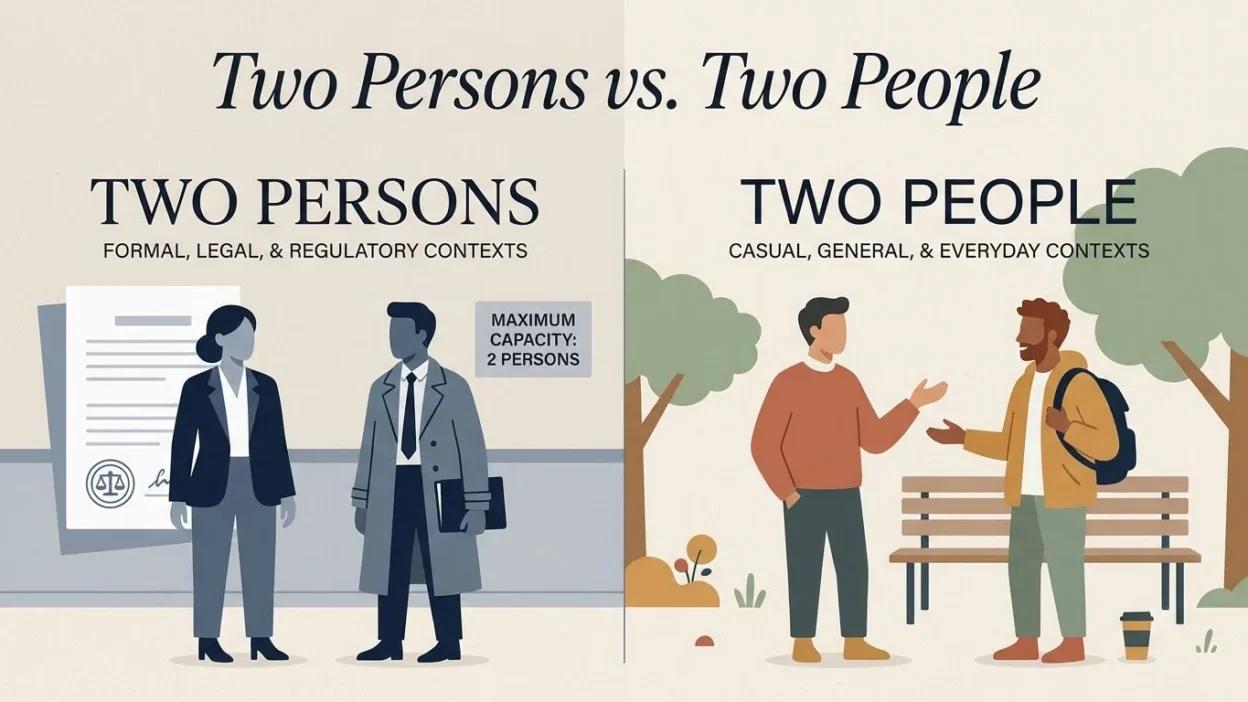
Is it correct to say two persons or two people? Both expressions are grammatically correct, but they differ in tone, usage, and context. People is the natural and widely preferred plural form of person in everyday English. Persons, on the other hand, is generally used in formal, legal, official, and administrative contexts. For example, you would normally say, “Two people are waiting outside,” rather than “Two persons are waiting outside.” However, a notice might say, “Only two persons are allowed inside.”
Understanding the difference between these expressions can help you communicate naturally and choose the right wording for different situations. Although both refer to more than one individual, they are not equally common in everyday conversation. In this guide, we will explore their meanings, grammatical rules, differences, practical examples, and regional usage so you can confidently decide whether to use two persons or two people.
Quick Answer
Both two persons and two people are grammatically correct. However, two people is the more natural and common expression in everyday English. Two persons is generally preferred in formal, legal, official, and administrative contexts. Use people for ordinary conversations and persons when a formal or technical tone is appropriate.
Why Do People Confuse Two Persons and Two People?
People often confuse these expressions because persons and people are both plural forms of person.
The confusion comes from English having more than one accepted way to express the plural of certain nouns.
For example:
- One person, two people.
- One person, two persons.
Both combinations are grammatically acceptable, but their usage differs.
In modern English, people is the standard plural form in most everyday situations. Persons is also correct, but it is more commonly associated with official notices, legal documents, regulations, and formal statements.
The important thing to remember is that the choice depends on context, not simply on grammar.
First Word: Two Persons
Two persons refers to two individual human beings. It is a grammatically correct plural expression, generally used in formal, legal, official, or administrative language.
Although it can be used in ordinary English, it often sounds more formal than two people.
Meaning of Persons
Persons is the plural form of person used when referring to individuals as separate members of a group.
It is particularly common when:
- Identifying individuals in legal documents.
- Writing official rules and regulations.
- Describing the number of people permitted in a place.
- Recording the number of individuals involved in an incident.
- Preparing formal or administrative reports.
Examples of Two Persons
- Two persons were arrested in connection with the incident.
- Only two persons are permitted to enter the restricted area.
- The agreement must be signed by two persons.
- Two persons were injured in the accident.
- The building can accommodate up to two persons per room.
In these examples, persons gives the sentences a formal or official tone.
Second Word: Two People
Two people refers to two individual human beings. It is the standard and most natural plural expression of person in everyday English.
It is widely used in conversations, stories, articles, emails, academic writing, and general communication.
Meaning of People
People is the usual plural form of person when referring to human beings collectively or individually.
It is appropriate when:
- Talking about individuals in everyday conversations.
- Describing groups of people.
- Writing informal or general content.
- Discussing social activities and relationships.
- Referring to individuals without a specifically legal or official tone.
Examples of Two People
- Two people are waiting outside.
- I saw two people walking along the road.
- Two people helped me carry the furniture.
- There are two people in the classroom.
- Two people attended the meeting yesterday.
In these examples, people sounds natural and conversational.
Two Persons vs Two People: Comparison Table
| Feature | Two Persons | Two People |
|---|---|---|
| Meaning | Two individual human beings | Two individual human beings |
| Grammatical status | Correct | Correct |
| Tone | More formal | Neutral and natural |
| Everyday conversation | Less common | More common |
| Legal writing | Common | Also possible |
| Official notices | Common | Also possible |
| General writing | Less common | Preferred |
| Academic writing | Context-dependent | Generally preferred |
The main difference is the level of formality and the context in which each expression is used.
When Should You Use Two Persons or Two People?
Choosing between these expressions is easy when you consider your audience and purpose.
When to Use Two Persons
Use two persons when writing in a formal, legal, official, or administrative context.
Examples:
- Two persons were questioned by the police.
- The application requires signatures from two persons.
- Only two persons are allowed in the examination room.
- Two persons were identified in the official report.
- The vehicle can carry two persons safely.
In these situations, persons creates a formal and precise tone.
When to Use Two People
Use two people in everyday conversations and general writing.
Examples:
- Two people are sitting on the bench.
- I invited two people to dinner.
- Two people called me this morning.
- Only two people know the truth.
- Two people were discussing the problem.
People is generally the better choice when you want your English to sound natural.
Can You Use Two Persons in Everyday Conversation?
Yes. Two persons is grammatically correct in everyday conversation, but it may sound unnecessarily formal.
For example:
Less natural: Two persons are standing at the door.
More natural: Two people are standing at the door.
Both sentences are correct, but the second is more common in ordinary conversation.
12 Examples of Two Persons vs Two People
Here are practical examples showing how both expressions can be used.
- Two persons: Two persons were involved in the accident.Two people: Two people were involved in the accident.
- Two persons: Only two persons can enter the room.Two people: Only two people can enter the room.
- Two persons: Two persons signed the agreement.Two people: Two people signed the agreement.
- Two persons: Two persons were waiting for the manager.Two people: Two people were waiting for the manager.
- Two persons: The report identified two persons responsible for the incident.Two people: The report identified two people responsible for the incident.
- Two persons: Two persons were injured during the event.Two people: Two people were injured during the event.
- Two persons: The office is designed to accommodate two persons.Two people: The office is designed to accommodate two people.
- Two persons: Two persons must approve the application.Two people: Two people must approve the application.
- Two persons: Two persons were seen entering the building.Two people: Two people were seen entering the building.
- Two persons: The investigation involved two persons from different departments.Two people: The investigation involved two people from different departments.
- Two persons: The law applies to two persons under these circumstances.Two people: The law applies to two people under these circumstances.
- Two persons: Two persons were selected for the final interview.Two people: Two people were selected for the final interview.
Notice that the basic meaning remains the same. The difference is mainly the tone and context.
Common Mistakes to Avoid
Understanding the difference between persons and people can help you avoid several common errors.
1. Assuming Persons Is Incorrect
Some people believe that persons is an incorrect plural of person.
This is not true. Persons is grammatically correct and has established uses, especially in formal and legal English.
2. Using Persons Everywhere
Although persons is correct, using it in every situation can make your writing sound unnecessarily formal.
For example:
Less natural: Three persons came to my house yesterday.
More natural: Three people came to my house yesterday.
3. Treating People as a Singular Noun
When people refers to multiple individuals, it normally takes a plural verb.
Incorrect: Two people is waiting outside.
Correct: Two people are waiting outside.
4. Confusing People With Peoples
People and peoples can have different meanings.
- People: Human beings or individuals.
- Peoples: Different ethnic, cultural, or national groups.
Example: The peoples of the world have diverse traditions.
5. Assuming Persons Is Only Used in Legal English
Persons is especially common in legal language, but it is not restricted to law. It can also appear in official notices, regulations, and administrative writing.
Memory Trick: How to Remember Two Persons vs Two People
Use this simple trick:
People = Everyday English
Persons = Formal and Official English
Think of these examples:
- Two people are playing football.
- Two persons must sign the legal document.
If you are having a normal conversation or writing a general article, choose people.
If you are preparing an official notice, legal document, or formal report, persons may be more appropriate.
American vs British English: Two Persons or Two People?
Both American and British English use people and persons. There is no major difference in the basic grammatical rules between the two varieties.
American English
In American English, people is the usual plural form in everyday communication.
Examples:
- Two people are waiting outside.
- I met two people at the conference.
Persons is also used in legal and official language.
Example:
- Only authorized persons may enter this area.
British English
British English also generally prefers people in everyday conversation and general writing.
Examples:
- Two people were walking in the park.
- I spoke to two people yesterday.
Persons appears in formal notices, regulations, and legal contexts.
Example:
- No more than two persons may enter the premises.
Which Expression Should International Writers Choose?
For general and international writing, two people is usually the safest and most natural choice.
Use two persons when the formal context makes it appropriate.
Similar Words Related to Person and People
Understanding related words can help you improve your vocabulary.
- Person: An individual human being.
- People: The usual plural form of person.
- Persons: A formal plural form of person.
- Individual: A single human being considered separately.
- Individuals: More than one individual.
- Human being: A member of the human species.
- Humans: The plural form of human.
- Population: The people living in a particular place.
- Public: The community or people generally.
- Peoples: Different cultural, ethnic, or national groups.
These words are related, but they are not always interchangeable. For example, population refers to a group collectively, while individuals emphasizes separate members of that group.
Final Verdict: Two Persons vs Two People
Both two persons and two people are grammatically correct expressions. They refer to two individual human beings, but they differ in their usual contexts and levels of formality.
Two people is the standard choice for everyday conversations, general writing, stories, and most articles. Two persons is more formal and is commonly found in legal documents, official notices, regulations, and administrative communication.
If you are unsure which expression to use, choose two people. It is natural, widely accepted, and suitable for most situations.
Frequently Asked Questions (FAQs)
1. Is it correct to say two persons?
Yes. Two persons is grammatically correct. It is generally used in formal, legal, official, and administrative contexts. However, two people is more common in everyday English.
2. Is two people grammatically correct?
Yes. Two people is grammatically correct and is the standard plural expression in everyday English. For example, “Two people are waiting outside.”
3. What is the plural of person: people or persons?
Both people and persons are accepted plural forms of person. People is the usual plural in general English, while persons is more common in formal and legal contexts.
4. Is two persons more formal than two people?
Yes. Two persons generally sounds more formal and official than two people. It is frequently used in legal documents, regulations, and administrative notices.
5. Can I use persons in everyday English?
Yes. You can use persons in everyday English, but it may sound overly formal in ordinary conversations. People is usually the more natural choice.
6. Is people singular or plural?
People is normally plural when it refers to multiple human beings. For example, “People are waiting outside.” However, people can also refer to a nation or ethnic group collectively, with a plural form such as peoples when discussing different groups.
7. Should I write two persons or two people in formal writing?
Both are acceptable, but the context matters. Use two persons when referring to individuals in a legal or official sense. For most other formal writing, two people is perfectly appropriate and often more natural.
Remember This
- Two persons and two people are both correct.
- People is the usual plural of person.
- Persons is a more formal alternative.
- People is preferred in everyday conversations.
- Persons is common in legal and official documents.
- Both expressions refer to individual human beings.
- When in doubt, use two people.
Conclusion
The difference between two persons and two people is mainly about usage and formality. Both expressions are grammatically correct, and neither should be considered a spelling or grammatical mistake. However, people is the more natural and widely used option in everyday English, while persons is generally associated with formal, legal, and official communication.
Remember the simple rule: use two people when talking naturally and two persons when a formal context calls for it. By understanding this distinction, you can make your writing clearer, more natural, and appropriate for different audiences.

Adam Aaron is a language enthusiast and content writer at SimileHive, creating clear, engaging guides on similes, idioms, metaphors, and figurative language to help readers improve English confidently every day.