Have you ever heard someone say, “What’s done is done; it’s water under the bridge”? This familiar English expression is an idiom used when talking about past events, mistakes, disagreements, or unpleasant experiences that no longer need to cause concern. Water under the bridge means that something has happened in the past and cannot be changed, so it is better to move on rather than continue worrying about it. For example, if two friends had an argument but have since reconciled, one might say, “Don’t worry about our disagreement. It’s water under the bridge now.”
The expression is commonly used in everyday conversations, personal relationships, and informal writing. It can communicate forgiveness, acceptance, or a willingness to leave past problems behind. However, it does not always mean that someone has completely forgotten what happened. Instead, it suggests that the past should no longer affect the present. Understanding its meaning, origin, usage, and examples will help you use this idiom naturally and confidently.
Quick Answer
Water under the bridge is an idiom meaning that a past problem, mistake, disagreement, or unpleasant experience is no longer important and should be left behind. It suggests accepting what has happened and moving forward instead of dwelling on the past. Example: “We had our differences, but that’s water under the bridge now.”
Why Do People Confuse Water Under the Bridge?
People sometimes misunderstand this expression because its literal meaning is different from its figurative meaning.
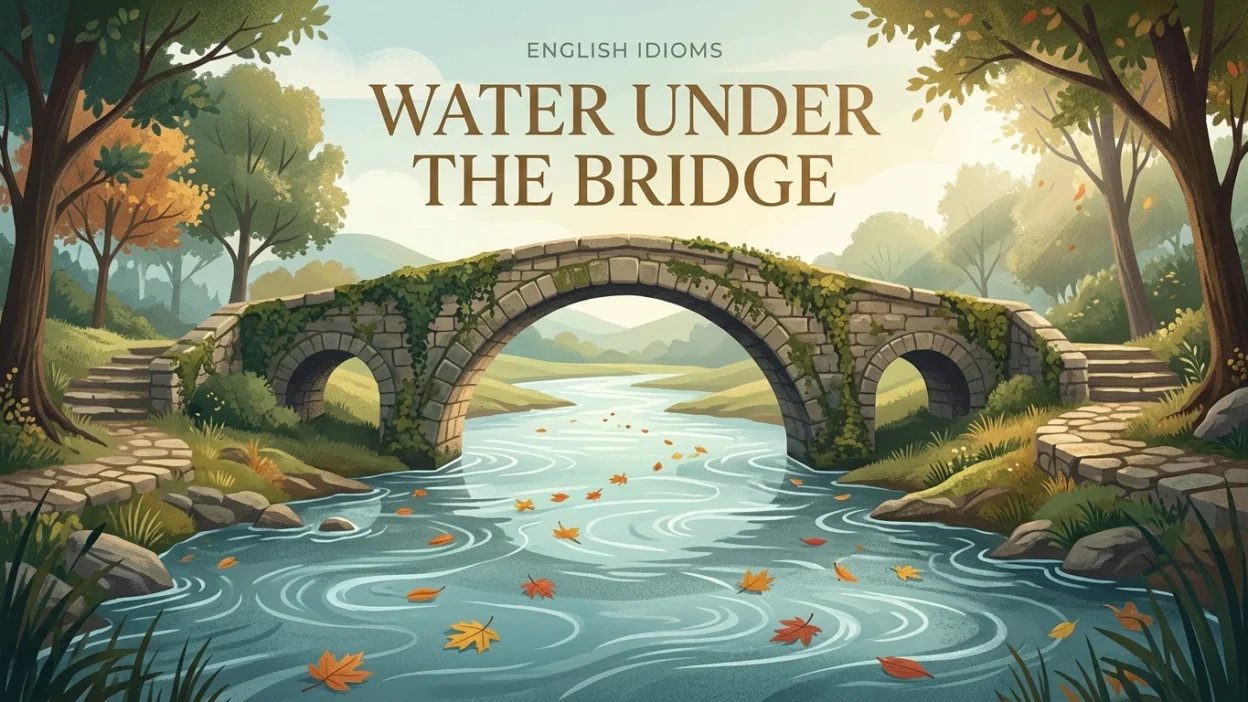
Literally, water under a bridge refers to water flowing beneath a bridge. However, as an idiom, it describes past events that have already happened and cannot be changed.
The confusion often arises because the expression does not directly mention forgiveness, acceptance, or moving forward. Its meaning becomes clear when understood as a figure of speech.
For example:
- Literal meaning: Water is flowing beneath the bridge.
- Figurative meaning: A past disagreement is no longer important.
The idiom is generally used to suggest that people should stop worrying about something that belongs to the past.
First Word: Water
Water is a noun that refers to a clear, colorless liquid essential for life. In the expression water under the bridge, it is used figuratively rather than referring simply to drinking water or a body of water.
Meaning of Water in the Idiom
Water represents something that has already passed and continues to move away.
The image suggests that, just as flowing water moves beneath a bridge and does not return to the same position, past events cannot be reversed.
Examples:
- The argument is water under the bridge.
- Our disagreement is now water under the bridge.
- All those difficult moments are water under the bridge.
In these sentences, water represents past experiences that should no longer cause concern.
Second Word: Under the Bridge
Under the bridge literally describes something located beneath a bridge. However, in this idiom, the phrase creates an image of water flowing away beneath a structure.
Meaning of Under the Bridge
The expression suggests that an event has already happened and is now behind us.
A bridge allows people to cross from one side to another. In the idiom, it provides a picture of time passing and leaving previous experiences behind.
Examples:
- The disagreement happened years ago. It’s water under the bridge.
- We made mistakes, but that is water under the bridge now.
- Their old argument is water under the bridge.
Together, the words create an expression about accepting the past and moving forward.
Water Under the Bridge: Meaning and Explanation
The idiom water under the bridge means that a past event is no longer worth worrying about, discussing, or allowing to affect the present.
It is commonly used in situations involving:
- Past arguments: When people have disagreed but have resolved their differences.
- Mistakes: When someone has made an error and moved forward.
- Regrets: When an unpleasant experience cannot be changed.
- Forgiveness: When someone decides not to hold a past mistake against another person.
- Old problems: When previous difficulties no longer affect a relationship or situation.
The expression can also suggest that someone has accepted what happened without necessarily forgetting it.
Water Under the Bridge: Comparison With Similar Expressions
| Expression | Meaning | Example |
|---|---|---|
| Water under the bridge | A past problem no longer matters | It’s water under the bridge now. |
| Let bygones be bygones | Forget past disagreements | Let’s let bygones be bygones. |
| Move on | Stop dwelling on the past | It’s time to move on. |
| What’s done is done | The past cannot be changed | What’s done is done. |
| Bury the hatchet | Make peace after a disagreement | They finally buried the hatchet. |
| Forgive and forget | Stop holding a mistake against someone | She decided to forgive and forget. |
| Put the past behind you | Stop focusing on previous experiences | Put the past behind you. |
These expressions share similar ideas, but they are not always interchangeable. For example, bury the hatchet specifically suggests ending a disagreement, while water under the bridge can refer to a wider range of past experiences.
When Should You Use Water Under the Bridge?
Use water under the bridge when you want to express that a past problem, disagreement, or mistake no longer needs attention.
1. When Talking About Past Arguments
Use the idiom when two people have resolved a disagreement and no longer want to discuss it.
Examples:
- We argued last year, but it’s water under the bridge now.
- Don’t worry about our disagreement. It’s water under the bridge.
- They had a serious argument, but everything is water under the bridge now.
2. When Discussing Past Mistakes
The expression can describe mistakes that have already happened and cannot be changed.
Examples:
- I made a few mistakes in the past, but that’s water under the bridge.
- Don’t keep blaming yourself. It’s water under the bridge.
- We all make mistakes, and some things are simply water under the bridge.
3. When Expressing Forgiveness
Use the expression when you want someone to understand that you are no longer holding a past mistake against them.
Examples:
- I forgive you. What happened is water under the bridge.
- You apologized, and that’s water under the bridge now.
- We are friends again, so let’s consider the argument water under the bridge.
4. When Moving Forward
The idiom can also communicate that it is better to focus on the present and future rather than remain concerned about the past.
Examples:
- We cannot change yesterday. It’s water under the bridge.
- Let’s focus on our future. The past is water under the bridge.
- Those difficult days are water under the bridge now.
15 Examples of Water Under the Bridge in Sentences
Here are practical examples showing how to use the expression naturally.
- We had a disagreement last month, but it’s water under the bridge now.
- Don’t worry about your mistake; it’s water under the bridge.
- She apologized for her behavior, and I told her it was water under the bridge.
- Our friendship is more important than an old argument, so let’s leave it as water under the bridge.
- I know I disappointed you in the past, but I hope that is water under the bridge.
- They used to argue frequently, but those problems are water under the bridge now.
- He made a poor decision years ago, but that is water under the bridge.
- We have both changed, and our previous disagreements are water under the bridge.
- I don’t want to discuss that incident again; it’s water under the bridge.
- She forgave her brother and considered their argument water under the bridge.
- We experienced difficult times together, but they are water under the bridge now.
- Whatever happened between us is water under the bridge.
- He reminded his colleague that their previous disagreement was water under the bridge.
- I made mistakes when I was younger, but I have learned from them. They are water under the bridge.
- Let’s forget about the past and concentrate on what lies ahead. It’s water under the bridge.
Common Mistakes to Avoid
Although water under the bridge is a straightforward idiom, some common mistakes can affect its meaning or usage.
1. Taking the Expression Literally
The expression usually does not refer to actual water flowing beneath a bridge.
Incorrect understanding: Water under a bridge always describes a physical location.
Correct understanding: It commonly describes past events that no longer matter.
2. Confusing It With Forgetting Everything
Water under the bridge does not necessarily mean that someone has completely forgotten what happened.
A person may remember a mistake or disagreement but choose not to let it affect the present.
3. Using It for an Unresolved Problem
The idiom is generally appropriate when a past event has been accepted, forgiven, or put aside.
If someone is still upset about an argument, describing it as water under the bridge may sound inappropriate or dismissive.
4. Changing the Established Expression
The standard idiom is water under the bridge.
Avoid changing it to expressions such as water beneath the bridge or water below the bridge when you intend to use the established idiom.
5. Assuming It Always Means Forgiveness
Although the expression can suggest forgiveness, it can also simply mean that an event is no longer relevant or worth worrying about.
Memory Trick: How to Remember Water Under the Bridge
Use this simple memory trick:
Water flows away, and the past moves on.
Imagine a river flowing beneath a bridge. Once the water has passed, it cannot return to the exact same place.
Similarly, past mistakes, arguments, and unpleasant experiences cannot be changed.
Remember:
- Water under the bridge = Past problems.
- Water flowing away = Time passing.
- Moving forward = Not dwelling on the past.
Whenever you want to say that something unpleasant belongs to the past and no longer matters, use water under the bridge.
American vs British English: Water Under the Bridge
There is no significant difference between American and British English in the spelling or meaning of this idiom.
Both varieties use water under the bridge to describe past events that are no longer important or worth worrying about.
American English
In American English, the expression is commonly used in everyday conversations and informal writing.
Examples:
- That argument is water under the bridge.
- We had our differences, but it’s water under the bridge now.
British English
British English uses the same expression with the same meaning.
Examples:
- Whatever happened between us is water under the bridge.
- Those disagreements are water under the bridge now.
Which Form Should International Writers Use?
Use water under the bridge in both American and British English. The expression does not require a spelling change or a different grammatical structure.
Similar Idioms Related to Water Under the Bridge
Understanding similar expressions can help you expand your vocabulary and communicate more naturally.
- Let bygones be bygones: Agree to forget past disagreements or mistakes.
- Bury the hatchet: End an argument or disagreement and make peace.
- Move on: Stop focusing on something that happened in the past.
- What’s done is done: Accept that the past cannot be changed.
- Put the past behind you: Stop allowing previous experiences to affect your present.
- Forgive and forget: Choose to forgive someone and stop dwelling on their mistake.
- Turn over a new leaf: Make a fresh start and change your behavior.
- Leave well enough alone: Avoid interfering with something that is already satisfactory.
- Let it go: Stop worrying about or holding on to something.
These expressions are related, but each has a slightly different emphasis.
Final Verdict: What Does Water Under the Bridge Mean?
Water under the bridge is a common English idiom meaning that a past problem, mistake, argument, or unpleasant experience is no longer important and should be left behind.
It is generally used to express acceptance, forgiveness, or a willingness to move forward instead of dwelling on something that has already happened.
For example, if two friends had an argument but have reconciled, one might say, “It’s water under the bridge now.”
Remember that the expression does not necessarily mean forgetting the past. It means accepting that the past cannot be changed and choosing not to let it interfere with the present.
Frequently Asked Questions (FAQs)
1. What does water under the bridge mean?
Water under the bridge means that something unpleasant happened in the past but is no longer important or worth worrying about. It suggests accepting the past and moving forward.
2. Is water under the bridge an idiom?
Yes. Water under the bridge is a common English idiom. Its figurative meaning is different from its literal meaning of water flowing beneath a bridge.
3. What is an example of water under the bridge?
An example is: “We had a disagreement several years ago, but it’s water under the bridge now.” This means the disagreement is no longer important.
4. Does water under the bridge mean forgiveness?
It can suggest forgiveness, but the meanings are not exactly identical. Water under the bridge indicates that a past event no longer matters, while forgiveness specifically involves letting go of resentment or blame.
5. Is it water under the bridge or water beneath the bridge?
The established idiom is water under the bridge. Although beneath can have a similar literal meaning to under, it is not the conventional wording of this expression.
6. Is water under the bridge formal or informal?
It is primarily an informal and conversational expression. However, it can also appear in articles, stories, interviews, and other forms of general writing.
7. What is another way to say water under the bridge?
Similar expressions include let bygones be bygones, move on, bury the hatchet, put the past behind you, and what’s done is done.
Remember This
- Water under the bridge is an English idiom.
- It refers to past problems, mistakes, or disagreements.
- It means something is no longer important or worth worrying about.
- It can suggest forgiveness and acceptance.
- It encourages people to move forward.
- It does not necessarily mean forgetting everything.
- The expression is used in both American and British English.
Conclusion
Water under the bridge is a useful English idiom for discussing past mistakes, disagreements, regrets, and unpleasant experiences. It describes situations in which people accept what has happened and decide that there is no reason to keep worrying about it. Although the expression comes from the image of water flowing beneath a bridge, its figurative meaning is about time passing and leaving the past behind.
Remember that water under the bridge does not mean that an event never happened or that someone has completely forgotten it. Instead, it suggests that the event no longer deserves attention or should not interfere with the present. When you want to express acceptance, forgiveness, or a willingness to move forward, this idiom is an excellent choice.

Lucas Luke is a passionate language writer and content creator at SimileHive, specializing in similes, idioms, metaphors, and figurative language. He enjoys making complex English expressions simple, engaging, and easy to understand for students, writers, and language enthusiasts through well-researched, practical content.