Have you ever come across the expression “be it” and wondered what it means or how to use it correctly? The phrase be it is a grammatical construction commonly used to introduce alternatives, possibilities, or examples. It often means “whether it is,” “whether they are,” or “no matter if it is.” For example, in the sentence “Be it rain or sunshine, the event will continue,” the expression introduces two possible weather conditions. It can also appear in formal expressions such as “Be it known that…” and “Be it resolved that…”
Although be it may sound unusual in everyday conversation, it is grammatically correct and appears in formal writing, speeches, literature, and established expressions. Understanding its meaning, structure, and appropriate contexts will help you recognize it and use it naturally.
Quick Answer
Be it is a grammatical expression used to introduce alternatives, examples, or possibilities. It often means “whether it is” or “regardless of whether it is.” For example, “Be it summer or winter, she enjoys walking outdoors.” It is also used in formal expressions such as “Be it known that…”
Why Do People Find “Be It” Confusing?
People sometimes find be it confusing because it does not follow the ordinary word order used in everyday English.
In a normal sentence, we might say:
- Whether it is sunny or cloudy, we will go outside.
However, a more formal or literary version is:
- Be it sunny or cloudy, we will go outside.
The second sentence uses the base form be rather than is. This construction is associated with the subjunctive mood and certain inverted or fixed expressions.
The phrase can also serve different purposes depending on the context. It may introduce alternatives, emphasize that something applies in every situation, or form part of a formal declaration.
What Does “Be It” Mean?
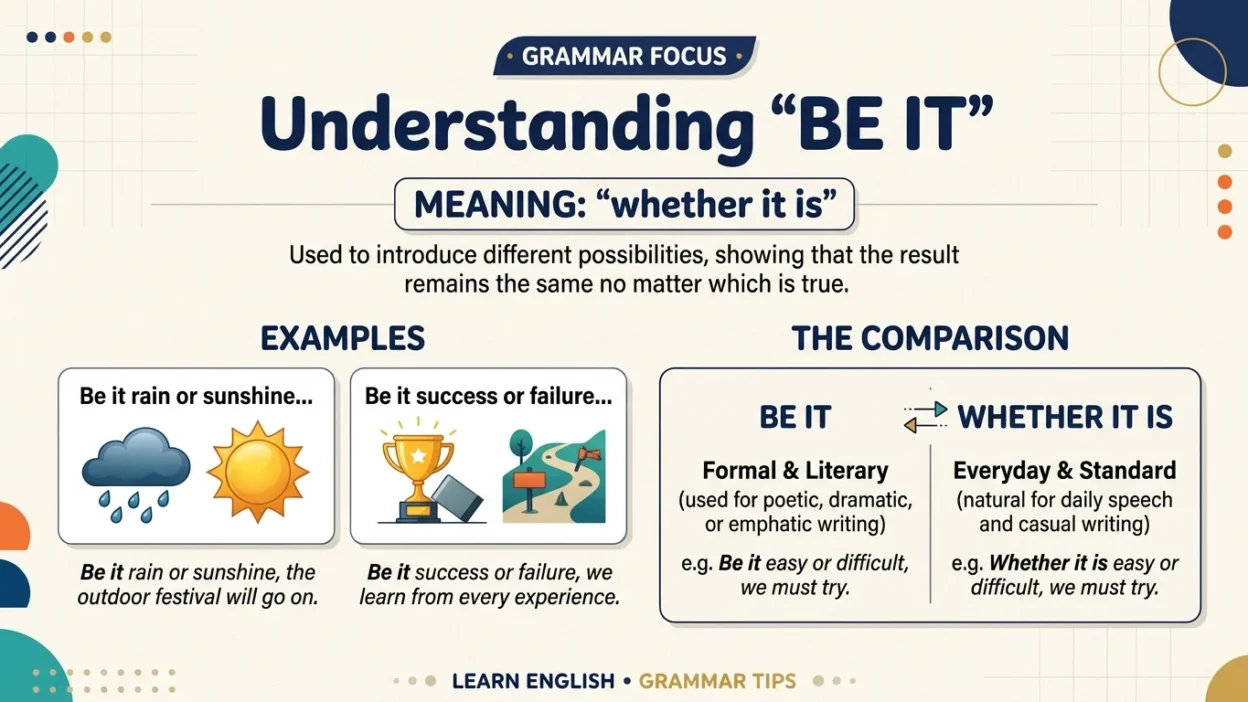
Be it generally means “whether it is,” “whether it may be,” or “regardless of whether it is,” depending on the sentence.
It is often used to introduce two or more possibilities without changing the main statement.
Examples:
- Be it day or night, the hospital remains open.
- Be it a small problem or a major challenge, we must address it.
- Be it success or failure, the experience will teach us something.
In these examples, be it introduces alternatives, while the rest of the sentence explains what applies to them.
How Is “Be It” Used in English?
There are several common ways to use be it.
1. To Introduce Alternatives
One of the most common uses of be it is to introduce two or more alternatives.
Examples:
- Be it tea or coffee, I enjoy a warm drink in the morning.
- Be it summer or winter, she exercises every day.
- Be it a question of money or time, we need a practical solution.
- Be it a friend or a stranger, everyone deserves respect.
In these sentences, be it introduces different possibilities.
2. To Express Something That Applies in Every Situation
The expression can emphasize that a statement remains true regardless of which possibility applies.
Examples:
- Be it a good day or a bad one, stay positive.
- Be it easy or difficult, complete the assignment.
- Be it near or far, we will support our family.
- Be it a small achievement or a major success, celebrate your progress.
This use often gives a sentence a formal, emphatic, or literary tone.
3. In Formal and Legal Expressions
Be it also appears in formal declarations, official documents, and legal language.
Common expressions include:
- Be it known that: A formal way of introducing a declaration or statement.
- Be it resolved that: A formal expression used to introduce a resolution or official decision.
Examples:
- Be it known that the agreement takes effect immediately.
- Be it resolved that the committee approves the proposal.
- Be it hereby declared that the meeting is officially closed.
These expressions are formal and are not usually necessary in everyday conversation.
4. In Literary and Rhetorical Writing
Writers sometimes use be it to create emphasis, rhythm, or a formal tone.
Examples:
- Be it courage or determination, both are necessary for success.
- Be it love or friendship, genuine relationships require trust.
- Be it a dream or a goal, hard work can bring it closer.
This construction can make writing sound more expressive or memorable.
Is “Be It” Grammatically Correct?
Yes. Be it is grammatically correct.
The word be is the base form of the verb to be. In this construction, it is used in a subjunctive or formulaic structure rather than the ordinary indicative form.
Compare these sentences:
| Ordinary Construction | Construction With “Be It” |
|---|---|
| Whether it is rain or sunshine, we will continue. | Be it rain or sunshine, we will continue. |
| Whether it is easy or difficult, try your best. | Be it easy or difficult, try your best. |
| Whether it is success or failure, learn from it. | Be it success or failure, learn from it. |
The versions with be it are more formal or literary. The ordinary versions are generally more natural in everyday conversation.
“Be It” vs. “Whether It Is”
Both expressions can introduce alternatives, but they differ in tone and sentence structure.
| Feature | Be It | Whether It Is |
|---|---|---|
| Meaning | Whether it is or regardless of the possibility | Introduces alternatives or uncertainty |
| Tone | Often formal or literary | Neutral and conversational |
| Structure | Be it + alternative | Whether it is + alternative |
| Example | Be it rain or sunshine, we will go. | Whether it is raining or sunny, we will go. |
Examples
Be it:
Be it a difficult task or an easy one, we must finish it.
Whether it is:
Whether it is a difficult task or an easy one, we must finish it.
Both sentences communicate a similar idea, but the second sounds more natural in everyday English.
15 Examples of “Be It” in Sentences
Here are 15 practical examples to help you understand how the expression works.
- Be it summer or winter, she enjoys spending time outdoors.
- Be it success or failure, we should learn from our experiences.
- Be it a small mistake or a serious error, honesty is important.
- Be it day or night, the emergency service remains available.
- Be it a friend or a stranger, treat everyone with kindness.
- Be it rain or sunshine, the match will continue.
- Be it a personal or professional matter, handle it responsibly.
- Be it a difficult decision or an easy one, think carefully.
- Be it money or time, both resources are valuable.
- Be it a short journey or a long one, enjoy the experience.
- Be it an opportunity or a challenge, make the most of it.
- Be it spoken or written, communication should be clear.
- Be it a question of skill or experience, practice can help.
- Be it a minor concern or a major issue, discuss it openly.
- Be it known that the new policy takes effect next month.
Common Mistakes to Avoid
Although be it is easy to understand once you recognize its structure, some common mistakes are worth avoiding.
1. Using “Is It” Instead of “Be It” in the Construction
Incorrect: Is it rain or sunshine, we will continue.
Correct: Be it rain or sunshine, we will continue.
The expression introducing alternatives uses the base form be in this construction.
2. Using “Be It” in Every Everyday Sentence
Although grammatically correct, be it can sound overly formal in casual conversation.
Formal: Be it a difficult task or an easy one, we must complete it.
More natural: Whether it is difficult or easy, we must complete it.
Choose the construction that suits your audience and writing style.
3. Confusing “Be It” With “Let It Be”
These expressions have different meanings.
- Be it: Introduces alternatives or possibilities.
- Let it be: Means to leave something alone or avoid interfering with it.
Examples:
- Be it rain or sunshine, we will travel.
- Let it be. There is no need to argue.
4. Forgetting the Meaning of the Alternatives
When using be it to introduce alternatives, make sure the possibilities relate logically to the rest of the sentence.
Unclear: Be it a table or happiness, we must continue.
Clear: Be it a challenge or an opportunity, we must make the most of it.
Memory Trick: How to Remember “Be It”
Remember this simple idea:
Be it = Whether it is.
For example:
- Be it rain or sunshine.
- Whether it is rain or sunshine.
Both expressions introduce alternatives.
Also remember that be it often sounds more formal or literary than whether it is. This will help you choose the right expression for your sentence.
American vs. British English: Be It
There is no significant difference between American and British English in the meaning, spelling, or grammatical use of be it.
Both varieties use the expression to introduce alternatives, possibilities, and formal declarations.
Examples in American English:
- Be it a small issue or a major concern, we should address it.
- Be it known that the meeting is now in session.
Examples in British English:
- Be it rain or sunshine, the event will proceed.
- Be it a question of time or money, we must find a solution.
The expression is understood in both varieties, although it may sound more formal than everyday alternatives.
Similar Expressions Related to “Be It”
Several expressions can communicate ideas similar to be it, depending on the context.
- Whether it is: Introduces alternatives or uncertainty. Example: Whether it is sunny or cloudy, we will go.
- Regardless of whether: Emphasizes that something remains true in either situation. Example: Regardless of whether it rains, the event will continue.
- No matter whether: Introduces possibilities that do not change the main statement. Example: No matter whether you agree or disagree, the decision has been made.
- Let it be: Means to leave something alone. Example: Let it be for now.
- Be that as it may: Means despite what has just been said. Example: Be that as it may, we must continue.
- Whether or not: Expresses that something applies regardless of the outcome. Example: Whether or not he agrees, we will proceed.
These expressions are related in meaning but are not interchangeable in every situation.
Final Verdict: What Does “Be It” Mean?
Be it is a grammatically correct English construction used to introduce alternatives, possibilities, or examples. It often means “whether it is” or “regardless of whether it is,” depending on the context.
For example, “Be it rain or sunshine, we will continue” means that the decision remains the same in either weather condition.
The expression is particularly common in formal writing, literary language, speeches, and established declarations. In everyday conversation, whether it is is often a more natural alternative.
Frequently Asked Questions (FAQs)
1. What does “be it” mean?
Be it generally means “whether it is” or “regardless of whether it is.” It is used to introduce alternatives or possibilities. For example, “Be it summer or winter, she enjoys walking.”
2. Is “be it” grammatically correct?
Yes. Be it is a correct English construction. It uses the base form of the verb be in a subjunctive or established formal structure.
3. What is another way to say “be it”?
Depending on the context, alternatives include whether it is, regardless of whether, and no matter whether. For example, “Be it rain or sunshine” can be rewritten as “Whether it is raining or sunny.”
4. What does “be it known that” mean?
Be it known that is a formal expression used to introduce an announcement, declaration, or official statement. It means that the information that follows is being formally made known.
5. What does “be it resolved that” mean?
Be it resolved that is a formal expression used to introduce an official decision or resolution, particularly in meetings, organizations, and legal or administrative documents.
6. Is “be it” formal or informal?
Be it is generally formal, literary, or rhetorical. It is grammatically correct in ordinary writing, but expressions such as whether it is often sound more natural in everyday conversation.
7. What is the difference between “be it” and “let it be”?
Be it introduces alternatives or possibilities, while let it be means to leave something alone or avoid interfering with it. For example, “Be it easy or difficult, try your best” and “Let it be; there is no need to argue.”
Remember This
- Be it is a grammatically correct expression.
- It often means whether it is.
- It introduces alternatives, possibilities, or examples.
- It commonly appears in formal and literary writing.
- Be it known that introduces a formal declaration.
- Be it resolved that introduces an official resolution.
- Whether it is is often more natural in everyday conversation.
- Be it and let it be have different meanings.
Conclusion
The expression be it is a useful grammatical construction that allows writers and speakers to introduce alternatives, possibilities, and examples. It often carries a formal or literary tone and can make a sentence sound more emphatic. Expressions such as “Be it rain or sunshine” and “Be it known that” demonstrate its use in different contexts.
To use be it correctly, remember that it often communicates the same general idea as whether it is. Although both constructions can be correct, be it is more common in formal, rhetorical, and literary language, while whether it is is usually more suitable for everyday communication.

Adam Aaron is a language enthusiast and content writer at SimileHive, creating clear, engaging guides on similes, idioms, metaphors, and figurative language to help readers improve English confidently every day.