The words obliged and obligated are closely related, and both describe situations in which someone has a duty, responsibility, or reason to do something. However, they are not always interchangeable. Understanding the difference between obliged and obligated can help you choose the right word in everyday conversations, formal writing, professional communication, and academic contexts.
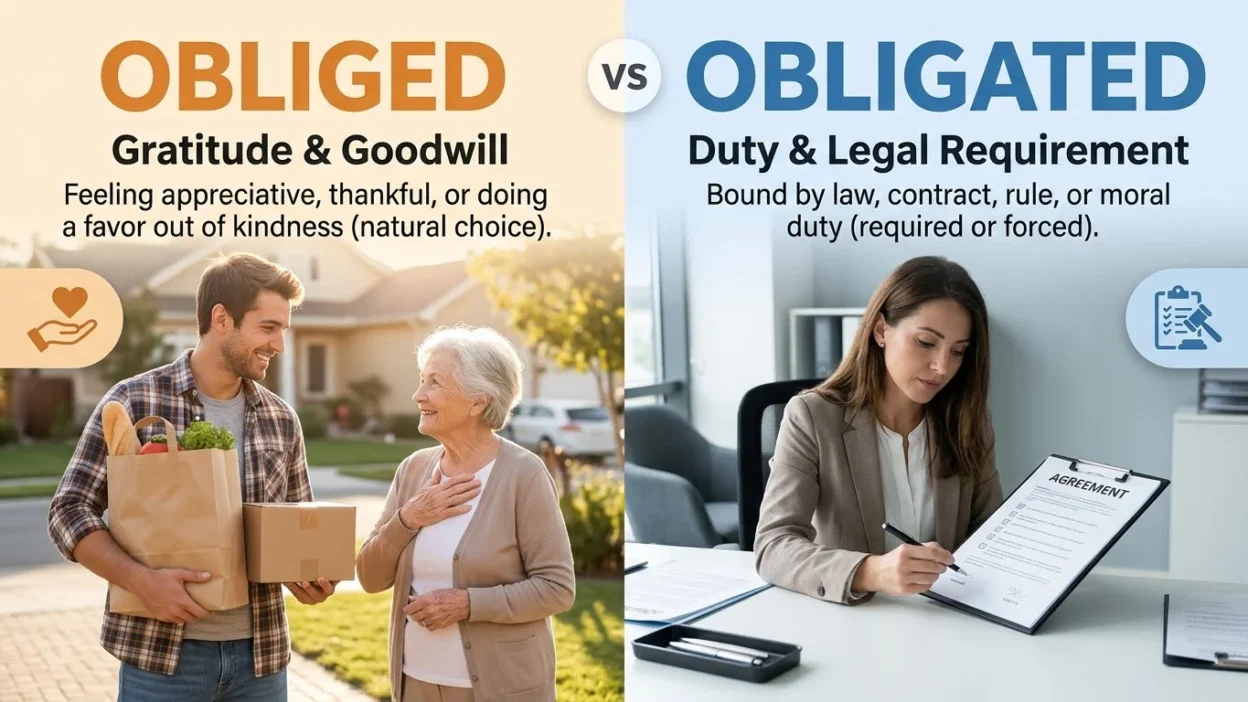
The main difference is that obliged can express gratitude, willingness, or a sense of duty, while obligated more strongly emphasizes a requirement or responsibility. For example, someone might feel obliged to help a friend because of kindness or gratitude, whereas someone might be obligated to follow a rule because of a legal or contractual requirement. Although both words can describe a responsibility, their meanings and typical uses have slightly different shades of meaning. This guide explains their definitions, differences, examples, and common mistakes so you can use each word confidently.
Quick Answer: Obliged vs Obligated
Obliged and obligated both mean having a duty or responsibility to do something. However, obliged can also mean grateful or willing to do someone a favor, as in “Much obliged.” Obligated generally emphasizes a requirement, commitment, or duty, especially one connected to rules, agreements, or formal responsibilities.
Why Do People Confuse Obliged and Obligated?
People often confuse obliged and obligated because they share the same root meaning and can both describe being required to do something.
For example:
- I am obliged to help my parents.
- I am obligated to help my parents.
Both sentences communicate a sense of responsibility. However, the second sentence places greater emphasis on a duty or requirement.
There are three main reasons for this confusion:
- Similar meanings: Both words can describe a responsibility or duty.
- Overlapping usage: In many situations, either word is grammatically correct.
- Different connotations: Obliged can suggest gratitude, courtesy, or personal willingness, while obligated usually highlights a stronger sense of responsibility.
The best choice depends on what you want to communicate.
First Word: Obliged
Obliged is an adjective and the past participle of the verb oblige. It generally means required to do something because of a moral duty, social expectation, personal commitment, or another person’s request.
It can also mean grateful or thankful, particularly in polite expressions.
Meaning of Obliged
The word obliged has two particularly common meanings.
1. Required or expected to do something
When someone is obliged to do something, they feel that they have a responsibility or duty to do it.
Examples:
- I felt obliged to attend the meeting.
- She was obliged to support her family.
- We are obliged to follow the rules.
2. Grateful or willing to help
Obliged can also express gratitude or a willingness to assist someone.
Examples:
- I would be much obliged if you could help me.
- Much obliged for your assistance.
- I would be obliged if you sent me the documents.
In these expressions, obliged communicates appreciation or polite willingness rather than simply describing a formal duty.
How to Use Obliged in a Sentence
Use obliged when discussing moral responsibilities, social expectations, gratitude, or polite requests.
Common expressions include:
- Feel obliged
- Be obliged to someone
- Much obliged
- Would be obliged if
- Be morally obliged
Example:
“I felt obliged to thank everyone who helped me.”
Here, obliged expresses a sense of personal responsibility and appreciation.
Second Word: Obligated
Obligated is an adjective and the past participle of the verb obligate. It means required or bound to do something because of a duty, responsibility, agreement, rule, or law.
It is particularly common in formal, professional, legal, and administrative contexts.
Meaning of Obligated
Obligated emphasizes that someone has a responsibility or requirement to fulfill.
Examples:
- Employees are obligated to follow company policies.
- You are legally obligated to pay your taxes.
- The company is obligated to fulfill its contractual responsibilities.
In each example, the person or organization has a specific duty to perform.
How to Use Obligated in a Sentence
Use obligated when you want to emphasize a requirement, commitment, or formal responsibility.
Common expressions include:
- Legally obligated
- Contractually obligated
- Financially obligated
- Feel obligated
- Be obligated to do something
Example:
“The tenant is obligated to pay rent on time.”
Here, obligated highlights a responsibility established by an agreement.
Obliged vs Obligated: Comparison Table
| Feature | Obliged | Obligated |
|---|---|---|
| Basic meaning | Required or grateful | Required or bound |
| Main emphasis | Duty, gratitude, or courtesy | Duty or responsibility |
| Formality | Common in everyday and formal English | Often more formal |
| Legal context | Can be used | Especially common |
| Social situations | Very common | Also possible |
| Expressing gratitude | Yes | Not normally |
| Expressing responsibility | Yes | Yes |
| Example | I am much obliged. | I am legally obligated. |
When to Use Obliged vs Obligated
Although both words can describe a duty, certain situations make one more suitable than the other.
When to Use Obliged
Use obliged when:
- You want to express gratitude or appreciation.
- You are describing a moral or social responsibility.
- You want to make a polite request.
- You are describing a personal sense of duty.
- You are using a traditional expression of thanks.
Examples:
- I am much obliged for your kindness.
- She felt obliged to visit her relatives.
- I would be obliged if you replied soon.
When to Use Obligated
Use obligated when:
- You are discussing a legal responsibility.
- Someone must fulfill a contractual agreement.
- You are describing professional duties.
- You want to emphasize a formal commitment.
- You are discussing financial or administrative responsibilities.
Examples:
- The company is obligated to provide the agreed services.
- Citizens are obligated to obey the law.
- I am contractually obligated to complete the project.
Can Obliged and Obligated Be Used Interchangeably?
Yes. In many situations, obliged and obligated are interchangeable when they describe being required to do something.
For example:
- I feel obliged to help her.
- I feel obligated to help her.
Both sentences are correct. However, the first may suggest a personal or moral sense of duty, while the second places more emphasis on a perceived responsibility.
When expressing gratitude, however, obliged is the natural choice.
12 Examples of Obliged and Obligated in Sentences
The following examples demonstrate how to use both words correctly.
Examples With Obliged
- I felt obliged to help my neighbor when he needed assistance.
- She was obliged to follow her parents’ instructions.
- I am much obliged for your generous support.
- We felt obliged to thank everyone who attended the event.
- He was morally obliged to tell the truth.
- I would be obliged if you could send me the information today.
Examples With Obligated
- Employees are obligated to maintain confidentiality.
- The landlord is obligated to repair the damaged property under the agreement.
- I feel obligated to finish the work I promised to complete.
- Every student is obligated to follow the school’s rules.
- The organization is legally obligated to protect its customers’ information.
- She is financially obligated to repay the loan.
Common Mistakes When Using Obliged and Obligated
Although both words are correct in appropriate contexts, some mistakes can make sentences sound unnatural or change their intended meaning.
Mistake 1: Using Obligated to Express Gratitude
Incorrect or unnatural: “I am much obligated for your help.”
Better: “I am much obliged for your help.”
The expression “much obliged” is a conventional way of expressing gratitude.
Mistake 2: Assuming Obliged Always Means Grateful
Incorrect assumption: “She is obliged to follow the law” means she is grateful to follow the law.
Correct understanding: In this sentence, obliged means required or expected to follow the law.
The meaning depends on the context.
Mistake 3: Thinking Obligated Only Applies to Legal Duties
Obligated is not limited to legal or contractual responsibilities.
Correct examples:
- I feel obligated to support my friend.
- Parents are obligated to care for their children.
Both sentences describe responsibilities that do not necessarily arise from legal agreements.
Mistake 4: Believing the Two Words Are Always Interchangeable
Although they overlap, they do not have exactly the same uses.
For example:
- Much obliged for your assistance.
- Much obligated for your assistance.
The first is the natural expression of gratitude.
Memory Trick: How to Remember the Difference
Here is an easy way to remember obliged vs obligated:
Obliged = Gratitude or Duty
Think of the expression “Much obliged.” It is commonly used to thank someone.
Obligated = Responsibility or Requirement
Think of legal agreements, workplace policies, and contractual commitments.
Remember these two examples:
- I am obliged for your kindness.
- I am obligated to follow the rules.
This simple distinction will help you choose the appropriate word in most situations.
Obliged vs Obligated in American and British English
Both obliged and obligated are used in American and British English. Neither word belongs exclusively to one variety of English.
However, their usage can vary depending on context, writing style, and personal preference.
In American English:
Obligated is particularly familiar in formal, legal, business, and professional contexts. Obliged is also widely understood and used, especially in expressions such as “much obliged.”
In British English:
Both words are accepted. Obliged is commonly used in everyday expressions, while obligated is also used when discussing duties and formal responsibilities.
The distinction is mainly about meaning and context rather than a strict difference between American and British spelling or grammar.
Similar Words: Obliged, Obligated, Required, and Compelled
Several English words are related to obliged and obligated, but each has a slightly different meaning.
| Word | Meaning | Example |
|---|---|---|
| Obliged | Required or grateful | I am much obliged for your help. |
| Obligated | Bound by a duty or responsibility | I am obligated to finish the work. |
| Required | Necessary according to a rule or condition | Students are required to attend class. |
| Compelled | Forced or strongly driven to act | He felt compelled to apologize. |
| Bound | Under an obligation or commitment | We are bound by the agreement. |
| Indebted | Owing gratitude or a favor | I am indebted to you for your kindness. |
These words are related, but they are not always interchangeable. Choose the one that best communicates the type of responsibility or feeling you intend to express.
Final Verdict: Obliged vs Obligated
The main difference between obliged and obligated is their emphasis.
Obliged can describe a moral or social duty, but it can also express gratitude, appreciation, and polite willingness.
Obligated generally emphasizes a responsibility, requirement, or commitment. It is especially useful when discussing legal, financial, professional, or contractual duties.
Both words are correct when describing a general responsibility. However, use obliged when expressing gratitude, particularly in the familiar expression “much obliged.” Choose obligated when you want to emphasize a specific duty or requirement.
Frequently Asked Questions
1. Are obliged and obligated the same?
Obliged and obligated have similar meanings, and both can describe being required to do something. However, obliged can also mean grateful or willing to help, while obligated primarily emphasizes a duty or responsibility.
2. Is it better to say obliged or obligated?
Neither word is universally better. Use obliged when expressing gratitude, courtesy, or a personal sense of duty. Use obligated when emphasizing a responsibility, formal commitment, or requirement.
3. Does obliged mean grateful?
Yes. Obliged can mean grateful or thankful, particularly in expressions such as “much obliged.” For example, “I am much obliged for your help” means “I am very grateful for your help.”
4. Is obligated a formal word?
Obligated is commonly used in formal and professional contexts, especially when discussing legal, financial, contractual, or workplace responsibilities. However, it can also appear in everyday conversations.
5. Can I say I feel obligated?
Yes. “I feel obligated” is grammatically correct and means that you feel you have a responsibility or duty to do something.
Example: “I feel obligated to help my family.”
6. What does much obliged mean?
“Much obliged” is a polite expression of gratitude. It means very grateful or thankful.
Example: “Much obliged for your assistance.”
7. Is legally obliged correct or should I say legally obligated?
Both expressions are grammatically correct. “Legally obligated” is a particularly familiar way to emphasize a legal responsibility, but “legally obliged” is also acceptable.
Remember This
- Obliged can mean required, grateful, or willing to help.
- Obligated means having a duty, responsibility, or requirement.
- Both words can describe a moral or personal responsibility.
- “Much obliged” is a natural expression of gratitude.
- “Legally obligated” is a common expression for a legal duty.
- Neither word is exclusively American or British English.
Conclusion
Understanding the difference between obliged and obligated is easier when you focus on what you want to communicate. Both words can describe a responsibility, but obliged has an additional meaning connected to gratitude and courtesy. Obligated, on the other hand, places greater emphasis on duties, commitments, and requirements. Recognizing these differences will help you use both words accurately in everyday conversations and formal writing.
Ultimately, choose obliged when expressing gratitude or describing a personal, moral, or social duty. Choose obligated when emphasizing a responsibility, particularly one connected to a rule, agreement, or formal commitment. When the two words overlap, either may be correct, so consider the context and intended meaning before making your choice.

Lucas Luke is a passionate language writer and content creator at SimileHive, specializing in similes, idioms, metaphors, and figurative language. He enjoys making complex English expressions simple, engaging, and easy to understand for students, writers, and language enthusiasts through well-researched, practical content.