The expressions I was told, I have been told, and I am told all describe receiving information from someone else. However, they are not interchangeable in every situation because they use different verb tenses and communicate different time relationships. Understanding these differences will help you speak and write more naturally in everyday conversations, professional communication, and academic writing.
The main difference is that I was told refers to information someone gave you in the past, I have been told emphasizes information you received before now that remains relevant in the present, and I am told often introduces information someone tells you or that you understand to be true. For example, you might say, “I was told the meeting was cancelled,” “I have been told that the meeting is cancelled,” or “I am told that the meeting is cancelled.” Each sentence is grammatically correct, but the emphasis and context are different.
Quick Answer: I Was Told vs I Have Been Told vs I Am Told
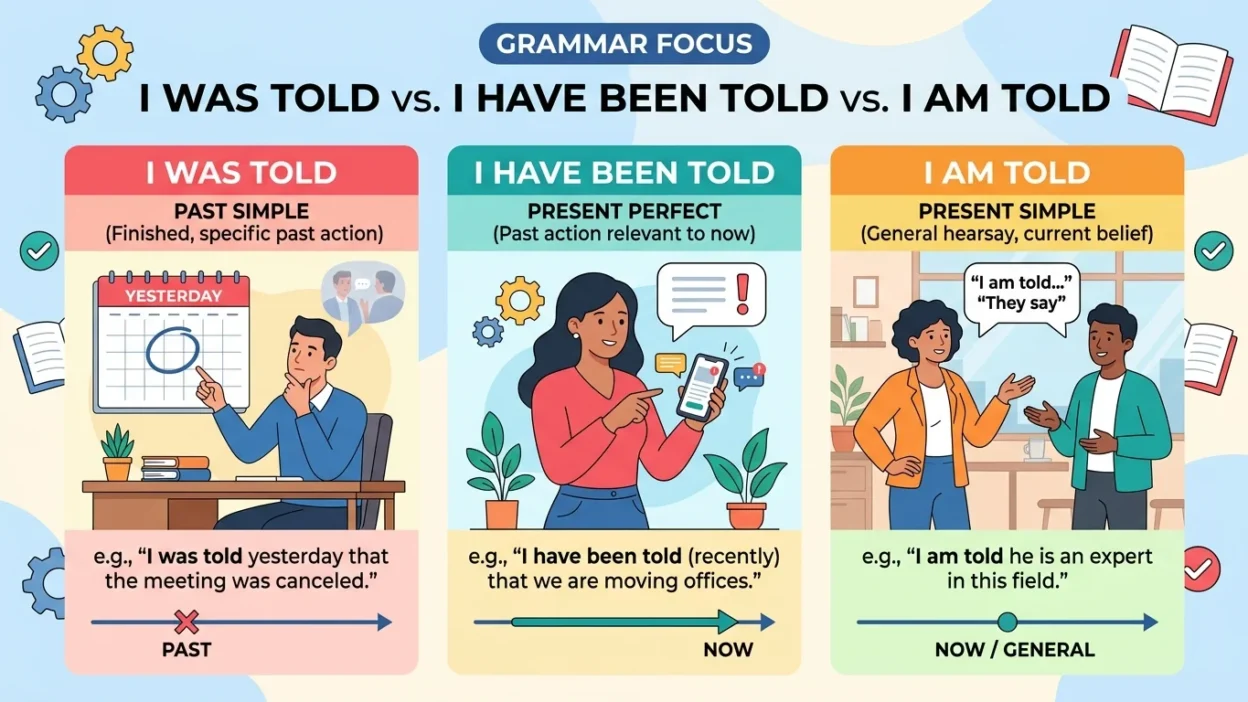
I was told uses the simple past and describes information received at a particular or unspecified time in the past. I have been told uses the present perfect and connects past information with the present. I am told uses the simple present passive and commonly introduces information you have been given, heard, or understand to be true, often without specifying exactly when you received it.
Why Do People Confuse These Expressions?
People often confuse these three expressions because they have similar meanings. All three involve someone communicating information to another person.
However, their grammatical structures are different:
- I was told: Simple past passive.
- I have been told: Present perfect passive.
- I am told: Simple present passive.
The main difference is how each expression connects the information to time and context.
For example:
- I was told that he was sick.
- I have been told that he is sick.
- I am told that he is sick.
All three sentences communicate information about someone’s illness, but they present that information differently.
First Expression: I Was Told
I was told is the simple past passive form of the verb tell. It means someone gave you information, advice, an instruction, or a message at some point in the past.
The expression focuses on a completed communication in the past. The person who gave you the information may or may not be identified.
Meaning of I Was Told
Use “I was told” when referring to something someone communicated to you in the past.
Examples:
- I was told that the shop was closed.
- I was told to arrive early.
- I was told that she had moved abroad.
- I was told about the new policy yesterday.
In these examples, the communication happened in the past.
When to Use I Was Told
Use this expression when:
- You are describing information received in the past.
- You want to mention what someone previously said.
- You are reporting past instructions or advice.
- You are explaining something you learned earlier.
- You want to emphasize a past communication rather than its present relevance.
Example Sentences With I Was Told
- I was told that the examination would begin at nine.
- I was told to submit the application before Friday.
- I was told that he was an experienced teacher.
- I was told about the accident yesterday.
- I was told that the restaurant had closed permanently.
Second Expression: I Have Been Told
I have been told is the present perfect passive form of the verb tell. It describes information someone communicated to you before now, with a connection to the present.
The exact time of the communication is often not important. Instead, the emphasis is on the information you now have.
Meaning of I Have Been Told
Use “I have been told” when you want to emphasize that you have received information and that it is relevant to the present situation.
Examples:
- I have been told that the manager is unavailable.
- I have been told that the road is closed.
- I have been told to wait here.
These sentences emphasize the information available to you now.
When to Use I Have Been Told
Use this expression when:
- Information you received earlier is still relevant.
- You do not want to specify exactly when someone told you.
- You are referring to something you have heard from other people.
- You want to emphasize your present knowledge.
- You are explaining advice or instructions that still apply.
Example Sentences With I Have Been Told
- I have been told that the new employee is very talented.
- I have been told that the office is closed today.
- I have been told to bring my identification documents.
- I have been told that the examination has been postponed.
- I have been told that she is moving to another city.
Third Expression: I Am Told
I am told is the simple present passive form of the verb tell. It is commonly used to introduce information that someone communicates to you or that you understand to be true based on what others have said.
It can also suggest that you are reporting information without personally confirming it.
Meaning of I Am Told
Use “I am told” when introducing information you have been given or understand from other sources.
Examples:
- I am told that he is an excellent doctor.
- I am told that the new restaurant is popular.
- I am told that the road is dangerous at night.
In these examples, the speaker presents the information as something they have been told by others.
When to Use I Am Told
Use this expression when:
- You are introducing information received from another person.
- You want to report something without claiming firsthand knowledge.
- You are discussing information that is currently believed to be true.
- You want to use a slightly formal or conversational reporting expression.
- You are referring to information without specifying when it was communicated.
Example Sentences With I Am Told
- I am told that the new teacher is very experienced.
- I am told that the weather will improve tomorrow.
- I am told that this restaurant serves excellent food.
- I am told that the company is hiring new employees.
- I am told that he is one of the best players in the team.
I Was Told vs I Have Been Told vs I Am Told: Comparison Table
| Feature | I Was Told | I Have Been Told | I Am Told |
|---|---|---|---|
| Verb tense | Simple past | Present perfect | Simple present |
| Voice | Passive | Passive | Passive |
| Main meaning | Someone told me in the past | Someone has told me before now | I understand or report information from others |
| Time emphasis | Past communication | Past information connected to now | General or current reporting |
| Exact time | Can be specified | Usually not specified | Usually not specified |
| Example | I was told yesterday. | I have been told recently. | I am told that he is reliable. |
When to Use Each Expression
Choosing the correct expression depends on the time of the communication and the message you want to convey.
When to Use I Was Told
Use this expression when the communication happened in the past.
Example:
“I was told yesterday that the school would remain closed.”
The word “yesterday” identifies the past time when the information was communicated.
When to Use I Have Been Told
Use this expression when the information you received earlier has a connection to the present.
Example:
“I have been told that the school is closed today.”
The information is relevant to the current situation.
When to Use I Am Told
Use this expression when reporting information that you understand to be true because someone has told you.
Example:
“I am told that the school is closed today.”
The speaker is reporting information received from another source without specifying when it was communicated.
15 Examples Comparing All Three Expressions
The following examples show how the three expressions work in different contexts.
1. Talking About a Meeting
- I was told that the meeting was cancelled yesterday.
- I have been told that the meeting has been cancelled.
- I am told that the meeting is cancelled.
2. Talking About a Person
- I was told that he was very intelligent.
- I have been told that he is very intelligent.
- I am told that he is very intelligent.
3. Talking About Instructions
- I was told to wait outside.
- I have been told to wait outside.
- I am told to wait outside.
4. Talking About a Job
- I was told that the company was hiring.
- I have been told that the company is hiring.
- I am told that the company is hiring.
5. Talking About a Restaurant
- I was told that the restaurant served excellent food.
- I have been told that the restaurant serves excellent food.
- I am told that the restaurant serves excellent food.
6. Talking About a Journey
- I was told that the road was closed.
- I have been told that the road is closed.
- I am told that the road is closed.
7. Talking About an Examination
- I was told that the examination would be difficult.
- I have been told that the examination will be difficult.
- I am told that the examination will be difficult.
8. Talking About a Doctor
- I was told that he was an experienced doctor.
- I have been told that he is an experienced doctor.
- I am told that he is an experienced doctor.
9. Talking About a New Rule
- I was told that the rule had changed.
- I have been told that the rule has changed.
- I am told that the rule has changed.
10. Talking About a House
- I was told that the house was for sale.
- I have been told that the house is for sale.
- I am told that the house is for sale.
11. Talking About an Appointment
- I was told that my appointment was at ten.
- I have been told that my appointment is at ten.
- I am told that my appointment is at ten.
12. Talking About a Promotion
- I was told that she had received a promotion.
- I have been told that she has received a promotion.
- I am told that she has received a promotion.
13. Talking About a New Employee
- I was told that the new employee was very hardworking.
- I have been told that the new employee is very hardworking.
- I am told that the new employee is very hardworking.
14. Talking About a Problem
- I was told that there was a problem with the computer.
- I have been told that there is a problem with the computer.
- I am told that there is a problem with the computer.
15. Talking About a Decision
- I was told that the decision had been made.
- I have been told that the decision has been made.
- I am told that the decision has been made.
Important: These examples illustrate common patterns, not a rule that the verb tense must always change in a particular way. The tense of the reported information depends on whether the situation is past, present, or future.
Common Mistakes When Using These Expressions
Although all three expressions are grammatically correct, learners sometimes use them incorrectly.
Mistake 1: Using I Have Been Told With a Definite Past Time
Incorrect: I have been told yesterday that the office was closed.
Correct: I was told yesterday that the office was closed.
The present perfect is generally not used with a finished past time expression such as yesterday, last week, or two days ago.
Mistake 2: Thinking I Am Told Refers Only to the Present Moment
“I am told” does not necessarily mean someone is speaking to you at this exact moment.
Example:
“I am told that the restaurant is excellent.”
This means you understand the restaurant to be excellent based on information provided by others.
Mistake 3: Assuming I Have Been Told and I Was Told Are Always Interchangeable
They can communicate similar information, but their time emphasis differs.
- I was told about the changes last week.
- I have been told about the changes.
The first emphasizes a past communication. The second emphasizes the information you have received before now.
Mistake 4: Confusing Active and Passive Voice
Remember these structures:
- Active: Someone told me.
- Passive: I was told.
- Passive: I have been told.
- Passive: I am told.
The person receiving the information becomes the subject in the passive construction.
Mistake 5: Using the Wrong Verb Form
Incorrect: I have being told.
Correct: I have been told.
The present perfect passive requires have or has + been + past participle.
Memory Trick: How to Remember the Difference
Here is a simple way to remember these three expressions.
I Was Told = Past Information
Think about something someone told you yesterday, last week, or at another time in the past.
I Have Been Told = Information I Have Received
Think about information you now have because someone communicated it to you before the present moment.
I Am Told = Information I Understand From Others
Think about introducing information you have received from another source.
Remember these three examples:
- I was told about the accident yesterday.
- I have been told that the road is closed.
- I am told that this is the best restaurant in town.
I Was Told vs I Have Been Told vs I Am Told in American and British English
All three expressions are grammatically correct in both American and British English.
There is no significant difference in their basic meanings or grammatical structures between the two varieties.
| Expression | American English | British English |
|---|---|---|
| I was told | Correct | Correct |
| I have been told | Correct | Correct |
| I am told | Correct | Correct |
One minor difference involves the present perfect and simple past. British English generally uses the present perfect more readily for certain recent events with present relevance, while American English sometimes uses the simple past in similar situations.
However, this does not make either construction incorrect. Context and intended meaning remain important.
Similar Expressions: I Was Told, I Heard, and I Was Informed
Several expressions can communicate similar ideas, but their meanings and levels of formality differ.
| Expression | Meaning | Example |
|---|---|---|
| I was told | Someone gave me information | I was told that the shop was closed. |
| I have been told | I have received information | I have been told that the shop is closed. |
| I am told | I understand this from others | I am told that the shop is excellent. |
| I heard | I received information by hearing or through reports | I heard that the shop was closed. |
| I was informed | Someone formally gave me information | I was informed that the shop was closed. |
| I understand | I believe or have been given information | I understand that the shop is closed. |
These expressions are useful alternatives, but they are not always interchangeable. For example, “I was informed” generally sounds more formal than “I was told.”
Final Verdict: I Was Told vs I Have Been Told vs I Am Told
The main difference between these three expressions is their tense and the way they present received information.
I was told is the simple past passive and refers to information someone communicated in the past.
I have been told is the present perfect passive and emphasizes information received before now that is relevant to the present.
I am told is the simple present passive and commonly introduces information that someone has communicated or that the speaker understands to be true.
All three are grammatically correct. The best choice depends on when the information was received and how you want to present it.
Frequently Asked Questions
1. What is the difference between I was told and I have been told?
“I was told” refers to a communication that happened in the past, while “I have been told” emphasizes information received before now that remains relevant to the present.
Example:
- I was told yesterday that he was leaving.
- I have been told that he is leaving.
2. Is I am told grammatically correct?
Yes. “I am told” is grammatically correct. It is the simple present passive form of the verb tell and is commonly used to introduce information received from other people.
Example: “I am told that she is an excellent writer.”
3. Can I use I was told and I am told interchangeably?
Not always. “I was told” emphasizes a past communication, whereas “I am told” commonly introduces information that the speaker currently understands or reports from others.
4. Which is correct: I have been told or I had been told?
Both are correct, but they refer to different time relationships.
“I have been told” connects information received in the past with the present.
“I had been told” refers to information received before another event or point in the past.
Example:
- I have been told that he is leaving.
- I had been told that he was leaving before the announcement was made.
5. Is I have been told more formal than I was told?
Not necessarily. Both expressions are appropriate in formal and informal English. The choice depends on the time relationship and context rather than formality alone.
6. Can I say I am told that he is coming?
Yes. The sentence is grammatically correct. It means that you understand he is coming because someone has given you that information.
7. What is the difference between I was told and I was informed?
Both expressions mean that someone communicated information to you. However, “I was informed” generally sounds more formal and is common in professional, official, and administrative situations. “I was told” is more natural in everyday conversation.
Remember This
- I was told: Someone communicated information to me in the past.
- I have been told: I received information before now, and it is relevant to the present.
- I am told: I understand or report information received from others.
- All three expressions use the passive voice.
- All three are grammatically correct in American and British English.
- Use the present perfect carefully with finished past time expressions.
Conclusion
The expressions I was told, I have been told, and I am told may appear similar, but they serve slightly different purposes in English. The first describes a past communication, the second connects previously received information to the present, and the third introduces information that the speaker understands or has received from others. Learning their differences will help you communicate more accurately and naturally.
The easiest way to remember them is to focus on their time relationships. Use I was told for past communication, I have been told for information received before now with present relevance, and I am told when reporting information from another source. Once you understand these distinctions, choosing the right expression becomes much easier.

Charles Kevin is a passionate language writer and researcher at SimileHive, creating clear, engaging content about similes, idioms, metaphors, and figurative language to help readers improve English communication confidently every day.