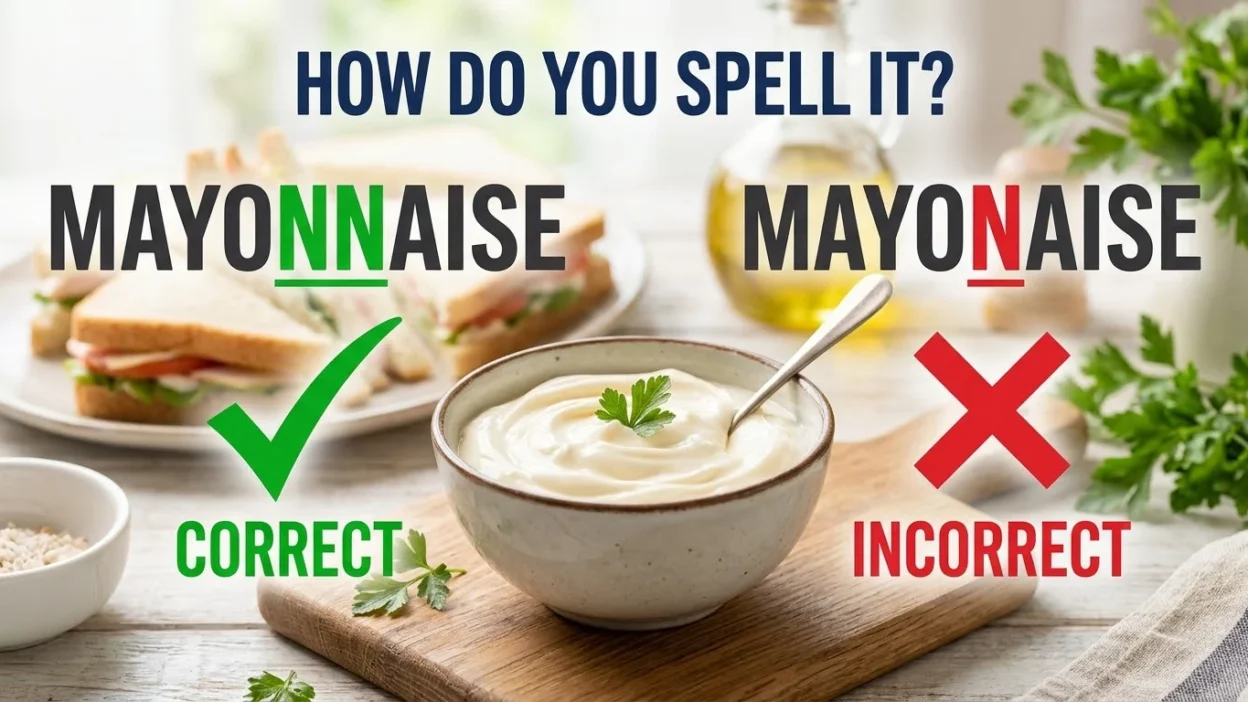
Mayonnaise and mayonaise are two spellings that people sometimes confuse when writing the name of the popular creamy condiment. However, only one of these spellings is correct in standard English. Mayonnaise is the correct spelling, while mayonaise is a common misspelling. The confusion usually occurs because the word has several syllables, and its pronunciation can make the middle letters difficult to remember.
Mayonnaise is a thick, creamy sauce commonly made from egg yolks, oil, vinegar or lemon juice, and seasonings. It is widely used in sandwiches, burgers, salads, dips, and other dishes. Whether you are writing a recipe, preparing a shopping list, or discussing your favorite food, using the correct spelling matters. This article explains the difference between mayonnaise and mayonaise, explores the word’s meaning and origin, and provides practical examples to help you remember the correct spelling.
Quick Answer: Mayonnaise vs Mayonaise
Mayonnaise is the correct English spelling of the creamy condiment made primarily from oil and egg yolks. Mayonaise is an incorrect spelling and should generally be avoided in standard English writing. If you are writing a recipe, menu, food review, or shopping list, always use mayonnaise.
Why Do People Confuse Mayonnaise and Mayonaise?
People confuse mayonnaise and mayonaise because the word is not always pronounced exactly as it is spelled.
In everyday speech, mayonnaise is often pronounced as “MAY uh nayz” or “MAY uh naiz.” The pronunciation can make it easy to overlook the second letter combination and accidentally write mayonaise.
There are three common reasons for this confusion:
- Pronunciation: The spoken form does not make every letter obvious.
- Spelling difficulty: The word contains several vowels and syllables.
- Familiarity: Some people write the word as they think it sounds.
Despite these differences, the standard spelling remains mayonnaise.
First Word: Mayonnaise
Mayonnaise is a noun that refers to a thick, creamy sauce or condiment made by combining oil with egg yolks and an acidic ingredient such as vinegar or lemon juice.
It is commonly used as a spread, dressing, or ingredient in different recipes.
Meaning of Mayonnaise
Mayonnaise is an emulsion, which means it is a mixture of ingredients that normally do not combine easily. Egg yolks help stabilize the mixture of oil and water based ingredients, producing its familiar creamy texture.
Common uses of mayonnaise include:
- Spreading it on sandwiches and burgers.
- Mixing it into potato and chicken salads.
- Using it as a base for dips and sauces.
- Adding it to coleslaw and other dishes.
- Combining it with garlic, herbs, or spices for flavored sauces.
Example Sentences With Mayonnaise
- I like mayonnaise in my chicken sandwich.
- She added mayonnaise to the potato salad.
- This burger tastes better with mayonnaise.
- Please put the mayonnaise in the refrigerator.
- He prefers homemade mayonnaise to store bought varieties.
Second Word: Mayonaise
Mayonaise is an incorrect spelling of mayonnaise in standard English.
Although people sometimes use it because it resembles the pronunciation of the word, it is not the accepted spelling of the condiment’s name.
Why Is Mayonaise Incorrect?
The correct spelling contains the letter combination “nn” in the middle:
- Correct: Mayonnaise
- Incorrect: Mayonaise
The incorrect version leaves out one of the two consecutive letters n.
For example:
Incorrect: I added mayonaise to my sandwich.
Correct: I added mayonnaise to my sandwich.
Remember that mayonnaise is the spelling you should use in formal writing, academic work, recipes, and everyday communication.
Mayonnaise vs Mayonaise: Comparison Table
| Feature | Mayonnaise | Mayonaise |
|---|---|---|
| Spelling status | Correct | Incorrect |
| Part of speech | Noun | Not a standard English spelling |
| Meaning | A creamy condiment | Intended to mean mayonnaise |
| Standard English | Accepted | Not accepted |
| Dictionaries | Listed | Generally not listed as a standard spelling |
| Usage | Recipes, menus, and everyday writing | Common spelling error |
When to Use Mayonnaise and Mayonaise
The choice is straightforward because only mayonnaise is correct in standard English.
When to Use Mayonnaise
Use mayonnaise whenever you refer to the creamy condiment.
Examples:
- I need a jar of mayonnaise.
- Mayonnaise is an important ingredient in this recipe.
- Would you like mayonnaise with your fries?
- She prepared a delicious mayonnaise dressing.
When to Avoid Mayonaise
Avoid writing mayonaise when referring to the condiment.
For example:
Incorrect: The recipe requires two tablespoons of mayonaise.
Correct: The recipe requires two tablespoons of mayonnaise.
There is no meaningful difference in definition between these spellings because mayonaise is simply a misspelling.
12 Examples of Mayonnaise in Sentences
Here are 12 practical examples showing the correct use of mayonnaise.
- I usually add mayonnaise to my sandwiches.
- She bought a large jar of mayonnaise from the supermarket.
- Would you prefer mayonnaise or ketchup with your burger?
- My mother makes homemade mayonnaise for family gatherings.
- This salad contains chicken, vegetables, and mayonnaise.
- Please keep the mayonnaise refrigerated after opening.
- He spread a thin layer of mayonnaise on the bread.
- The restaurant serves its burgers with homemade mayonnaise.
- You can mix mayonnaise with garlic to make a simple dip.
- I do not like too much mayonnaise in my food.
- The chef used mayonnaise as the base for the dressing.
- We ran out of mayonnaise while preparing lunch.
Common Mistakes When Spelling Mayonnaise
Even familiar English words can cause spelling difficulties. Here are some mistakes to avoid.
Mistake 1: Leaving Out One N
Incorrect: Mayonaise
Correct: Mayonnaise
The correct spelling has two consecutive n letters.
Mistake 2: Writing the Word as It Sounds
Incorrect: Mayonase
Correct: Mayonnaise
English spelling does not always follow pronunciation. It is better to remember the accepted written form.
Mistake 3: Assuming Mayonaise Is an Alternative Spelling
Mayonaise is not a recognized standard alternative spelling. Always write mayonnaise in English.
Mistake 4: Confusing Mayonnaise With Mayonnaise Based Sauces
Mayonnaise is a condiment, while sauces made with mayonnaise may contain additional ingredients such as mustard, garlic, herbs, or spices.
For example, garlic mayonnaise is mayonnaise flavored with garlic.
Memory Trick: How to Remember Mayonnaise
Here is a simple way to remember the correct spelling:
Mayonnaise has two consecutive Ns.
Think of the spelling as:
MAY + ON + NAise
Remember the double n in the middle of the word.
You can also use this simple reminder:
Mayonnaise has two Ns, but mayonaise has only one.
Whenever you write the name of this condiment, check that both n letters are present.
Mayonnaise vs Mayonaise in American and British English
The spelling mayonnaise is accepted in both American and British English.
There is no standard American or British spelling difference between these two forms.
| English Variety | Correct Spelling |
|---|---|
| American English | Mayonnaise |
| British English | Mayonnaise |
| Australian English | Mayonnaise |
| Canadian English | Mayonnaise |
Although pronunciation and regional food terminology may vary, the standard spelling remains the same.
Similar Words and Food Terms
Some food related words are also frequently misspelled or confused.
| Correct Word | Meaning |
|---|---|
| Mayonnaise | A creamy condiment made with oil and egg yolks |
| Mustard | A condiment made from mustard seeds |
| Ketchup | A tomato based condiment |
| Vinaigrette | A dressing commonly made with oil and vinegar |
| Aioli | A garlic based sauce, traditionally made by emulsifying garlic and oil |
| Coleslaw | A salad commonly made with shredded cabbage and dressing |
Knowing these related food terms can help expand your vocabulary and improve your spelling.
Final Verdict: Mayonnaise vs Mayonaise
The difference between mayonnaise and mayonaise is a matter of spelling, not meaning.
Mayonnaise is the correct and accepted spelling in standard English. It refers to the creamy condiment commonly used in sandwiches, burgers, salads, and sauces.
Mayonaise is a misspelling and should not be used in standard English writing.
If you are ever unsure, remember that mayonnaise contains two consecutive n letters. This small spelling detail will help you avoid a common mistake.
Frequently Asked Questions
1. Is it mayonnaise or mayonaise?
Mayonnaise is the correct spelling. Mayonaise is a common misspelling and is not accepted as a standard English spelling.
2. Why is mayonnaise spelled with two Ns?
The spelling reflects the established form of the word, which entered English through French. The two consecutive n letters are part of its standard spelling and should not be omitted.
3. Is mayonaise ever correct?
Mayonaise is not correct when referring to the condiment in standard English. Use mayonnaise instead.
4. How do you pronounce mayonnaise?
Mayonnaise is commonly pronounced MAY uh nayz. Pronunciation can vary slightly between English speakers and regions.
5. Is mayonnaise the same in American and British English?
Yes. Both American and British English use the spelling mayonnaise. There is no spelling difference between the two varieties.
6. What does mayonnaise mean?
Mayonnaise is a thick, creamy condiment or sauce traditionally made from oil, egg yolks, and an acidic ingredient such as vinegar or lemon juice.
7. Is mayonnaise a noun?
Yes. Mayonnaise is a noun because it names a food product or condiment.
Example: “I bought mayonnaise for the sandwiches.”
Remember This
- Mayonnaise is the correct spelling.
- Mayonaise is an incorrect spelling.
- Mayonnaise is a creamy condiment commonly used in sandwiches, burgers, salads, and sauces.
- The correct spelling contains two consecutive n letters.
- American and British English use the same spelling.
Conclusion
The confusion between mayonnaise and mayonaise is understandable because the word can be difficult to spell based on pronunciation alone. However, there is only one standard English spelling: mayonnaise. It is the correct form used in dictionaries, recipes, menus, and everyday communication.
Whenever you write about this popular condiment, remember to include both n letters in mayonnaise. Avoid mayonaise, and you will have the correct spelling every time.

Adam Aaron is a language enthusiast and content writer at SimileHive, creating clear, engaging guides on similes, idioms, metaphors, and figurative language to help readers improve English confidently every day.