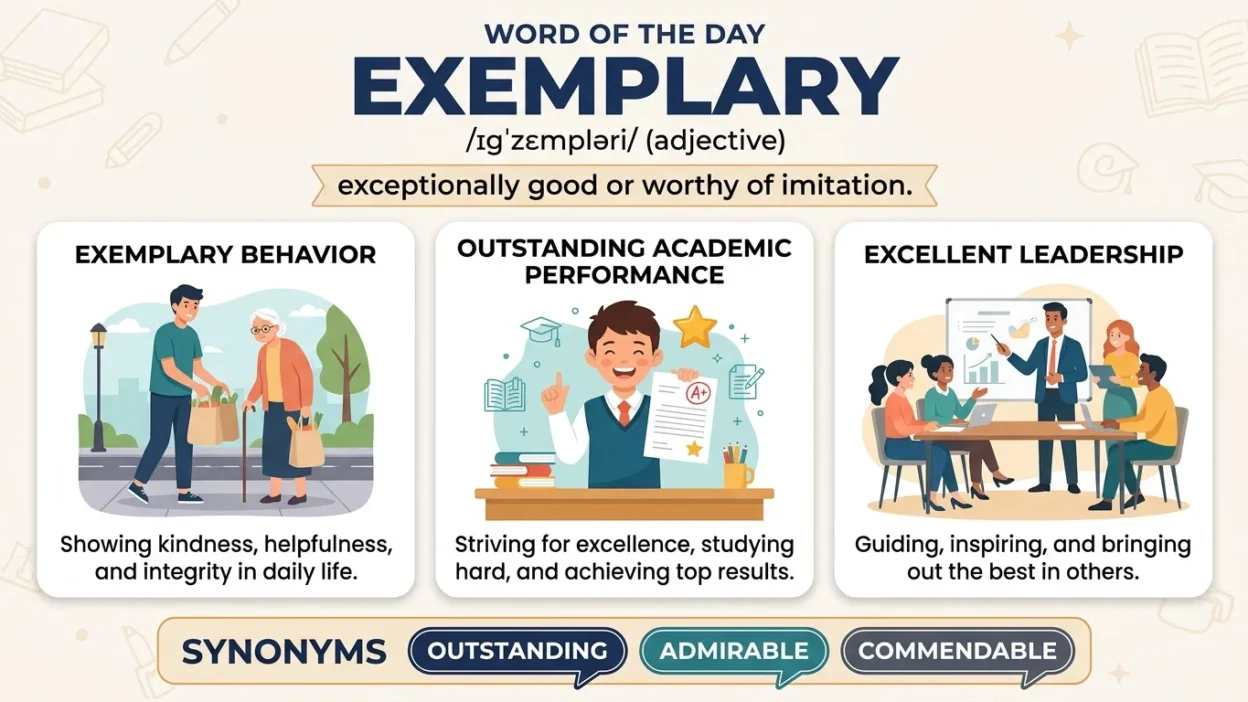
What does exemplary mean, and how should you use it in a sentence? The word exemplary is an adjective that describes someone or something that is exceptionally good and worthy of admiration or imitation. It is commonly used to praise excellent behavior, outstanding performance, high standards, and actions that set a positive example for others. For instance, an employee who consistently demonstrates honesty, dedication, and professionalism may be described as exemplary.
Although exemplary is often associated with praise, it can also describe something that serves as a model or example. In certain formal or legal contexts, it may refer to a punishment or action intended to serve as a warning to others. Understanding these meanings, along with its synonyms, antonyms, and practical usage, will help you use this versatile English word accurately.
Quick Answer
Exemplary is an adjective meaning exceptionally good, admirable, or worthy of imitation. It describes behavior, performance, or qualities that set a positive standard for others. For example, She received an award for her exemplary leadership. In some formal contexts, it can also describe an action intended to serve as a warning or example to others.
Why Do People Confuse the Meaning of Exemplary?
People sometimes misunderstand exemplary because it is related to the word example. However, it does not simply mean ordinary or typical.
When someone or something is described as exemplary, it usually means that it demonstrates an exceptionally high standard and deserves to be followed or admired.
For example:
- An example is something that illustrates a point.
- An exemplary performance is an outstanding performance worthy of recognition.
The word can also have a special meaning in legal expressions, such as exemplary damages, which may refer to damages intended to punish particularly wrongful conduct and deter similar behavior.
Meaning of Exemplary
Exemplary means exceptionally good, admirable, or worthy of being copied or followed.
It is commonly used to describe positive qualities and actions, including:
- Excellent behavior
- Outstanding academic performance
- Responsible leadership
- Professional conduct
- Exceptional service
- Honesty and integrity
- Dedication and commitment
Examples:
- The teacher praised the student’s exemplary conduct.
- Her exemplary leadership inspired the entire team.
- The employee received recognition for his exemplary service.
- His dedication to the community is exemplary.
In each sentence, exemplary expresses a high standard that others can admire or follow.
First Word: Exemplary
Exemplary is an adjective. It describes someone or something that serves as an excellent model or demonstrates an outstanding standard.
How to Use Exemplary in a Sentence
Use exemplary when you want to praise someone’s behavior, performance, qualities, or achievements.
Examples:
- She demonstrated exemplary leadership during the difficult project.
- The student received an award for exemplary academic performance.
- His honesty and dedication are truly exemplary.
- The company is known for its exemplary customer service.
- The nurse provided exemplary care to her patients.
- Their exemplary behavior impressed everyone at the event.
- The principal praised the teacher for her exemplary work.
- He has an exemplary record of professional achievement.
- The volunteers showed exemplary commitment to helping the community.
- Her conduct throughout the competition was exemplary.
Exemplary in Different Contexts
The word can be used in several situations.
1. Exemplary Behavior
This refers to conduct that is exceptionally good and worth following.
Example: The children displayed exemplary behavior during the school trip.
2. Exemplary Performance
This describes work or performance that demonstrates an outstanding standard.
Example: The athlete delivered an exemplary performance in the final match.
3. Exemplary Leadership
This refers to leadership that sets a positive standard through good judgment, responsibility, and integrity.
Example: The manager demonstrated exemplary leadership during the crisis.
4. Exemplary Service
This describes service that is exceptionally good and deserves recognition.
Example: The hotel received positive reviews for its exemplary customer service.
5. Exemplary Conduct
This refers to behavior that serves as a model for others.
Example: The award recognized her exemplary conduct in the workplace.
Is Exemplary Always Positive?
Usually, yes. In everyday English, exemplary is generally a positive word used to praise excellent behavior, performance, or qualities.
However, it can also be used in formal contexts to describe an action intended to serve as an example or warning.
For instance, exemplary punishment refers to punishment intended to discourage others from committing similar offenses.
Similarly, exemplary damages, also called punitive damages in some legal systems, are damages intended to punish particularly wrongful conduct and deter similar behavior. Their availability and meaning depend on the relevant law.
Therefore, although exemplary usually expresses praise, its meaning depends on the context.
Exemplary vs. Example vs. Exemplify
These three words are related, but they have different grammatical functions.
| Word | Part of Speech | Meaning | Example |
|---|---|---|---|
| Exemplary | Adjective | Outstanding or worthy of imitation | Her exemplary conduct impressed us. |
| Example | Noun | Something that illustrates or represents an idea | She gave an example of good behavior. |
| Exemplify | Verb | To demonstrate or illustrate something | Her actions exemplify honesty. |
Exemplary
Use exemplary to describe something exceptionally good or worthy of imitation.
Example: His exemplary work earned him a promotion.
Example
Use example to refer to something that illustrates a particular point or idea.
Example: This is a good example of teamwork.
Exemplify
Use exemplify when someone or something demonstrates a quality or principle.
Example: Her actions exemplify kindness and generosity.
Synonyms of Exemplary
Several words have meanings similar to exemplary, although their exact meanings can differ depending on the context.
- Outstanding: Exceptionally good or impressive.
- Excellent: Extremely good in quality or performance.
- Admirable: Deserving respect or approval.
- Commendable: Worthy of praise.
- Model: Serving as an example for others.
- Model-like: Demonstrating qualities worth following.
- Exceptional: Unusually good or remarkable.
- Laudable: Deserving praise or recognition.
- Meritorious: Deserving reward or appreciation because of good qualities or actions.
- Impeccable: Free from faults or mistakes.
- Distinguished: Recognized for excellence or achievement.
- Paragon: A person or thing regarded as a perfect example of a particular quality.
Examples of Exemplary Synonyms in Sentences
- Her outstanding performance earned her a scholarship.
- The employee’s commendable efforts impressed the manager.
- His admirable behavior inspired his colleagues.
- The team delivered an exceptional performance.
- Her laudable efforts helped improve the community.
Antonyms of Exemplary
An antonym is a word that expresses the opposite meaning of another word.
Depending on the context, antonyms of exemplary include:
- Poor: Below an acceptable standard.
- Inferior: Lower in quality or value.
- Unsatisfactory: Not good enough.
- Mediocre: Average or below expectations.
- Unacceptable: Not meeting the required standard.
- Deficient: Lacking something necessary or desirable.
- Disgraceful: Deserving strong disapproval.
- Inadequate: Not sufficient or satisfactory.
- Flawed: Containing faults or weaknesses.
Examples:
- His performance was mediocre, not exemplary.
- The service was unsatisfactory.
- The report contained several deficient sections.
- Her behavior was unacceptable.
When Do We Use Exemplary?
Use exemplary when you want to describe something that demonstrates an unusually high standard or serves as a model for others.
Common situations include:
1. Education
Teachers and schools use the word to praise excellent academic performance or behavior.
Example: The student received an award for exemplary academic achievement.
2. Workplace
Employers use it to recognize outstanding performance, professionalism, and dedication.
Example: The company recognized her exemplary contribution to the project.
3. Leadership
It can describe leaders who demonstrate responsibility, integrity, and good judgment.
Example: His exemplary leadership helped the organization overcome its challenges.
4. Public Service
The word can describe outstanding contributions to society or the community.
Example: The organization honored the volunteers for their exemplary public service.
5. Personal Character
It can describe admirable qualities such as honesty, kindness, patience, and generosity.
Example: Her exemplary character earned her the respect of everyone around her.
Common Mistakes to Avoid
1. Thinking Exemplary Means Ordinary
Incorrect understanding: Exemplary means typical or average.
Correct understanding: Exemplary usually means exceptionally good or worthy of imitation.
Example: The teacher’s exemplary performance impressed the students.
2. Confusing Exemplary With Example
Example is a noun, while exemplary is an adjective.
Incorrect: She showed example behavior.
Better: She displayed exemplary behavior.
3. Using Exemplary for Every Good Thing
Although exemplary is positive, it usually suggests a particularly high standard.
For something that is simply good, words such as good, positive, or satisfactory may be more appropriate.
4. Forgetting Its Legal Meaning
In formal and legal contexts, exemplary may describe punishment or damages intended to discourage similar wrongdoing.
Example: The court awarded exemplary damages where permitted by the applicable law.
Memory Trick: How to Remember Exemplary
Use this simple memory trick:
Exemplary = Excellent enough to be an example.
The word is related to example. When someone’s actions are exemplary, they are so good that other people can learn from or imitate them.
Remember:
- Exemplary behavior = Behavior worth following.
- Exemplary performance = Outstanding performance.
- Exemplary leadership = Leadership that sets a high standard.
- Exemplary service = Service worthy of praise.
American vs. British English: Exemplary
There is no significant difference between American and British English in the spelling, pronunciation, or basic meaning of exemplary.
Both varieties use the word to describe something exceptionally good or worthy of imitation.
American English example: The employee received recognition for her exemplary performance.
British English example: The teacher praised the pupil for his exemplary conduct.
The spelling remains exemplary in both varieties.
Similar Words Related to Exemplary
Understanding related words can help you use exemplary more accurately.
- Exemplar: A person or thing that serves as an excellent example.
- Exemplify: To demonstrate or illustrate a particular quality.
- Exemplification: The act of illustrating something with an example.
- Example: Something that illustrates a point or idea.
- Excellence: The quality of being exceptionally good.
- Excellence-minded: Focused on achieving high standards.
- Commendable: Deserving praise.
- Model: A person or thing worthy of imitation.
- Paragon: A perfect or outstanding example of a particular quality.
Final Verdict: What Does Exemplary Mean?
Exemplary is an adjective that means exceptionally good, admirable, or worthy of imitation. It is commonly used to describe outstanding behavior, performance, leadership, service, and personal qualities.
For example, an employee who consistently demonstrates honesty, dedication, and professionalism may be described as exemplary.
Although the word is generally positive, it can also appear in formal and legal expressions such as exemplary punishment and exemplary damages, where it refers to an action intended to serve as a warning or deterrent.
Remember the simple definition: exemplary means so good that it can serve as an example for others.
Frequently Asked Questions (FAQs)
1. What does exemplary mean in simple words?
Exemplary means exceptionally good or worthy of being copied. It describes behavior, performance, or qualities that set a positive example for others.
2. Is exemplary a positive or negative word?
In everyday English, exemplary is usually positive. It describes something admirable or outstanding. However, in legal expressions such as exemplary punishment, it can refer to an action intended to discourage wrongdoing.
3. What is an example of exemplary in a sentence?
“She received an award for her exemplary leadership.” In this sentence, exemplary means that her leadership was outstanding and worthy of admiration.
4. What is another word for exemplary?
Common synonyms include outstanding, excellent, admirable, commendable, exceptional, laudable, and meritorious. The best alternative depends on the sentence.
5. What is the opposite of exemplary?
Common antonyms include poor, mediocre, inferior, unsatisfactory, unacceptable, and inadequate.
6. What is the difference between exemplary and example?
Exemplary is an adjective meaning outstanding or worthy of imitation. Example is a noun referring to something that illustrates an idea or demonstrates a particular quality.
7. What does exemplary behavior mean?
Exemplary behavior means conduct that is exceptionally good and worthy of imitation. It may include honesty, respect, responsibility, kindness, and discipline.
8. What does exemplary service mean?
Exemplary service means service that demonstrates an exceptionally high standard of quality, professionalism, and customer care.
Remember This
- Exemplary is an adjective.
- It means exceptionally good or worthy of imitation.
- It commonly describes behavior, performance, leadership, and service.
- Exemplary is related to the word example.
- Exemplify is the related verb.
- Common synonyms include outstanding, admirable, and commendable.
- Common antonyms include poor, mediocre, and unsatisfactory.
- In legal contexts, exemplary can describe punishment or damages intended to deter wrongdoing.
Conclusion
The word exemplary is a useful adjective for describing outstanding qualities, excellent performance, and behavior worthy of imitation. Whether you are discussing a student’s achievements, an employee’s dedication, a leader’s conduct, or someone’s personal character, the word communicates a particularly high standard. It is stronger than simply saying that something is good because it suggests that others can learn from or follow the example.
Remember that exemplary is generally used positively in everyday English, although it has a specific application in certain legal expressions. By understanding its meaning, synonyms, antonyms, and grammatical use, you can use this word confidently in conversations, essays, professional communication, and formal writing.

Lucas Luke is a passionate language writer and content creator at SimileHive, specializing in similes, idioms, metaphors, and figurative language. He enjoys making complex English expressions simple, engaging, and easy to understand for students, writers, and language enthusiasts through well-researched, practical content.