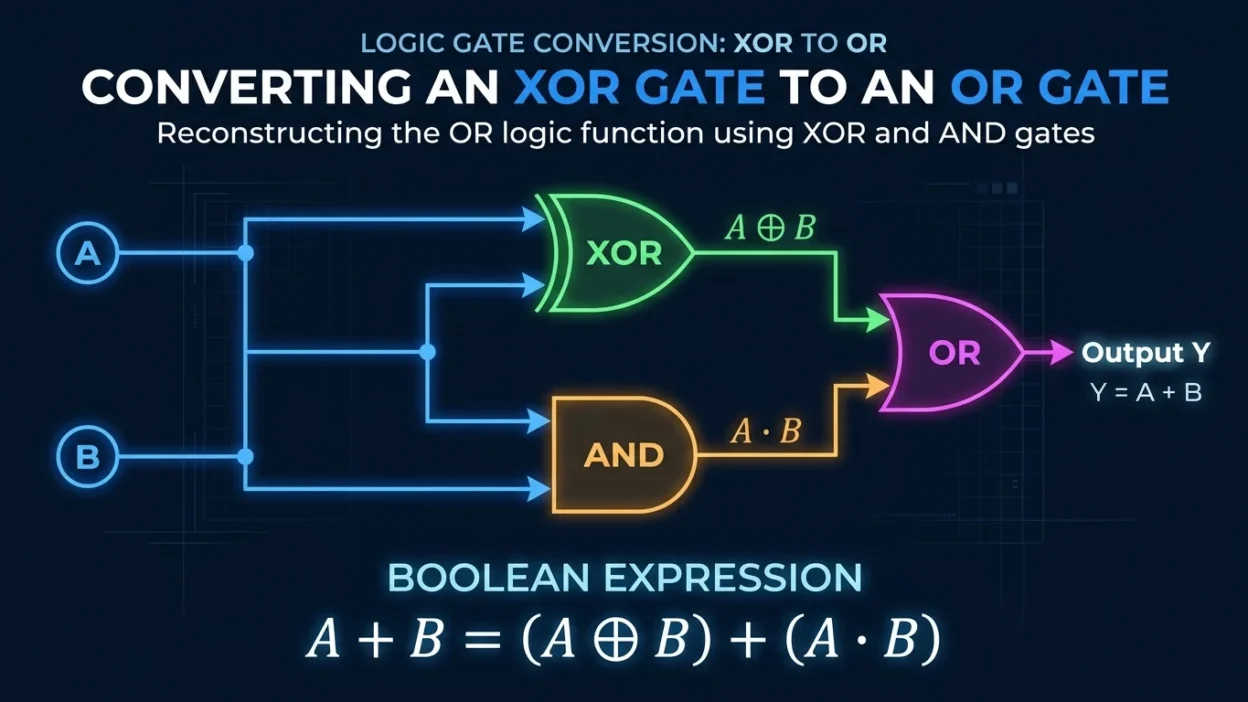
An XOR gate and an OR gate are two important logic gates used in digital electronics and computer engineering. Both gates produce an output based on their binary inputs, but they follow different logical rules. An XOR gate produces an output of 1 when its inputs are different, while an OR gate produces an output of 1 when at least one input is 1.
If you want to convert an XOR gate into an OR gate, you need to understand how their truth tables and Boolean expressions differ. For two inputs, an OR gate can be constructed using an XOR gate and an AND gate. This is because an OR gate produces 1 for the input combination 1,1, whereas an XOR gate produces 0 for that combination.
Quick Answer: How Do You Convert XOR to OR?
To convert an XOR gate into an OR gate, combine the output of an XOR gate with the output of an AND gate using another OR gate:
[
A+B=(A\oplus B)+(A\cdot B)
]
Here, (A\oplus B) represents the XOR operation, while (A\cdot B) represents the AND operation. The final OR operation produces the same output as a standard OR gate.
What Is an XOR Gate?
An XOR gate is a digital logic gate that stands for Exclusive OR. It produces an output of 1 when its inputs have different binary values.
For a two input XOR gate:
- If both inputs are 0, the output is 0.
- If the first input is 0 and the second is 1, the output is 1.
- If the first input is 1 and the second is 0, the output is 1.
- If both inputs are 1, the output is 0.
The Boolean expression for an XOR gate is:
[
Y=A\oplus B
]
XOR Gate Truth Table
| Input A | Input B | Output Y |
|---|---|---|
| 0 | 0 | 0 |
| 0 | 1 | 1 |
| 1 | 0 | 1 |
| 1 | 1 | 0 |
<AsyncImage query=”digital logic XOR gate symbol two inputs truth table educational diagram” aspectRatio=”16:9″ width=”100%” />
What Is an OR Gate?
An OR gate is a basic digital logic gate that produces an output of 1 when at least one input is 1.
For a two input OR gate:
- If both inputs are 0, the output is 0.
- If either input is 1, the output is 1.
- If both inputs are 1, the output is 1.
The Boolean expression for an OR gate is:
[
Y=A+B
]
OR Gate Truth Table
| Input A | Input B | Output Y |
|---|---|---|
| 0 | 0 | 0 |
| 0 | 1 | 1 |
| 1 | 0 | 1 |
| 1 | 1 | 1 |
<AsyncImage query=”digital logic OR gate symbol two inputs truth table educational diagram” aspectRatio=”16:9″ width=”100%” />
XOR vs OR Gate: What Is the Difference?
The main difference between XOR and OR gates appears when both inputs are 1.
| Input A | Input B | XOR Output | OR Output |
|---|---|---|---|
| 0 | 0 | 0 | 0 |
| 0 | 1 | 1 | 1 |
| 1 | 0 | 1 | 1 |
| 1 | 1 | 0 | 1 |
An XOR gate produces 1 only when the inputs are different. An OR gate produces 1 whenever at least one input is 1.
Therefore, an XOR gate alone cannot perform the same function as an OR gate.
How to Convert an XOR Gate into an OR Gate
You can construct an OR gate by combining an XOR gate and an AND gate.
The required Boolean expression is:
[
Y=(A\oplus B)+(A\cdot B)
]
Where:
- (A) and (B) are the two binary inputs.
- (\oplus) represents XOR.
- (\cdot) represents AND.
- (+) represents OR.
Step by Step Conversion
Step 1: Apply the XOR operation
First, calculate the XOR output:
[
X=A\oplus B
]
Step 2: Apply the AND operation
Next, calculate the AND output:
[
Z=A\cdot B
]
Step 3: Apply the OR operation
Finally, combine both outputs using an OR operation:
[
Y=X+Z
]
Therefore:
[
\boxed{Y=(A\oplus B)+(A\cdot B)}
]
This expression is equivalent to:
[
\boxed{Y=A+B}
]
Logic Circuit Diagram
<AsyncImage query=”XOR gate AND gate OR gate combination circuit diagram implementing OR function with two inputs A B labeled outputs” aspectRatio=”16:9″ width=”100%” />
The circuit uses three gates:
- An XOR gate receives inputs A and B.
- An AND gate receives the same inputs A and B.
- An OR gate combines the outputs of the XOR and AND gates.
The final output is identical to that of a standard OR gate.
Boolean Algebra Proof
We can prove the conversion using the Boolean expression for XOR.
The XOR expression is:
[
A\oplus B=A’B+AB’
]
Substitute this into the conversion formula:
[
Y=A’B+AB’+AB
]
Rearrange the terms:
[
Y=A’B+AB’+AB
]
Combine the last two terms:
[
Y=A’B+A(B’+B)
]
Using the complement rule:
[
B’+B=1
]
We get:
[
Y=A’B+A
]
Using the absorption law:
[
A+A’B=A+B
]
Therefore:
[
\boxed{Y=A+B}
]
This proves that the combination of XOR, AND, and OR operations produces the same result as a standard OR gate.
Can You Convert XOR to OR Using Only XOR Gates?
No. You cannot construct a two input OR function using only two input XOR gates and no additional logic or constants.
XOR operations produce parity functions. Their outputs cannot reproduce the OR function for all possible binary input combinations without additional logic.
You need an additional gate or another suitable logic arrangement.
Practical Applications of XOR and OR Gates
Both gates are used in digital circuits, but they serve different purposes.
Applications of XOR Gates
- Binary addition circuits.
- Parity generators and checkers.
- Error detection systems.
- Digital comparators.
- Data encryption circuits.
Applications of OR Gates
- Control circuits.
- Alarm systems.
- Digital decision making.
- Computer processors.
- Logic control systems.
For example, an alarm system may use an OR gate to activate an alarm when any one of several sensors detects a problem.
An XOR gate may be used in a circuit that checks whether two binary signals have different values.
Frequently Asked Questions
1. Can an XOR gate be converted into an OR gate?
Yes. For two inputs, you can construct an OR function using an XOR gate, an AND gate, and an OR gate. The expression is (A+B=(A\oplus B)+(A\cdot B)).
2. What is the Boolean expression for XOR to OR conversion?
The Boolean expression is:
[
Y=(A\oplus B)+(A\cdot B)
]
It simplifies to (Y=A+B).
3. Why are XOR and OR gates different?
An XOR gate produces 1 when its inputs are different. An OR gate produces 1 when at least one input is 1. Their outputs differ when both inputs are 1.
4. What is the output of XOR when both inputs are 1?
The output is 0 because both inputs have the same value.
5. What is the output of OR when both inputs are 1?
The output is 1 because an OR gate produces 1 when at least one input is 1.
6. Can an XOR gate replace an OR gate?
No. A single XOR gate cannot replace an OR gate because their truth tables are different.
7. What is the difference between XOR and Exclusive OR?
There is no difference. XOR is simply the shortened name for Exclusive OR.
Remember This
The most important point is that XOR and OR gates are not identical.
- XOR produces 1 when inputs are different.
- OR produces 1 when at least one input is 1.
- XOR produces 0 when both inputs are 1.
- OR produces 1 when both inputs are 1.
To construct an OR function using an XOR gate, use:
[
\boxed{A+B=(A\oplus B)+(A\cdot B)}
]
Conclusion
Converting an XOR function into an OR function is a useful exercise in digital electronics and Boolean algebra. The key is to understand that XOR does not produce 1 when both inputs are 1, while OR does.
By combining XOR and AND outputs through an OR operation, you can reproduce the exact truth table of an OR gate. Understanding this relationship makes it easier to simplify Boolean expressions and design digital logic circuits.

Ashley Anna is the Administrator of SimileHive, dedicated to creating clear, engaging, and accurate content about similes, idioms, metaphors, and figures of speech. She helps readers improve English skills through practical examples and easy-to-understand explanations.