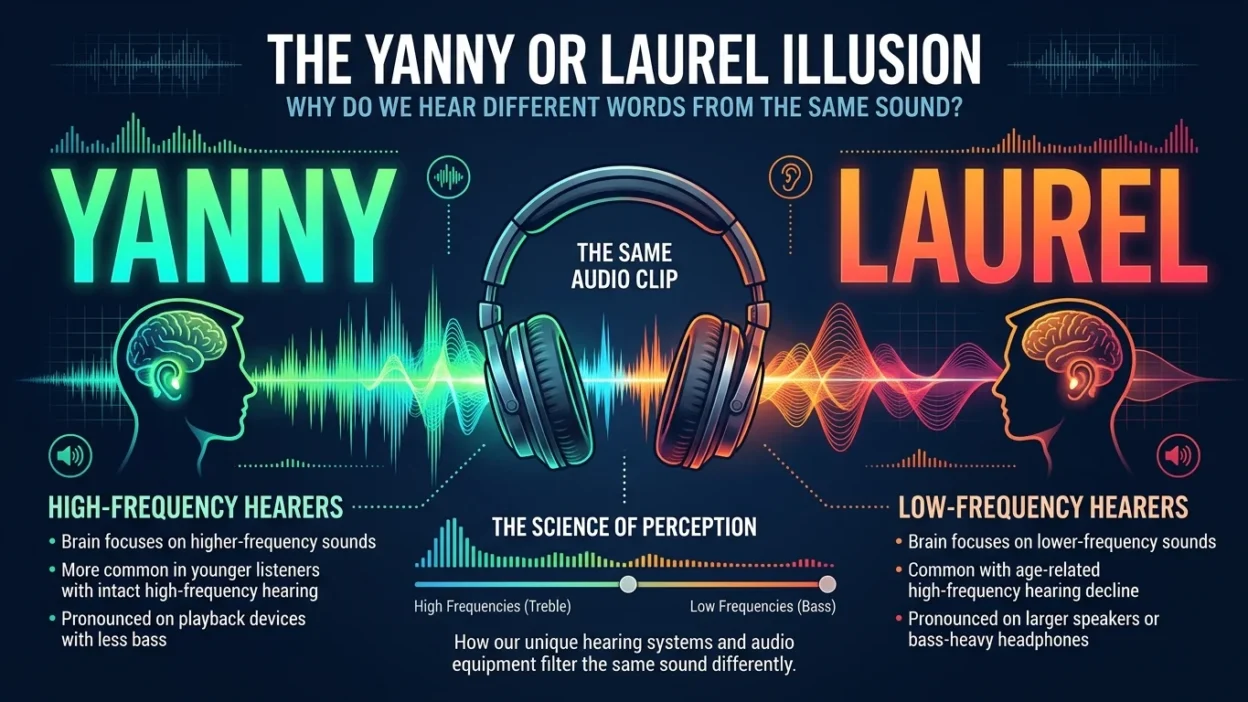
Have you ever listened to an audio clip and heard one word, only to discover that someone else hears something completely different? That is exactly what happened with the famous Yanny or Laurel audio illusion. Some people clearly hear the word “Yanny,” while others hear “Laurel,” even though everyone listens to the same recording.
The Yanny or Laurel debate became an internet sensation in 2018. People shared the short audio clip on social media, discussed what they heard, and tried different ways to make the other word more noticeable. The interesting part is that neither group is necessarily wrong. The recording contains sound frequencies that can be interpreted differently by the human brain.
Understanding this viral listening challenge reveals how hearing, sound frequencies, perception, and expectations work together.
Quick Answer: Is It Yanny or Laurel?
The famous audio clip can sound like either “Yanny” or “Laurel,” depending on how a listener perceives its sound frequencies. Some listeners focus more on higher frequencies and hear Yanny, while others perceive lower frequencies and hear Laurel. The recording became popular because different people genuinely hear different words.
What Is the Yanny or Laurel Audio Illusion?
Yanny or Laurel is an auditory illusion involving a short recording of a spoken word. When people listen to it, some hear “Yanny,” while others hear “Laurel.”
The recording became widely popular in May 2018 after it was shared online. It attracted attention because people could listen to the same audio clip but reach completely different conclusions about what it said.
Unlike a visual illusion, which tricks the eyes, an auditory illusion creates an unusual experience through sound.
The Yanny or Laurel clip demonstrates that hearing is not always a simple process of receiving sound. The brain also interprets and organizes the information it receives.
Why Do Some People Hear Yanny and Others Hear Laurel?
The main reason is that the recording contains different sound frequencies that can influence how the spoken word is perceived.
Sound is made up of vibrations that travel through the air. These vibrations contain different frequencies, which are measured in hertz (Hz).
The Yanny or Laurel recording includes overlapping acoustic information. Depending on which frequencies a listener notices, the brain may interpret the sound as either word.
1. High Frequency Sounds
Higher frequency information can make the recording sound more like “Yanny” to some listeners.
These sounds may be more noticeable to people who naturally focus on higher pitched elements in the recording.
2. Low Frequency Sounds
Lower frequency information can make the recording sound more like “Laurel.”
Listeners who perceive these lower frequency elements more strongly may identify the word as Laurel.
3. The Brain Interprets What It Hears
Your brain does more than simply receive sound. It uses previous experiences, expectations, and surrounding information to interpret what you hear.
This process helps explain why two people can listen to the same recording and perceive different words.
Yanny vs Laurel: What Is the Difference?
Yanny and Laurel are two different words, but the viral recording makes them sound surprisingly similar.
| Feature | Yanny | Laurel |
|---|---|---|
| Type | Name | Name |
| Pronunciation | Usually sounds like YAN ee | Usually sounds like LOR el |
| Sound perception | Often associated with higher frequencies | Often associated with lower frequencies |
| Meaning in the recording | One possible interpretation | Another possible interpretation |
| Popularity | Viral audio interpretation | Viral audio interpretation |
The difference is not simply about pronunciation. It is also about how the brain processes the acoustic information in the recording.
How Can You Hear Both Yanny and Laurel?
If you initially hear only one word, you may be able to notice the other by changing how you listen.
Try these methods:
- Listen several times: Replaying the recording may help you notice different parts of the sound.
- Use headphones: Headphones may make certain sound details easier to hear.
- Adjust the volume: A different listening level can sometimes change which sound features stand out.
- Focus on the other word: Read the word Yanny or Laurel before playing the clip again.
- Change the playback speed: Slowing down the recording may reveal different acoustic details.
- Try different speakers: Your headphones, phone, or computer speakers may reproduce frequencies differently.
These methods do not guarantee that everyone will hear both words, but they can make the illusion easier to understand.
Does Age Affect Whether You Hear Yanny or Laurel?
Age can influence hearing because people’s ability to detect certain sound frequencies may change over time.
In particular, sensitivity to higher frequencies often decreases with age. This may affect how someone perceives an audio recording.
However, age alone does not determine whether a person hears Yanny or Laurel. Listening equipment, playback conditions, individual hearing differences, and expectations can also influence perception.
Therefore, it would be inaccurate to say that everyone in one age group hears Yanny while everyone in another hears Laurel.
Is Yanny or Laurel a Psychological Trick?
Yanny or Laurel is an example of an auditory illusion, not a trick or a sign that someone has poor hearing.
An auditory illusion happens when the brain interprets sound in a way that differs from what another listener perceives.
The phenomenon demonstrates that perception is influenced by several factors, including:
- Sound frequencies.
- Individual hearing characteristics.
- Previous experiences.
- Expectations.
- Attention.
- Audio quality.
This is why the same recording can create different listening experiences.
Why Did Yanny or Laurel Become So Popular?
The debate became a major internet trend in May 2018 because it was simple, surprising, and easy to share.
People could listen to the same recording and immediately compare their experiences with friends and family.
The discussion spread across social media, news websites, and online communities. Even public figures joined the conversation.
The popularity of the recording also came from its unusual nature. Most people expect everyone to hear the same spoken word, so discovering that others hear something entirely different was fascinating.
Yanny or Laurel and the Difference Between Hearing and Listening
Hearing and listening are related, but they are not exactly the same.
Hearing is the physical process of detecting sound through the ears.
Listening involves paying attention to sound and interpreting its meaning.
The Yanny or Laurel illusion demonstrates that hearing a sound does not always mean everyone will interpret it in the same way.
For example, two people may hear the same sentence but understand its tone or meaning differently. Similarly, two listeners may hear the same recording but identify different words.
Frequently Asked Questions
1. What is Yanny or Laurel?
Yanny or Laurel is a viral auditory illusion in which people hear either the word Yanny or the word Laurel when listening to the same audio recording.
2. Which word is actually being said, Yanny or Laurel?
The recording is commonly identified as a pronunciation of Laurel, but its acoustic characteristics allow many listeners to perceive Yanny instead.
3. Why do I hear Yanny instead of Laurel?
You may be more sensitive to or focused on certain higher frequency components of the recording. Your brain interprets those sounds as Yanny.
4. Why do I hear Laurel instead of Yanny?
You may perceive the lower frequency components more strongly, making the recording sound like Laurel.
5. Can someone hear both Yanny and Laurel?
Yes. Some people can hear both interpretations, particularly after changing the playback conditions or focusing on a different sound.
6. Is Yanny or Laurel a hearing test?
No. It is an auditory illusion, not a medically designed hearing test. Hearing either word does not establish whether someone’s hearing is normal or abnormal.
7. When did the Yanny or Laurel debate become popular?
The debate became a viral internet sensation in May 2018 after the audio recording circulated widely on social media.
8. What does Yanny or Laurel teach us about the brain?
It demonstrates that the brain actively interprets sound rather than simply recording it. Expectations, attention, and acoustic information can influence what people perceive.
Remember This
The Yanny or Laurel debate is a famous example of how human perception can differ.
- Yanny and Laurel are two possible interpretations of the same recording.
- Higher frequency information can make Yanny more noticeable.
- Lower frequency information can make Laurel more noticeable.
- Individual hearing and expectations influence perception.
- Hearing either word does not mean someone is right or wrong.
The central lesson is that people can experience the same sound in different ways.
Conclusion
Yanny or Laurel became one of the most memorable internet listening challenges because it showed how differently people can interpret the same audio recording. While some listeners hear Yanny, others clearly hear Laurel. The difference is connected to sound frequencies, individual hearing characteristics, and the way the brain processes information.
The next time someone disagrees with you about what they hear, remember that perception is not always identical from one person to another. Sometimes, two different experiences can come from exactly the same sound.

Adam Aaron is a language enthusiast and content writer at SimileHive, creating clear, engaging guides on similes, idioms, metaphors, and figurative language to help readers improve English confidently every day.